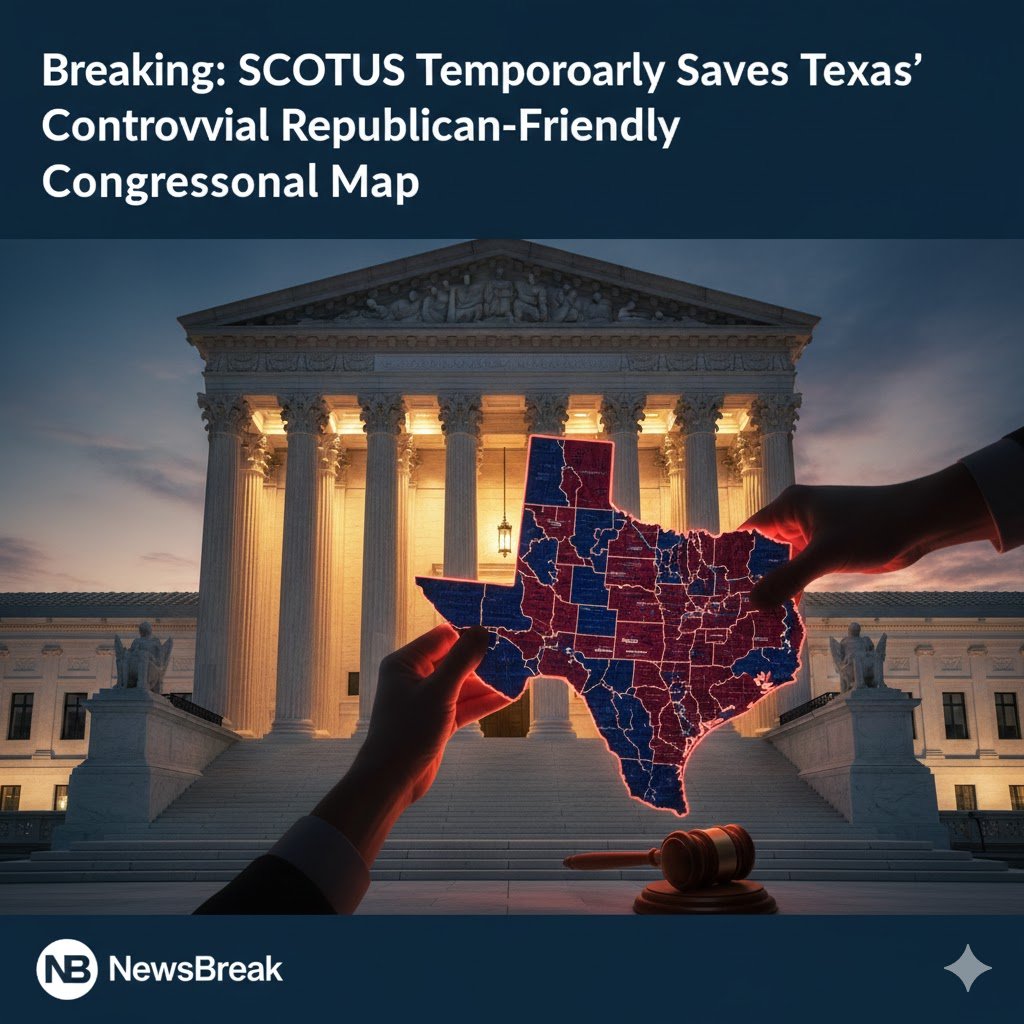
In the high-stakes world of American electoral politics, where district lines can swing entire congressional majorities, the U.S. Supreme Court has once again thrust itself into the fray. On November 21, 2025, Justice Samuel Alito, acting on an emergency request from Texas officials, issued a temporary order halting a federal district court’s recent block on the state’s newly drawn congressional map. This administrative stay restores the 2025 boundaries—at least for the immediate future—allowing Texas to proceed with preparations for the 2026 midterm elections under lines widely seen as tilting the scales toward Republicans. The move comes amid accusations of racial gerrymandering, partisan maneuvering, and a broader national push by President Donald Trump to fortify GOP control of the House. As candidates scramble toward a December 8 filing deadline, this decision underscores the precarious balance between electoral fairness and political ambition in one of the nation’s fastest-growing states.
Texas, with its 38 congressional seats—the second-most after California’s—has long been a battleground for redistricting battles. The state’s explosive population growth, fueled by migration and high birth rates among diverse communities, has amplified these fights. Republicans currently hold 25 of those seats, a slim edge in a delegation that could tip national power dynamics. The 2025 map, if it holds, could net the GOP up to five additional victories, potentially expanding their narrow House majority from 219-214 to a more comfortable cushion. Critics, however, argue it’s not just about party loyalty but a deliberate dilution of minority voting power, echoing decades of contentious history.
To understand this latest chapter, one must rewind through Texas’s tangled redistricting saga. The process, mandated every decade after the census to reflect population shifts, has rarely been straightforward in the Lone Star State. Since the Voting Rights Act of 1965 dismantled Jim Crow-era barriers, federal courts have repeatedly intervened to curb discriminatory practices. In the 1970s, maps were struck down for packing Black voters into a single district, minimizing their statewide influence. The 1980s and 1990s saw similar rebukes, with judges decrying “cracking”—spreading minority voters across districts to weaken their sway—and outright racial stereotyping in boundary drawing.
The turn of the millennium brought infamy with the 2003 mid-decade redistricting orchestrated by then-House Majority Leader Tom DeLay. Fresh off gaining full control of the Texas Legislature, Republicans redrew lines that had been court-imposed after the 2000 census, flipping six Democratic seats to GOP hands. Dubbed the “Texas Tomistone,” it was a masterclass in partisan gerrymandering, upheld by the Supreme Court in League of United Latin American Citizens v. Perry (2006) despite outcries over racial undertones. Justice Anthony Kennedy’s opinion noted that while mid-decade changes weren’t inherently unconstitutional, they demanded scrutiny for discriminatory intent.
Fast-forward to the 2020s: The 2021 maps, drawn post-census, faced immediate lawsuits from civil rights groups like the League of United Latin American Citizens (LULAC) and the ACLU. Courts found violations in districts like the 35th in Austin, where lines bizarrely snaked through town to capture specific neighborhoods, and in South Texas, where Hispanic voters were splintered. Partial fixes ensued, but the maps barely withstood challenges before the 2022 cycle. By 2025, with Trump back in the White House and eyeing a House firewall against midterm losses—historically brutal for the president’s party—the stage was set for round two.
The spark ignited on July 7, 2025, when Harmeet Dhillon, Trump’s appointee heading the Justice Department’s Civil Rights Division, fired off a letter to Texas Attorney General Ken Paxton. Citing four “coalition districts”—areas where no single racial group predominated but Black and Hispanic voters together formed majorities—Dhillon claimed they violated the Constitution by relying on race over traditional factors like compactness or community ties. These districts, held by Democrats, were relics of prior court orders aimed at protecting minority influence. Dhillon threatened DOJ action if Texas didn’t redraw them, framing it as a blow against “unconstitutional racial sorting.”
Texas Governor Greg Abbott wasted no time. Two days later, he called a special legislative session, explicitly instructing lawmakers to address the DOJ’s “concerns” by eliminating coalition districts and crafting new majority-Hispanic ones—free, he said, from partisan motives. Critics smelled a rat: This was less about compliance and more about a Trump-orchestrated power grab. By August, the Legislature passed the new map, signed by Abbott amid Democratic walkouts that briefly broke quorum. The result? Boundaries that fragmented Democratic strongholds in Houston, Dallas-Fort Worth, and San Antonio, while bolstering rural white conservative areas. Analysts projected Republicans could claim 30 seats, up from 25, by diluting urban minority votes.
Enter the challengers. Before Abbott’s pen dried, a coalition of six groups—including LULAC, the Texas NAACP, and Latino advocacy outfits—sued in federal court in El Paso. They alleged the map was a textbook racial gerrymander: Lines drawn not for compactness or shared interests, but to “bleach” districts of minority coalitions at the DOJ’s racial behest. Evidence piled up—emails from Abbott’s office prioritizing race, legislative testimony admitting the overhaul targeted specific demographics, and expert analyses showing unnatural boundary twists that correlated with racial data more than voter history.
The three-judge panel—comprising U.S. District Judge Jeffrey Brown (a Trump appointee), Senior Judge David Guaderrama (Obama era), and Fifth Circuit Judge Jerry Smith (Reagan appointee)—heard weeks of testimony. On November 18, Brown and Guaderrama dropped a blistering 160-page ruling, blocking the map for 2026 and reverting to the 2021 version. “Politics played a role,” Brown wrote, “but it was much more than just politics. Substantial evidence shows that Texas racially gerrymandered the 2025 Map.” The court dismissed the DOJ’s coalition-district theory as baseless, noting it contradicted Supreme Court precedent like Bartlett v. Strickland (2009), which affirmed such districts’ legality under the Voting Rights Act.
They also rebuffed Texas’s Purcell principle defense—a doctrine from Purcell v. Gonzalez (2006) cautioning against late election changes to avoid chaos. With primaries four months out and the general a year away, the judges saw minimal disruption, especially since the 2021 map was already in use for a January special election runoff. Smith’s dissent was fiery, accusing the majority of judicial overreach and Brown of bias, but it couldn’t sway the 2-1 vote.
Texas didn’t flinch. Hours after the ruling, Paxton’s office appealed to the Supreme Court, painting the injunction as an “eleventh-hour” sabotage that risked ballot chaos. Solicitor General Judd Stone argued the map was partisan, not racial—aligned with the Court’s 2024 Alexander v. South Carolina NAACP ruling, which greenlit race-conscious drawing if subordinate to politics. Harm to the state? Catastrophic, they claimed: Candidates prepping under the new lines, counties investing in signage, and voters expecting stability. Challengers faced none, as the status quo favored Republicans anyway.
Alito, who handles the Fifth Circuit’s emergency appeals, acted swiftly. By evening on November 21, he granted the stay, pausing the district court’s order pending full review. Challengers must respond by November 24, buying Texas time past the filing deadline. Paxton hailed it as a “victory against radical left-wing activists,” vowing to fight on merits. It’s a procedural win, not substantive—the Court hasn’t weighed constitutionality yet—but it keeps the GOP map alive for primaries on March 3, 2026.
The stakes couldn’t be higher. A upheld 2025 map could lock in Republican gains, shielding Trump’s agenda from midterm backlash. Texas’s delegation sways key committees on energy, border security, and immigration—issues central to GOP branding. Yet if struck down, reverting to 2021 lines might flip those projected seats blue, narrowing the House gap and energizing Democrats in a state where Hispanics (now 40% of the population) and Blacks (13%) are surging voter blocs.
Broader ripples extend to voting rights. This case tests the post-Shelby County v. Holder (2013) landscape, where gutted preclearance left states freer to experiment—often at minorities’ expense. The DOJ’s role under Trump, weaponizing civil rights tools for partisan ends, raises alarms about federal overreach. Civil rights advocates like those at the Lawyers’ Committee for Civil Rights Under Law decry it as “discrimination by design,” stripping coalition power in a diversifying Texas. They point to data: Under the new map, white voters (40% of the populace) could control 70% of districts.
Reactions poured in swiftly. On X (formerly Twitter), conservative voices cheered: “Yeehaw! Big win for Texas,” posted one user, echoing the relief of maintaining status quo. Paxton amplified the sentiment, framing it as resistance to “baseless racism accusations.” Democrats fumed: “Term limits are way past due for the Inferior Court,” vented one, tagging Alito’s order as a partisan lifeline. Experts like election law professor Rick Hasen warned it perpetuates a “gerrymander arms race,” urging Congress to impose independent commissions nationwide.
As briefing deadlines loom, the Supreme Court faces a pivotal choice. Will it expedite merits review, as Texas urges, or let litigation drag into 2026? Alito’s stay buys breathing room, but the underlying question—can race lurk behind partisan fig leaves?—echoes Shaw v. Reno (1993), where the Court first demanded strict scrutiny for racial line-drawing. In a 6-3 conservative majority, outcomes lean predictable, but Trump’s shadow adds unpredictability.
For everyday Texans, from Houston’s bustling barrios to Dallas’s suburban sprawl, this isn’t abstract jurisprudence. It’s about whose voices echo in Washington—those of growing Latino families eyeing better schools, or entrenched interests guarding the ranchlands. As one El Paso plaintiff told reporters post-ruling, “We’ve fought these maps before. We’ll fight again, because democracy isn’t drawn in secret.” With the gavel’s echo still fading, Texas’s electoral soul hangs in the balance, a reminder that in America, the map is mightier than the ballot—until the courts say otherwise.