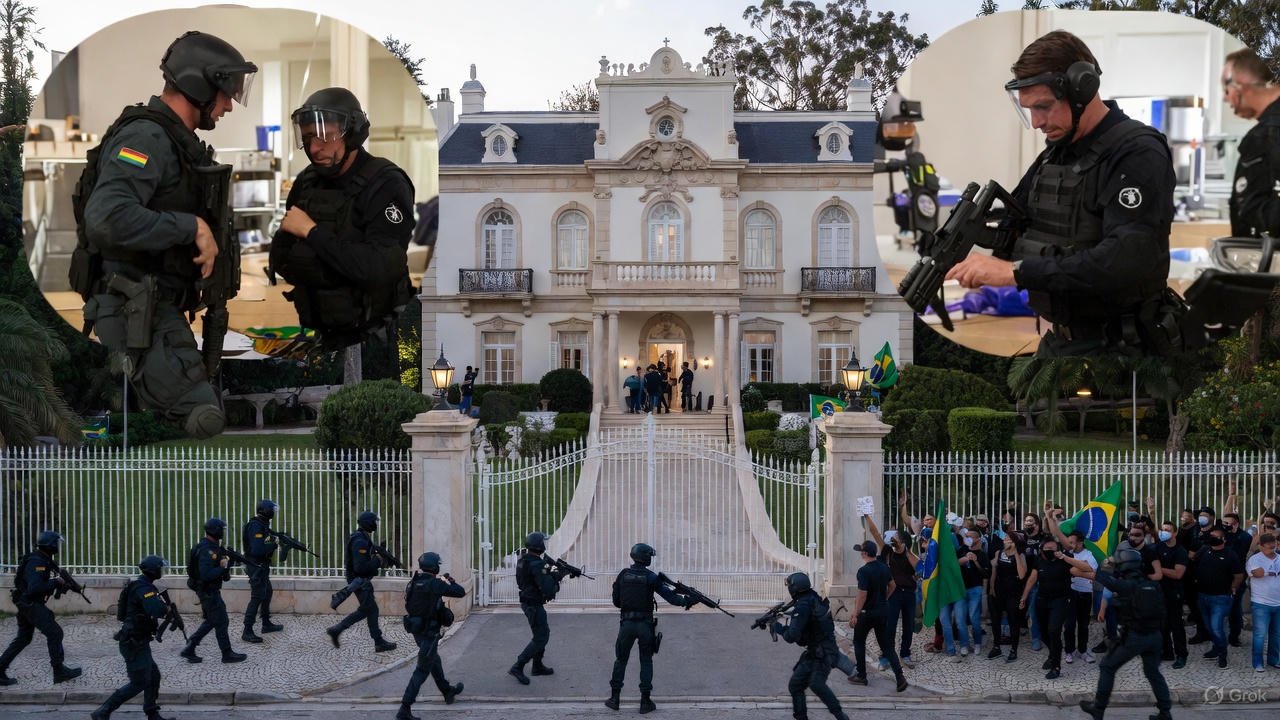
In the early morning haze of Brasília, where the air still carried the chill of a tropical dawn, federal police stormed the gated villa of Brazil’s most polarizing figure. It was November 22, 2025, and Jair Bolsonaro, the firebrand former president whose name alone could ignite street protests or congressional brawls, was yanked from his bed. Handcuffs clicked shut not because of a fresh crime, but out of sheer dread: officials believed the 70-year-old Bolsonaro was inches away from bolting, perhaps to the welcoming arms of a foreign embassy, to dodge the iron bars of a 27-year prison term. This wasn’t just an arrest; it was a preemptive strike in a saga that’s gripped Brazil like a fever dream, blending echoes of January 6 in Washington with the raw, unfiltered chaos of Latin American politics.
The operation unfolded with the precision of a chess master closing in on a king. Supreme Court Justice Alexandre de Moraes, the steely jurist who’s become Bolsonaro’s nemesis, greenlit the raid after spotting irregularities in the ex-leader’s electronic ankle monitor. At precisely 12:08 a.m., the device—a digital leash imposed during his house arrest since August—showed signs of tampering. Was it a glitch, or a deliberate snip in the wire? Moraes didn’t wait to find out. He cited the brewing storm of a supporter-led rally planned outside Bolsonaro’s home, plus whispers of allies hightailing it across borders, as red flags screaming flight risk. By sunrise, agents had bundled the silver-haired Bolsonaro into a black SUV, his face a mask of defiance mixed with the weary resignation of a man who’d danced too close to the edge one too many times.
For those who’ve followed Bolsonaro’s rollercoaster ride through Brazilian power corridors, this moment feels both inevitable and surreal. The man who once rode a wave of anti-establishment fury into the Planalto Palace in 2019, promising to drain the swamp of corruption and crime, has long been a lightning rod. Nicknamed the “Trump of the Tropics” for his bombastic style, unapologetic conservatism, and cozy ties to evangelical voters, Bolsonaro’s tenure was a whirlwind of reforms and ruptures. He slashed environmental protections in the Amazon, clashed with indigenous communities, and championed gun rights in a nation scarred by urban violence. Supporters hailed him as a bulwark against socialism; critics decried him as an authoritarian flirt, especially after his relentless drumbeat of election fraud claims following his 2022 defeat to Luiz Inácio Lula da Silva.
That loss, by a razor-thin margin of less than 2%, didn’t fade quietly into the history books. Instead, it festered, morphing into the January 8, 2023, storming of Brazil’s Congress, Supreme Court, and presidential offices by Bolsonaro loyalists clad in green-and-yellow gear. The images were haunting: rioters smashing windows, defacing statues, and chanting for military intervention. It was Brazil’s version of the U.S. Capitol siege, but with samba rhythms and soccer chants twisted into calls for upheaval. Prosecutors wasted no time pinning the blame on Bolsonaro, alleging he orchestrated the plot from the shadows, sowing distrust in democratic institutions to claw back power. By mid-2025, a federal court had convicted him on charges of coup plotting, sedition, and incitement—crimes that carried the weight of decades behind bars.
The 27-year sentence, handed down in a packed courtroom that hummed with tension, was a thunderclap. For a politician who’d survived a near-fatal stabbing during his 2018 campaign, it seemed an almost poetic cruelty: the warrior felled not by blade, but by ballot and bench. House arrest followed, a compromise that let him stew in his sprawling Brasília residence rather than a dank cell. But even that fragile peace cracked under the pressure of impending lockdown. Bolsonaro’s legal team appealed furiously, arguing the trial was a witch hunt orchestrated by a “judicial dictatorship.” Yet as the appeals clock ticked toward zero, shadows of evasion began to lengthen.
Enter the ankle monitor fiasco, the spark that lit this powder keg. Federal police logs revealed not just the tampering but a pattern: Bolsonaro’s inner circle buzzing with coded messages about “safe havens” abroad. One ally, a mid-level congressman from São Paulo, had already vanished to Paraguay, citing “family emergencies.” Another, a former military attaché, was rumored to be sipping caipirinhas in Miami, beyond extradition’s easy reach. Moraes, drawing from intelligence briefs, painted a vivid picture in his arrest order: Bolsonaro, eyes on the U.S. embassy just a stone’s throw from his villa, allegedly plotting a dash for diplomatic asylum. The rally outside his gates? Not a farewell bash, but cover fire for chaos, his son Eduardo—a vocal congressman and Trump whisperer—fanning the flames on social media with posts decrying “Lula’s gulag.”
The arrest rippled outward like a stone skipped across the Amazon. In Brasília’s streets, Bolsonaro’s base erupted in a kaleidoscope of fury and grief. Green-clad motorcades clogged avenues, horns blaring anthems of resistance. “Free Bolsonarismo!” they roared, waving flags emblazoned with the ex-president’s face. Clashes with riot police were swift and ugly—tear gas canisters arcing through the air, rubber bullets pinging off barricades. By midday, at least a dozen arrests marred the scene, with reports of minor injuries on both sides. Farther afield, in rural strongholds like the cattle-ranching heartlands of Mato Grosso, evangelical churches held prayer vigils, pastors invoking biblical underdogs against pharaohs. One São Paulo shopkeeper, a lifelong Bolsonaro voter, told reporters through tears, “He’s our shield against the communists. This is the end of Brazil as we know it.”
Lula’s camp, meanwhile, exhaled a collective sigh laced with vindication. The president, back in office after a 2022 comeback that defied his own corruption scandals, framed the arrest as justice’s long arm finally catching a destabilizer. In a terse statement from the Planalto, Lula urged calm: “Democracy isn’t a playground for coups; it’s a garden we all tend.” Behind closed doors, aides whispered of electoral windfalls—polls already showing a dip in far-right momentum ahead of 2026 midterms. Yet even Lula’s allies tread warily; Bolsonaro’s ghost haunts the Workers’ Party, a reminder that charisma can outlast convictions.
Internationally, the drama played out like a telenovela twist. In Washington, where Bolsonaro’s bromance with Donald Trump once fueled joint golf outings and shared memes on election denialism, reactions split along partisan lines. Trump himself, campaigning for a potential 2024 redux (or was it 2028 now?), fired off a Truth Social post: “Crooked judges in Brazil are doing to Jair what they did to me—FAKE NEWS TRIAL! Stand strong, friend!” U.S. conservatives echoed the sentiment, with Fox News panels decrying “deep state overreach” in the Global South. Europe, ever the stickler for rule-of-law sermons, offered measured praise for Brazil’s judiciary, though whispers of concern over embassy asylum protocols bubbled up in diplomatic cables. And in the Southern Cone, neighbors like Argentina’s libertarian Javier Milei—another Bolsonaro acolyte—pledged moral support, hinting at quiet offers of sanctuary if extradition soured.
But peel back the headlines, and this arrest lays bare Brazil’s fractured soul. The nation of 215 million, a colossus of biodiversity and inequality, has long wrestled with its dual identity: vibrant democracy or powder keg prone to military meddling? Bolsonaro’s rise tapped into that vein, channeling frustration over economic stagnation, soaring crime, and a left-leaning elite seen as out of touch. His 58% approval peak in 2020 stemmed from pandemic-era cash handouts and a bulldozer approach to bureaucracy. Yet his fall exposed the rot: COVID denialism that cost over 700,000 lives, environmental rollbacks that torched global goodwill, and a flirtation with the armed forces that chilled spines from Rio to Roraima.
The coup trial itself was a masterclass in judicial theater. Prosecutors paraded wiretaps, manifestos, and witness testimonies painting Bolsonaro as the puppet master. One bombshell: a 2022 meeting where he allegedly urged generals to “choose a side” as Lula’s votes piled up. Defense lawyers countered with claims of entrapment, insisting the January 8 mob acted on its own fevered impulses. The 27-year haul—unprecedented for a living ex-president—dwarfs even Lula’s own Lava Jato stints, which he parlayed into a martyr’s comeback. Legal experts buzz with speculation: Will Bolsonaro serve full time, or leverage age and health for house arrest redux? At 70, with a history of gut issues from that 2018 stabbing, mercy pleas loom large.
As sunset painted Brasília’s modernist skyline in oranges and purples, the day’s dust settled into uneasy quiet. Bolsonaro, now in a federal holding facility, faces his first night without the comforts of villa life. His family—wife Michelle, sons Flavio, Carlos, and Eduardo—huddled in strategy sessions, vowing appeals that could drag into 2026. Supporters, undeterred, plotted marches for the coming week, while Lula’s security detail beefed up. In this moment, Brazil teeters on a knife’s edge, its democracy tested not by ballots alone, but by the unyielding grip of accountability.
What does this mean for the future? For one, it cements the Supreme Court’s role as democracy’s guardian, Moraes emerging as a folk hero to some, villain to others. It may chill far-right adventurism, forcing Bolsonaro’s heirs—perhaps Eduardo, with his U.S. connections—to pivot toward ballot boxes over barricades. Economically, markets shrugged off the news with a mild Bovespa dip, buoyed by commodity booms, but investors eye the stability wildcard warily. And culturally? Brazil’s carnival spirit endures, but so does its undercurrent of unrest—a reminder that in lands of stark divides, heroes and villains wear the same flag.
Bolsonaro’s arrest isn’t the epilogue to a wild chapter; it’s a pivot point. Will it heal wounds or widen them? As the man himself might quip from his cell, only God and the generals know. For now, Brazil holds its breath, watching a nation redefine itself one handcuff click at a time.