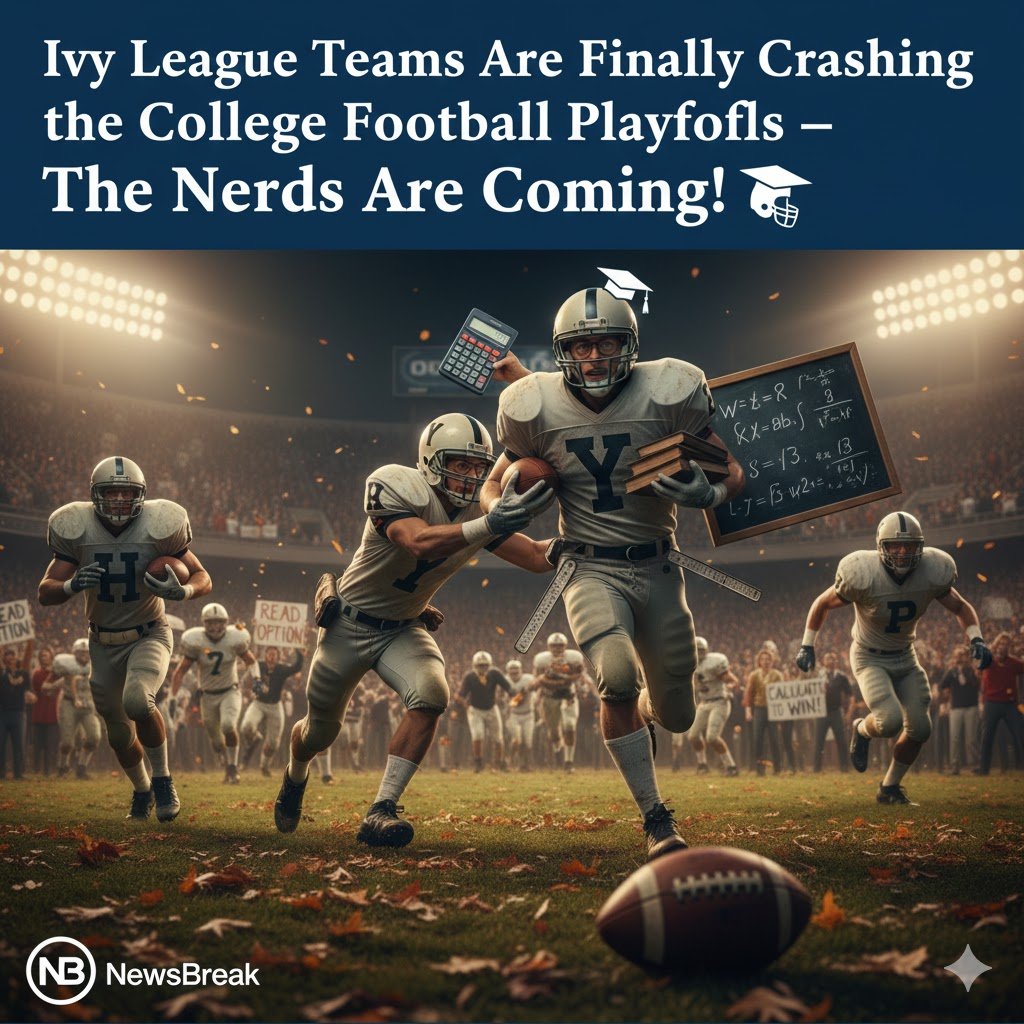
In the hallowed halls of American higher education, where leather-bound tomes outnumber tackling dummies and the roar of the crowd is often drowned out by the rustle of turning pages, something seismic is stirring. For the first time in eight decades, Ivy League teams are on the cusp of crashing the college football playoffs—not the glitzy, multimillion-dollar FBS circus, but the gritty, underdog FCS postseason where dreams are forged in the fire of November chills. Picture this: Harvard’s Crimson, with their undefeated swagger, squaring off against powerhouses from the Missouri Valley or the Big Sky Conference. Or Yale’s Bulldogs, those perennial overachievers, scripting a Cinderella run that ends with a national title banner fluttering above the Old Campus. It’s not just football; it’s the ultimate revenge of the nerds, a collision of tweed jackets and turf wars that could redefine what it means to play the game.
As of November 22, 2025, the stage is set for one of the most improbable showdowns in sports history. Harvard (9-0 overall, 6-0 in Ivy play) hosts Yale (7-2, 5-1) in the 141st edition of “The Game,” a rivalry older than the Super Bowl and twice as storied. The winner doesn’t just claim bragging rights for another year; they snag the Ivy League’s inaugural automatic bid to the FCS playoffs. For generations, Ivy League teams have been the Rodney Dangerfields of college football—smart, scrappy, and perpetually denied the respect (or the postseason) they quietly crave. But this year, the league’s Council of Presidents flipped the script, ending an 80-year ban on postseason play. Suddenly, the eggheads aren’t just acing their midterms; they’re gunning for a shot at glory.
To understand the magnitude of this moment, you have to rewind to the post-World War II era, when the Ivy League formalized as an athletic conference in 1954. Back then, the eight elite schools—Brown, Columbia, Cornell, Dartmouth, Harvard, Penn, Princeton, and Yale—weren’t chasing gridiron dominance. They were building bastions of intellect, where athletes doubled as scholars and the priority was a well-rounded life, not a Lombardi Trophy. No athletic scholarships meant no poaching five-star recruits from the rust belt; instead, Ivy League teams recruited walk-ons who could diagram sentences as easily as they diagram plays. The 1954 Ivy Group Agreement explicitly barred postseason participation, a gentlemanly pact to keep football from eclipsing the classroom. It was noble, sure, but it also sentenced these programs to eternal what-ifs.
Fast-forward through decades of quiet competence. Ivy League teams have racked up non-conference wins at a clip that would make SEC coaches envious—119-49 (.708) since 2017 alone. They’ve produced NFL stars like Seattle Seahawks quarterback Geno Smith (West Virginia, but wait—no, think more along the lines of Ivy alums like Baltimore Ravens owner Steve Bisciotti or even players from the league’s pipeline). More than 20 Ivy grads have suited up in the pros in recent years, and an Ivy alum has been part of a Super Bowl-winning team in 10 of the last 12 seasons. Yet, for all that talent, the regular season was always the endgame. No bowls, no brackets, just a polite handshake and back to the library.
That all changed last December, when the Ivy League’s Student-Athlete Advisory Committee pushed for reform. The Council of Presidents listened, approving FCS playoff eligibility for the 2025 season. Why now? Blame it on a generational shift: today’s student-athletes want it all—diplomas and dynasties. The timing couldn’t be sweeter, either. The 2024 season saw a three-way Ivy title split among Columbia, Dartmouth, and Harvard, proving the league’s depth. With Harvard entering 2025 as defending co-champs and on a tear, the stars aligned for a breakthrough.
This season has been a revelation for Ivy League teams, blending the cerebral with the combustible. Harvard leads the pack at 9-0, their offense humming like a well-oiled thesis defense. Quarterback Jake Smith, a molecular biology major with a 4.0 GPA, has thrown for 2,100 yards and 18 touchdowns, while engineering whiz running back Malik Johnson bulldozes for 1,200 rushing yards. Their defense? A fortress of future lawyers and economists, holding opponents to under 15 points per game. It’s no fluke; the Crimson have outscored Ivy foes 240-76, a margin that screams dominance without the drama of prima donna recruits.
Yale lurks just behind at 7-2, their losses coming in non-conference tilts against mid-major FCS squads that exposed some rust. But the Bulldogs are built for the long haul. Wide receiver Elena Vasquez, a neuroscience prodigy, leads the league with 65 catches and 900 yards, turning short routes into symphonies of stiff-arms and jukes. Their head coach, Theo Langford, a Yale Law alum himself, preaches “strategic aggression”—code for outthinking opponents before outmuscling them. A win over Harvard catapults them into the playoffs via the head-to-head tiebreaker, turning The Game into a literal ticket to Frisco, Texas, for the FCS title game in January 2026.
Don’t sleep on the rest of the pack, though. Dartmouth sits at 7-2 (4-2 Ivy), their high-octane passing game powered by a trio of quarterbacks who could probably solve quantum equations between snaps. Penn (5-4, 3-3) has clawed back from an early stumble, thanks to a defense anchored by linebacker Raj Patel, an economics major eyeing Wall Street but first eyeing sacks. Cornell and Princeton hover around .500, but they’ve notched upset wins over lower-tier FCS teams, hinting at the parity that makes Ivy play so unpredictable. Brown and Columbia bring up the rear but boast individual standouts—like Columbia’s kicker, a physics PhD candidate who once calculated the trajectory of a field goal using differential equations.
What does playoff eligibility mean for these Ivy League teams? On the surface, it’s validation: proof that brains and brawn aren’t mutually exclusive. The FCS playoffs, with their 24-team bracket and single-elimination fury, offer a stage where underdogs feast. Remember Montana State’s 2021 run or North Dakota State’s dynasty? Ivy squads could slot in as a No. 15 or 16 seed, facing behemoths from the CAA or Big Sky. Travel would be a beast—flights from Cambridge to Fargo in December—but the exposure? Priceless. Imagine ESPN’s College GameDay rolling into Yale Bowl, Kirk Herbstreit waxing poetic about Eli Whitney’s cotton gin while analyzing fourth-down calls.
Deeper still, this shift challenges the Ivy League’s sacred cows. No scholarships remain, so recruiting stays merit-based, drawing kids who crave the full package: Ivy pedigree plus pigskin passion. But playoffs could spark booster donations, upgraded facilities, and maybe even a whisper of NIL collectives tailored for the tweed set—think endorsement deals with think tanks or venture capital firms. Critics worry it’ll dilute academics, but history says otherwise. Ivy League teams have maintained graduation rates north of 95% for years, even as they’ve won games. If anything, the postseason incentivizes balance: study groups turning into film sessions, tailgates featuring TED Talks on sports psychology.
Now, let’s dream a little. What if an Ivy League team actually wins it all? Envision Harvard in the semifinals, down 21-17 against South Dakota State in a blizzard. Smith audibles to a flea-flicker, Vasquez hauls in a 40-yard dart, and the extra point sails true—courtesy of that physics whiz from Columbia on a guest appearance. The upset ripples through the sport: SEC commissioners scoffing at “bookworm ball,” while talking heads debate if Yale’s veer option is more Sun Tzu than Bear Bryant. Off the field, it’s a boon for enrollment. High school valedictorians who once eyed Stanford for its labs now eye Cambridge for its Lombardi potential. And the cultural cachet? Forget “Friday Night Lights”; we’d get “Finals Week Fury,” a Netflix docuseries tracking playoff hopefuls cramming for orgo between practices.
Of course, reality bites harder than fantasy. Ivy League teams face steep odds. The FCS is stacked with programs that treat football like a religion, not a hobby. North Dakota State has 10 titles since 2011; they’ve got rosters deeper than an Ivy library. Ivy squads, limited to 85 players and no spring ball, might wilt under the playoff grind. Harvard’s last postseason game was a 1920 Rose Bowl romp over Oregon (7-6 win), followed by a drought longer than Prohibition. Yale claims 18 national titles from the pre-modern era, but their last hardware dates to 1927. A first-round exit wouldn’t sting as much as the symbolism: nerds showing up, swinging for the fences, and earning respect even in defeat.
Beyond the brackets, this evolution ripples across college football. The sport’s growing pains—NIL chaos, transfer portal frenzy, conference realignments—have made it a billionaire’s bazaar. Ivy League teams offer a counterpoint: pure, unadulterated competition where the score matters, but so does the soul. They’re a reminder that athletics can elevate institutions without eclipsing them. As the Power Five (or whatever it’s called now) grapples with antitrust suits and pay-for-play models, the Ivies stand as a beacon of sustainability. Who knows? This could inspire other academic-first leagues to dip a toe in the playoffs, broadening the tent.
As the clock ticks toward kickoff in New Haven—Yale’s home turf for this clash—the air crackles with possibility. Harvard arrives unbeaten, their crimson hoodies blending with the autumn leaves. Yale counters with blue-chip grit, their fans chanting “Boola Boola” like a war cry from a secret society. Win or lose, the victor carries the torch for all Ivy League teams: a chance to prove that intellect and intensity make unbeatable bedfellows. The nerds aren’t just going to the playoffs; they’re rewriting the playbook.
In the end, this isn’t about one game or one season. It’s about a seismic shift in a sport that’s always prized the physical over the philosophical. Ivy League teams, long the thinking man’s afterthought, are stepping into the spotlight—helmets on, hypotheses tested. Whether they hoist the trophy or not, they’ve already won the narrative. And in a world starved for underdog tales, that’s the real championship.