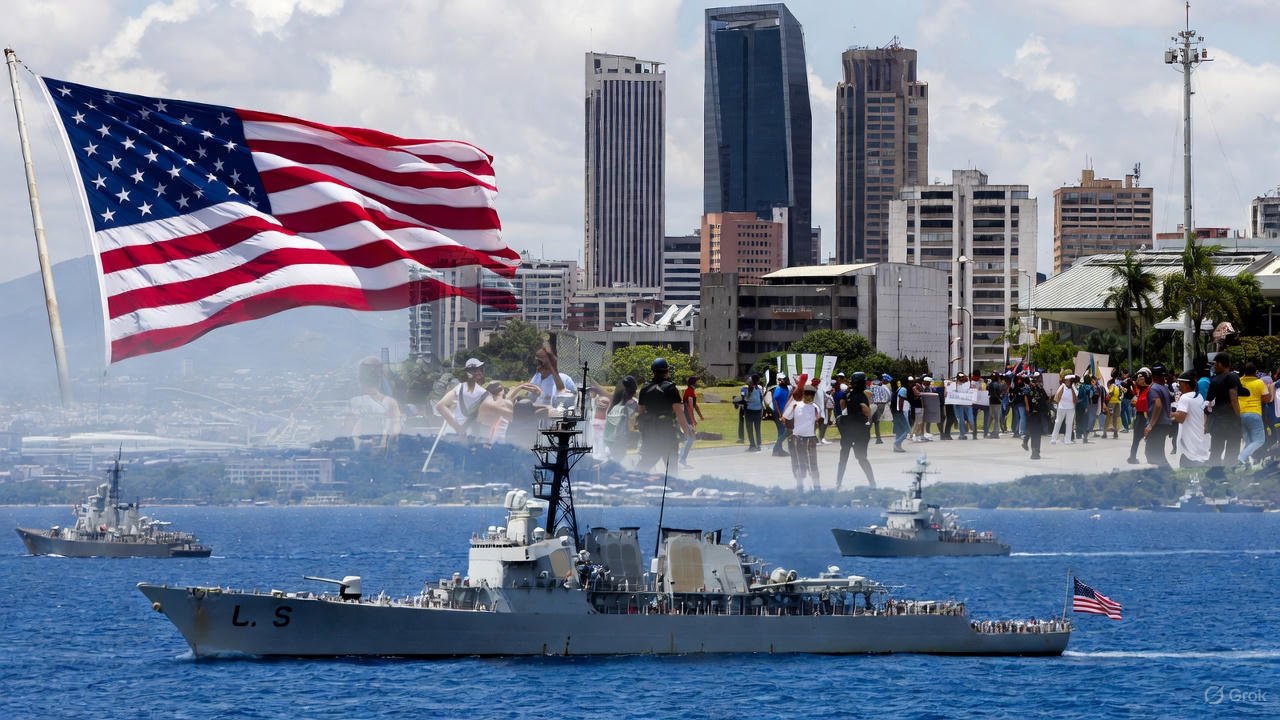
In the sweltering heat of Caracas, where the air hangs heavy with the scent of diesel and desperation, whispers of change have long circulated like the humid winds off the Caribbean. For years, Venezuela’s streets have echoed with protests, its markets with the hollow clink of empty shelves, and its airwaves with defiant speeches from President Nicolás Maduro. But today, those whispers carry a sharper edge—a metallic tang of impending storm. According to multiple high-level sources within the U.S. government, Washington is on the cusp of unleashing a bold new chapter in its long-standing campaign against the Maduro regime. This “new phase,” as insiders describe it, promises to blend shadow games with overt muscle, all aimed at toppling a leader the White House has branded a dictator, a narco-trafficker, and a threat to hemispheric stability.
The revelation, first broken by Reuters late Friday, paints a picture of calculated escalation under President Donald Trump’s second term. Four anonymous U.S. officials, speaking on condition of deep background, outlined plans that could redefine U.S. foreign policy in Latin America. At the forefront: covert operations designed to sow discord within Maduro’s inner circle, disrupt his financial networks, and amplify the voices of opposition forces. “This isn’t about regime change overnight,” one official confided. “It’s about turning the screws until the whole apparatus cracks.” Another hinted at a menu of options, from cyber intrusions into state media to psychological campaigns that exploit Venezuela’s fracturing loyalties. While no timeline has been finalized—Trump’s signature on the executive order remains pending—the machinery is already humming. U.S. naval assets, including the USS Gerald R. Ford carrier strike group, have steamed into the Caribbean, their decks buzzing with F-35 jets and drone swarms.
For Venezuelans, already battered by hyperinflation, blackouts, and a migrant exodus that has displaced over 7 million souls, the news lands like a thunderclap. “We’ve survived sanctions, we’ve survived the pandemics, but this? This feels like the endgame,” says Maria Gonzalez, a 42-year-old teacher in the teeming Petare slum, where murals of Hugo Chávez—Maduro’s mentor and the firebrand who once charmed Latin America’s left—fade under graffiti calling for “libertad o muerte.” Gonzalez’s words capture the duality of hope and dread rippling through a nation of 28 million. Opposition leader María Corina Machado, barred from running in recent elections amid fraud allegations, has rallied her supporters with cautious optimism. “The world is finally listening,” she told a crowd in Valencia last week, her voice cutting through the chants. Yet even she warns of the human cost: “Any intervention must prioritize our people, not just power plays.”
To understand this pivot, one must rewind the tape of U.S.-Venezuela relations, a saga as convoluted as the Orinoco River’s delta. It began in earnest during Trump’s first term, when Maduro’s 2018 reelection—widely decried as rigged—prompted Washington to recognize Juan Guaidó, a young lawmaker, as the “interim president.” Billions in sanctions followed, freezing Venezuelan assets and choking oil exports, the lifeblood of an economy once the envy of South America. Venezuela sits atop the world’s largest proven oil reserves, a glittering prize that has tempted empires from Spain’s conquistadors to today’s energy-hungry superpowers. But under Chávez’s socialist revolution in the early 2000s, those riches funded expansive social programs—free healthcare, literacy drives—that lifted millions from poverty, even as corruption gnawed at the foundations.
Maduro, inheriting the mantle in 2013, faced a perfect storm: plummeting oil prices, U.S. shale booms undercutting demand, and internal mismanagement that turned breadbasket farmlands fallow. By 2017, GDP had shrunk 75%, and the bolívar’s value evaporated faster than morning mist. Enter the U.S., wielding sanctions not just as economic levers but as geopolitical weapons. The Treasury Department’s “maximum pressure” campaign targeted PDVSA, the state oil company, and even Maduro’s inner circle, labeling them “specially designated nationals.” Human rights groups credit these measures with curbing regime abuses, but critics—from Amnesty International to Venezuelan economists—argue they’ve exacerbated famine and disease, killing thousands indirectly. “Sanctions are blunt instruments,” notes Dr. Carla Rodriguez, a Caracas-based analyst who fled to Bogotá in 2019. “They hit the poor hardest while the elite smuggle gold and crypto to Dubai.”
Trump’s return to the Oval Office in January 2025 supercharged the rhetoric. Campaign promises to “liberate Venezuela” echoed his first-term playbook, but with a twist: integration into a broader “war on cartels” narrative. Maduro’s government stands accused of colluding with the “Cartel de los Soles,” a shadowy network allegedly using state aircraft to ferry cocaine north. This Monday, the State Department is expected to formally designate the cartel a foreign terrorist organization, unlocking new tools for asset seizures and bounties. It’s a move that could sever Venezuela’s remaining ties to global finance, already strained by Russia’s shadow fleet of tankers evading U.S. patrols. In a fiery state TV address last night, Maduro dismissed the charges as “Yankee fairy tales,” vowing retaliation. “They think they can starve us into submission? We’ll rise like the Andes,” he thundered, flanked by uniformed generals whose loyalty has been the regime’s fragile spine.
The immediate ripples are already disrupting daily life. The Federal Aviation Administration’s stark advisory—citing “worsening security” and “heightened military activity”—has grounded flights from Delta, American, and LATAM, stranding thousands at Maiquetía International Airport. Passengers like Javier López, a migrant returning from Colombia with remittances sewn into his jacket, stare at departure boards gone dark. “I just want to see my kids,” he mutters, phone clutched like a talisman. Venezuelan airspace, once a conduit for tourists and traders, now feels like a no-fly zone in a forgotten war. Maduro’s response? A defiant military drill off La Guaira, where Su-30 jets—gifts from Moscow—screamed overhead in a “nuclear attack demo,” as state media crowed. It’s theater, but with teeth: Venezuela’s armed forces, though underfunded, boast Russian S-300 missiles and Iranian drones, a hedge against U.S. air superiority.
Behind the bluster lies a web of back-channel diplomacy that’s as intriguing as the covert plots. Sources reveal Trump has greenlit CIA frameworks for “preparatory actions”—think sabotage of regime-linked infrastructure or info-ops flooding social media with defector testimonies—while keeping a hotline open to Caracas. In a surprising overture last month, Maduro floated a deal: his resignation in 2027, after “stabilizing” elections, in exchange for lifted sanctions. The White House rebuffed it, viewing it as a stalling tactic. “He’s playing for time, hoping China or Russia bails him out,” a State Department veteran explains. Indeed, Beijing’s loans—over $60 billion since 2007—prop up PDVSA, while Putin dispatches Wagner mercenaries (now rebranded Africa Corps) to guard oil fields. A U.S. success here could ripple to Tehran and Moscow, undermining their footholds in America’s backyard.
Latin America watches with bated breath, a region scarred by U.S. interventions from Chile’s 1973 coup to Grenada’s 1983 invasion. Brazil’s Lula da Silva, a Chávez ally, has urged “dialogue over coercion,” fearing a refugee surge across the Amazon. Colombia’s Petro, navigating his own leftist tightrope, hosts 2.5 million Venezuelan migrants but dreads border clashes if fighting erupts. In Mexico, AMLO’s successor López Obrador echoes the call for OAS mediation, wary of Trump’s tariff threats tying migration to Venezuela’s fate. “This isn’t 1961’s Bay of Pigs,” says Dr. Sofia Mendes, a Georgetown University expert on hemispheric security. “The Monroe Doctrine is dead; now it’s multilateralism or bust. But Trump’s unilateral streak could isolate us all.”
Human rights advocates sound the loudest alarms. “Covert ops sound clean, but they’ve never been,” warns Amnesty’s Erika Guevara-Rosas. Past U.S. forays—like drone strikes in Yemen or rendition flights in the War on Terror—have bred blowback: radicalized survivors, eroded alliances. In Venezuela, where security forces have tortured dissidents and “disappeared” activists, any escalation risks civilian bloodbaths. The UN’s recent resolution against torture, boycotted by the U.S. alongside Israel and Argentina, underscores the irony: Washington lectures on democracy while vetoing global norms. Groups like Human Rights Watch decry the FAA’s airspace no-go as collective punishment, stranding medevac flights and aid convoys.
Economically, the stakes couldn’t be higher. Venezuela’s oil—sweet, heavy crude ideal for U.S. refineries—flows at a trickle, 700,000 barrels daily versus 3 million pre-crisis. A regime collapse could flood markets, crashing prices and delighting consumers from Houston to Hamburg. But chaos might spike Brent crude to $100, hammering global recovery. Chevron, the lone major still pumping under license, eyes expansion; rivals like Exxon salivate over untapped Orinoco Belt fields. “It’s not just about Maduro; it’s the black gold,” quips energy analyst Tom DiChristopher. Migrants, too, factor in: a toppled regime might stem the tide to U.S. borders, fulfilling Trump’s “secure the hemisphere” vow.
As night falls over Caracas, the city pulses with uneasy rhythm. Street vendors hawk arepas under flickering LEDs, reggaeton thumps from cantinas, and Maduro’s billboards proclaim “Patria o Muerte.” In Miami’s exile enclaves, Venezuelan-Americans—doctors turned Uber drivers, engineers in warehouses—cheer the headlines, dreaming of return. “We’ve waited too long,” says Carlos Ruiz, a 2017 émigré now in Doral. Yet veterans of the opposition recall 2019’s failed uprising, when U.S. saber-rattling fizzled without follow-through.
What does this new phase portend? Optimists see a democratic dawn, with free elections and rebuilt institutions. Pessimists foresee quagmire: ethnic militias carving fiefdoms, Russian proxies digging in, a Balkanized Venezuela exporting violence. Trump, ever the showman, might opt for spectacle—a leaflet drop over Caracas on Maduro’s July birthday, as floated in internal memos. Or it could fizzle into more sanctions, the default of frustrated empires.
One thing is certain: the Caribbean’s waters, once playgrounds for cruise ships, now bristle with gray hulls and watchful radars. As dawn breaks on November 23, 2025, Venezuela teeters on history’s fulcrum. Will it tip toward renewal or ruin? The sources say the dice are rolling. The world—and its weary people—can only wait.