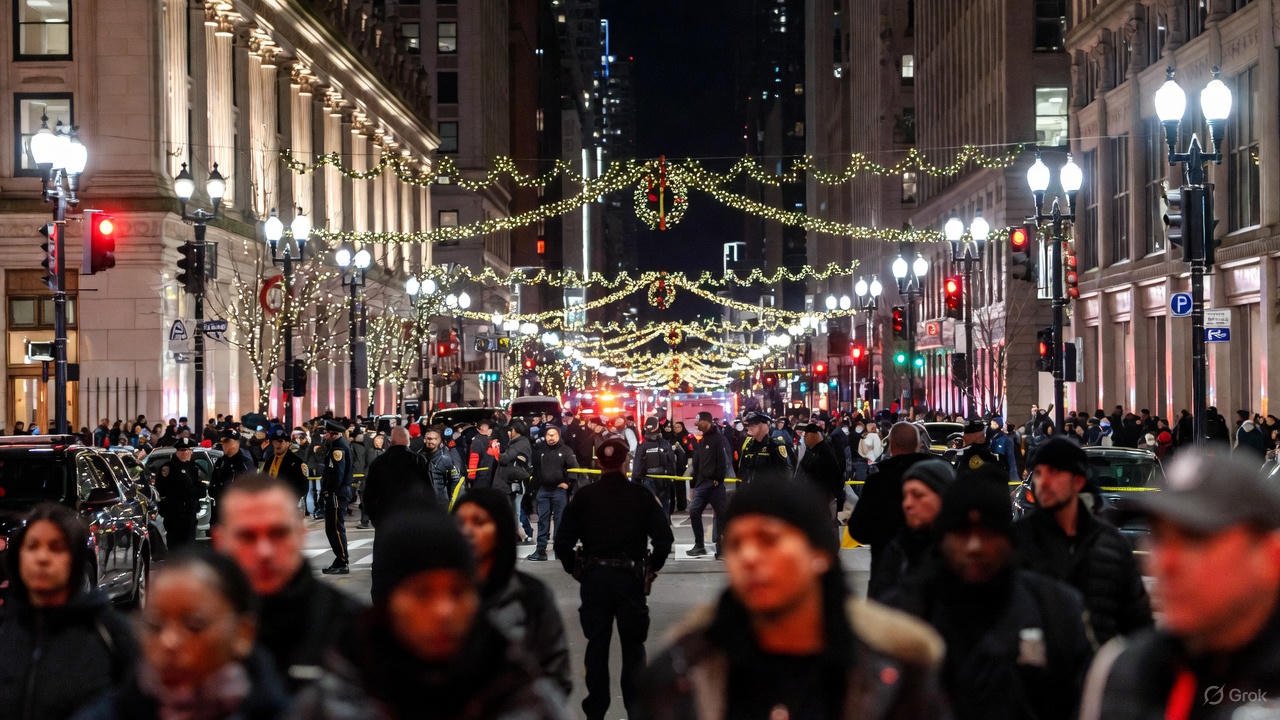
The twinkling lights of Chicago’s official Christmas tree had barely begun to cast their festive glow over Millennium Park when the sharp cracks of gunfire pierced the crisp November air. What was meant to be a night of joy and celebration in the heart of the city’s downtown Loop district turned into one of heartbreak and horror. In two separate but devastating shootings just blocks apart, one young life was lost, and eight teenagers were left grappling with injuries that will scar them far beyond the physical wounds. As families bundled up for hot cocoa and carols, the Windy City’s persistent struggle with gun violence reared its ugly head once more, leaving residents to question how to reclaim the season’s spirit amid such senseless tragedy.
This incident, unfolding on the evening of November 22, 2025, serves as a stark reminder of the fragile line between festivity and fear in urban America. With the Christkindlmarket in Daley Plaza wrapping up its first night and crowds spilling into the streets, the shootings not only disrupted the holiday kickoff but also amplified ongoing debates about youth safety, policing strategies, and the root causes of violence in Chicago. Officials are scrambling to reassure the public as the city gears up for its annual Thanksgiving Parade, but the echoes of those shots linger, demanding answers and action.
A Night Unraveled: The Timeline of Terror
The evening began on a high note, as it has for decades in Chicago. At around 7 p.m., the annual Christmas tree lighting ceremony drew thousands to Millennium Park, where the 50-foot Norway spruce – adorned with 50,000 multicolored lights – symbolized hope and renewal. Families posed for photos under the glowing Cloud Gate sculpture, children laughed at the ice rink, and vendors hawked roasted chestnuts and gingerbread. It was the kind of scene that postcard-perfect Chicago thrives on, especially as the holidays approach.
But beneath the cheer, authorities were on high alert. Social media buzz had hinted at a potential “teen takeover” – large, unsanctioned gatherings often advertised on platforms like TikTok and Instagram, where young people converge for fun but sometimes spiral into chaos. Chicago Public Schools had even sent a precautionary letter to parents earlier in the week, urging vigilance. With that in mind, the Chicago Police Department (CPD) had bolstered patrols, deploying extra officers to monitor the crowds.
Trouble erupted shortly after 9:50 p.m., mere blocks from the park. Near the iconic Chicago Theatre at the corner of State and Randolph streets, officers on foot patrol spotted a large group of teenagers clustered on the sidewalk in the 100 block of North State Street. What started as what police described as a lively but unmanaged assembly quickly escalated. Gunshots rang out – at least a dozen, witnesses later recounted – sending revelers scattering in panic. Screams mixed with the holiday music still piping from nearby speakers as seven teenagers, ages 13 to 17, collapsed with gunshot wounds, mostly to their legs.
Paramedics and police swarmed the scene within minutes, transforming the bustling boulevard into a makeshift triage zone. The victims – a mix of boys and girls – were rushed to John H. Stroger Hospital and Ann & Robert H. Lurie Children’s Hospital. Miraculously, all were listed in fair to good condition by early Saturday morning, with surgeons reporting no life-threatening injuries. “These kids were just out enjoying the night,” said one paramedic who declined to be named. “It’s gut-wrenching to see them like this.”
The chaos hadn’t even subsided when, less than an hour later at around 10:20 p.m., another burst of gunfire shattered the fragile calm. This time, it was in the 100 block of South Dearborn Street, near Adams and Dearborn, close to Federal Plaza and just a few blocks south of the first incident. Two more young people were hit in what appeared to be a targeted exchange, though details remain murky. A 14-year-old boy was shot multiple times in the torso and legs; he was transported to Northwestern Memorial Hospital but succumbed to his injuries shortly after arrival. The second victim, an 18-year-old man, sustained a gunshot wound to the leg and was listed in serious but stable condition at the same facility.
In total, nine young people were caught in the crossfire across the two events – one dead, eight injured – all under the age of 19. No bystanders unaffiliated with the gatherings were reported hurt, a small mercy in the midst of the mayhem.
The Human Toll: Faces Behind the Numbers
In the sterile halls of Chicago’s trauma centers, the real story of these shootings unfolds not in headlines, but in hushed conversations between doctors, distraught parents, and wide-eyed survivors. The seven teens from the first shooting, hailing from neighborhoods across the South and West Sides, shared a common thread: they were simply teenagers chasing the thrill of the city lights on a Friday night. One 15-year-old girl, shot in the thigh, told nurses through tears that she’d snuck out to meet friends after the tree lighting, dreaming of selfies under the marquee lights of the Chicago Theatre. Her mother arrived at Lurie Children’s Hospital around midnight, clutching a stuffed bear from the gift shop as if it could shield her daughter from the world’s cruelty.
The 14-year-old boy killed in the second shooting has been identified by Mayor Brandon Johnson as a “bright young soul” from the Englewood community, though his name has not yet been released pending family notification. Friends remembered him on social media as a budding artist with a quick laugh and a passion for basketball, often posting sketches of the city skyline. His death marks the 278th homicide in Chicago this year, a number that, while down significantly from prior years, carries an immeasurable weight for those left behind.
The 18-year-old survivor, shot while reportedly trying to intervene in an argument, faces a long road of physical therapy and psychological counseling. “These aren’t statistics; they’re our children,” said Rev. Jesse Jackson Sr., who visited the hospitals early Saturday. “Every bullet fired steals a piece of tomorrow from someone.”
Official Response: A Scramble for Security
CPD Superintendent Larry Snelling addressed the media at a predawn press conference outside CPD headquarters, his face etched with exhaustion. “Our officers were right there when it happened – they heard the shots and responded like pros,” he said. “But with thousands of people downtown, it’s like herding cats in a storm.” Over the course of the night, police made 18 arrests unrelated to the shootings, recovering five illegal firearms in the process. However, no suspects have been taken into custody for the actual incidents, and investigators are combing through surveillance footage from the theater district’s extensive camera network.
Mayor Johnson, speaking later that morning at a community center in the Loop, didn’t mince words. Flanked by faith leaders and youth advocates, he called the shootings “unacceptable” and a symptom of deeper societal ills. “We have too many guns on our streets and too many young people who don’t yet value their own lives or the lives of their peers,” Johnson stated, his voice steady but laced with frustration. He urged parents to monitor social media for pop-up events and reiterated the city’s plea: “These unauthorized gatherings advertised online? They end in tragedy too often. Stay home, stay safe, or better yet, come to official events where we can protect you.”
In response, the city announced an immediate surge of 300 additional officers for Saturday night’s holiday parade route, including drone surveillance and K-9 units. The CPD’s Gang Enforcement Unit is also partnering with federal agencies to trace the weapons used, many of which are believed to be stolen from out of state.
Voices from the Streets: Eyewitnesses Speak Out
For those who witnessed the pandemonium, the night will be etched in memory forever. Linda Dixon, a 52-year-old teacher from Oak Park, had just exited a holiday show at the Chicago Theatre when the first shots rang out. “One minute, we’re humming ‘Jingle Bells,’ the next, people are diving behind cars,” she recalled, her hands trembling as she sipped coffee at a nearby diner Saturday morning. “I saw cops sprinting, lights flashing everywhere. It was like a movie, but real – and terrifying. This is supposed to be our happy place.”
Moe Akl, a 28-year-old software engineer enjoying the Christkindlmarket with colleagues, was blocks away during the second shooting. “I heard this ‘ping’ – like fireworks at first – then screams,” he said. “Someone hit the ground right near me. We just ran, no questions asked.” Akl posted a shaky video on X (formerly Twitter) capturing the fleeing crowd, which quickly garnered thousands of views and sparked a wave of concern.
Social media lit up with similar accounts: hashtags like #LoopShooting and #ChicagoSafe trended locally, blending grief with demands for change. One viral post from a local activist read, “Holiday lights can’t hide the darkness if we don’t address it head-on. #EndGunViolenceNow.”
The Bigger Picture: Progress Amid Persistent Pain
These shootings come at a paradoxical moment for Chicago. Year-to-date through November 2025, the city has recorded a 29.2% drop in homicides and a 36% decrease in shooting victimizations compared to the same period last year – leading the nation in violent crime reduction, according to a recent Axios report. Summer 2025 marked the safest in six decades, with just 123 homicides from June to August, down from 274 in 2021. Experts credit community violence interruption programs, stricter gun trafficking laws, and collaborative efforts between police and neighborhood groups.
Yet, the raw numbers – over 1,200 shooting victims through August alone – underscore that decline doesn’t equate to eradication. “We’re bending the curve, but it’s not broken,” notes criminologist Amanda Klonsky of the University of Chicago Crime Lab. “Teen-involved incidents like this often stem from peer conflicts amplified by easy access to firearms and the anonymity of crowds.” She points to a 18% lethality rate for shootings this year, up slightly from a decade ago, as evidence that when bullets fly, survival isn’t guaranteed.
This isn’t the first time the holidays have been marred. Just last November 23, 2024, a 19-year-old woman was shot outside Macy’s on State Street during the Magnificent Mile Lights Festival – a eerily similar backdrop of twinkling lights and throngs of shoppers. Rich Guidice, former chief of staff to Mayor Johnson and ex-director of the city’s Office of Emergency Management, blames a lack of parental engagement. “These are kids under 17 – where are the adults? Band-Aids like more cops help, but real change starts at home.”
Ripples of Reaction: Community, Politics, and Calls to Heal
The shootings have ignited a firestorm of responses. Community leaders, including Cardinal Blase Cupich, held an impromptu prayer vigil outside Millennium Park Saturday afternoon, where hundreds gathered with candles and signs reading “Peace Over Presents.” Youth organizations like My Block, My Hood, My City pledged to host free holiday events in safer venues, emphasizing mentorship over mere monitoring.
Politically, the incident has drawn national eyes – and sharp elbows. President Donald Trump took to Truth Social, decrying “massive crime and rioting” in the Loop and accusing Gov. JB Pritzker and Mayor Johnson of rebuffing federal aid, including National Guard deployment. (Police clarified no officers were injured, countering claims of attacks on law enforcement.) Johnson fired back in his briefing, framing the rhetoric as distraction: “We’re focused on solutions, not soundbites. Let’s invest in our kids, not inflame divisions.”
Cook County Crime Stoppers upped the ante with a $10,000 reward for tips leading to arrests, urging anonymity via their hotline (1-800-535-7867). As of Sunday morning, detectives had received over 50 calls, a sign that the community is ready to speak – if protected.
Toward a Safer Season: Hope in the Holidays
As Chicago dusts itself off for Thanksgiving and beyond, the question looms: Can the city turn this tragedy into a turning point? Initiatives like the mayor’s “Safe Passages” program, which provides after-school havens, and expanded mental health services in schools are gaining traction. Advocates call for stricter social media regulations on event promotions and federal buyback programs to stem the flow of illegal guns.
For the families forever changed – the parents mourning a son too young to lose, the teens learning to walk again – healing won’t come from headlines. But in the resilience of a city that rebuilds after every storm, there’s a flicker of the same light that illuminated that Christmas tree. Chicago’s story isn’t defined by one night of darkness; it’s written in the collective will to rise, one community step at a time.
This Chicago news story underscores the urgency: In a city of contrasts – glittering skyscrapers and gritty streets – safety must be the greatest gift we give our youth. As the parade floats roll down State Street tomorrow, let the crowds march not just for spectacle, but for solidarity. The lights will shine again, but only if we ensure no more shadows fall.