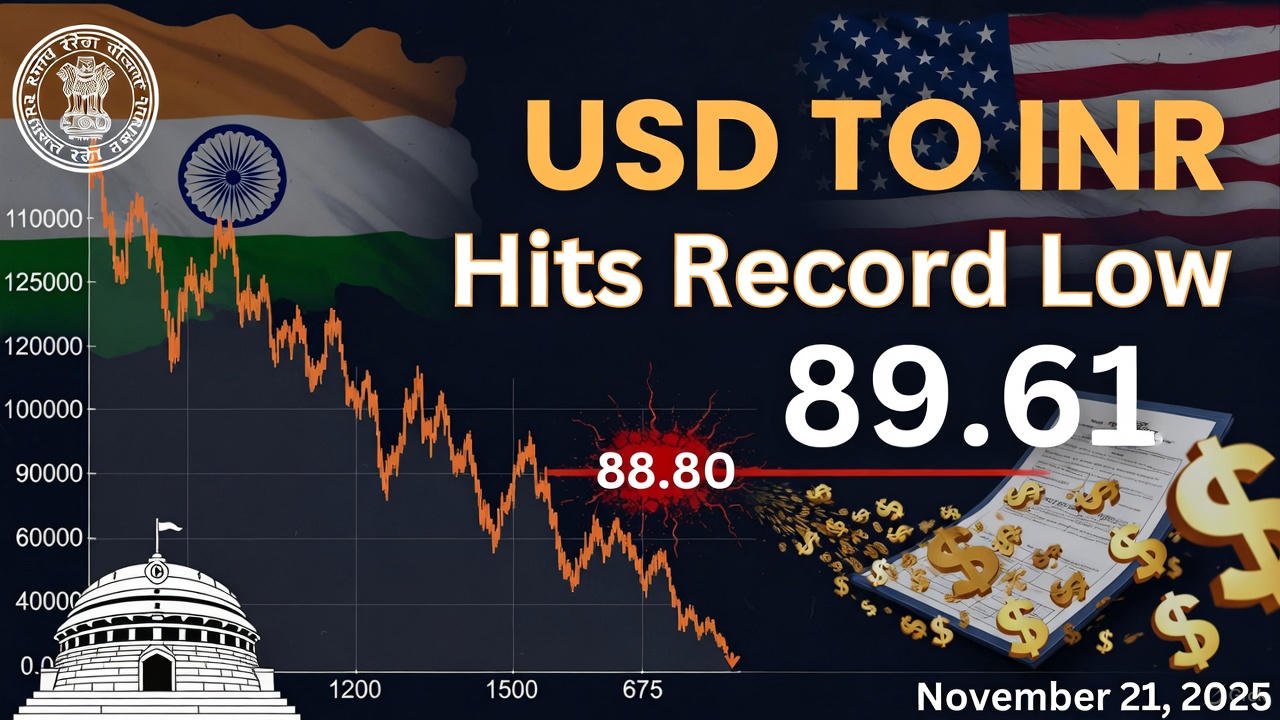
In a stark reminder of how global winds can buffet emerging markets, the Indian rupee plummeted to an unprecedented low on November 21, 2025, breaching the 89-mark against the US dollar for the first time. Trading at 89.61 by the close of the session, the currency’s slide marked a 1.05% depreciation in a single day—the sharpest in months—and erased the psychological barrier that the Reserve Bank of India (RBI) had steadfastly defended for weeks. This downturn, fueled by relentless foreign portfolio outflows and escalating US-India trade frictions, has ignited concerns about India’s economic resilience amid a backdrop of geopolitical uncertainty.
For everyday Indians, the USD to INR exchange rate isn’t just a financial metric; it’s the invisible hand that dictates the cost of imported fuel, electronics, and even holiday getaways abroad. As the rupee weakens, the pinch is felt from Mumbai’s bustling markets to Delhi’s corporate boardrooms. But what triggered this record plunge, and what does it spell for the months ahead? Let’s unpack the forces at play.
The Perfect Storm: Capital Flight and Geopolitical Jitters
The rupee’s woes didn’t erupt overnight. Over the past year, the USD to INR pair has surged by more than 6%, reflecting a broader trend of dollar strength driven by the US Federal Reserve’s hawkish stance on interest rates. Yet, the latest catalyst was a toxic brew of domestic and international pressures.
Foreign investors, spooked by the lack of progress in bilateral trade negotiations, have yanked out over $16.5 billion from Indian equities year-to-date. This capital exodus accelerated in November, with portfolio inflows turning negative for the third straight month. Analysts point to fading hopes of a timely US-India trade pact as a primary culprit. Hopes were high earlier in the year for a deal that could ease American tariffs on Indian goods—tariffs that have already slashed exports to the US, India’s largest trading partner, by double digits.
October’s trade data painted a grim picture: India’s deficit ballooned to a record $28.5 billion, as imports of crude oil and gold soared while shipments of textiles, pharmaceuticals, and auto parts to the US cratered under 50% duties imposed by the Trump administration. “The delay in sealing a comprehensive trade agreement has amplified risk aversion,” notes economist Priya Sharma, a former RBI advisor. “Investors are pricing in prolonged uncertainty, leading to a flight to safety in US treasuries.”
Adding fuel to the fire, the Fed’s latest minutes dashed expectations of aggressive rate cuts, bolstering the dollar index to multi-month highs. For India, a nation heavily reliant on foreign capital to fund its current account deficit, this spells trouble. The rupee’s depreciation isn’t isolated; it’s part of a regional malaise where Asian currencies like the Indonesian rupiah and Thai baht have also shed value against the greenback.
RBI’s Tactical Retreat: From Defender to Observer
At the heart of the drama is the RBI’s evolving strategy. For months, the central bank had been the rupee’s steadfast guardian, selling dollars from its $650 billion forex reserves to cap volatility. The 88.80 level became a de facto floor, with interventions totaling over $20 billion in the third quarter alone. But on November 21, as the pair pierced this threshold, the RBI appeared to step back, allowing market forces to take the wheel.
Governor Sanjay Malhotra, in a mid-week address, hinted at this shift: “The exchange rate is market-determined, and our interventions are calibrated to smooth excessive swings, not to peg it artificially.” This philosophy echoes the RBI’s post-pandemic playbook—prioritizing inflation control over currency stability. With retail inflation dipping to a multi-year low of 3.2% in October, the central bank has room to maneuver. Yet, the absence of visible dollar sales triggered a cascade of short-covering by speculators, propelling the USD to INR rate past 89.50 intraday.
Critics argue this hands-off approach risks eroding confidence. “By letting the rupee find its ‘natural’ level, the RBI is signaling that reserves are finite and trade imbalances must be addressed structurally,” says Rakesh Mohan, a veteran currency trader at a Mumbai-based firm. Data from the forwards market shows one-year non-deliverable forwards (NDFs) pricing in further weakness, with implied rates hovering near 91 by mid-2026.
Still, the RBI isn’t entirely passive. Spot interventions resumed late Friday, lifting the rupee marginally to 89.43 by session end. Offshore desks report discreet sales in the NDF market to temper volatility without depleting reserves aggressively. The bank’s toolkit also includes moral suasion—urging oil importers to hedge exposures and exporters to repatriate dollars promptly.
Ripple Effects: From Inflation to Corporate Bottom Lines
The rupee’s record low is more than a headline; it’s a seismic shift with tangible consequences. For starters, it stokes imported inflation. India imports 85% of its crude oil needs, and a weaker currency translates to higher pump prices. Expect petrol and diesel rates in major cities to climb 5-7% in the coming weeks, squeezing household budgets already strained by monsoon disruptions.
Exporters, on the flip side, stand to gain. Sectors like IT services, gems, and apparel— which derive 40% of revenues from the US—could see earnings boosts of 8-10% in rupee terms. Companies such as TCS and Infosys have already flagged currency tailwinds in their Q2 guidance. However, this silver lining is dimmed by the trade angst: US tariffs on steel and aluminum have idled factories in Gujarat and Tamil Nadu, leading to 15,000 job losses in the metals sector alone since September.
Corporate India is hedging furiously. The RBI’s recent relaxation of forward limits has seen hedging volumes spike 30%, with firms like Reliance Industries locking in rates for six months out. Yet, small and medium enterprises (SMEs) without access to derivatives markets are vulnerable, facing margin calls on dollar loans that now cost 12-15% more in local currency.
On the macroeconomic front, the slide exacerbates India’s external vulnerabilities. The current account deficit, at 2.8% of GDP, is sustainable but widening. Remittances from the Gulf, a $100 billion lifeline, offer some ballast, but FPI outflows could push bond yields higher, complicating the government’s borrowing plans for its $1.2 trillion fiscal deficit.
Equity markets mirrored the currency’s distress, with the Sensex shedding 450 points on Friday. Foreign institutional investors (FIIs) offloaded $800 million in stocks, rotating into US tech amid AI hype. Domestic mutual funds stepped in, absorbing 60% of the selling, but breadth weakened as midcaps lagged.
Historical Echoes and Lessons Learned
This isn’t India’s first rodeo with a depreciating rupee. Flash back to 2013’s “taper tantrum,” when the currency cratered 20% on Fed signals, prompting capital controls and a sovereign rating downgrade scare. Or 2020’s COVID crash, where the USD to INR pair touched 76 amid global lockdowns. Each episode honed the RBI’s crisis playbook: build buffers, diversify funding sources, and lean on multilateral lenders like the IMF.
Today, India’s position is stronger—forex reserves cover 11 months of imports, up from 6 in 2013—but complacency is the enemy. The 1991 balance-of-payments crisis, which forced gold pledges to the Bank of England, remains a cautionary tale. Policymakers are dusting off old strategies: accelerating rupee trade settlements with Russia and UAE, and piloting CBDC cross-border pilots to reduce dollar dependence.
Peering Ahead: Pathways to Stability
So, where does the rupee go from here? Short-term, traders eye 90 as the next resistance, with support at 88.50 if RBI firepower returns. A breakthrough US-India trade deal—rumored for December—could spark a 2-3% rebound, easing tariffs on $50 billion in annual exports. Optimists like Deutsche Bank’s Pradeep Kumar forecast stabilization around 88 by Q1 2026, assuming Fed cuts materialize in March.
Pessimists, however, warn of a vicious cycle. Persistent outflows could drain $50 billion in reserves by year-end, forcing tighter monetary policy and stifling growth projected at 6.8% for FY26. Geopolitical wildcards, from Middle East flares to US election rhetoric, add layers of unpredictability.
For the RBI, the balancing act intensifies. A December rate cut—bets are 75% priced in—could lure inflows, but only if paired with fiscal prudence. Finance Minister Nirmala Sitharaman’s upcoming budget may unveil export incentives, like enhanced interest subventions, to stem the trade bleed.
Investors should watch key indicators: November’s PMI data on December 2, US non-farm payrolls next week, and any whiff of trade thaw from Washington. Diversifying into rupee-hedged global funds or gold ETFs could mitigate risks for retail portfolios.
A Call for Resilience
The rupee’s tumble past RBI’s defended line underscores a harsh truth: in an interconnected world, no currency is an island. Outflows and trade angst have exposed fault lines in India’s growth story, but they also spotlight opportunities for reform—from boosting domestic manufacturing under Atmanirbhar Bharat to forging deeper ties with ASEAN partners.
For the average Indian, this means budgeting smarter: stock up on imports now, eye export-linked jobs, and remember that a weaker rupee historically precedes comebacks. As the sun sets on another volatile trading day, one thing is clear—the USD to INR saga is far from over. It’s a test of endurance, ingenuity, and international diplomacy. How India navigates it will define not just its wallet, but its global stature.