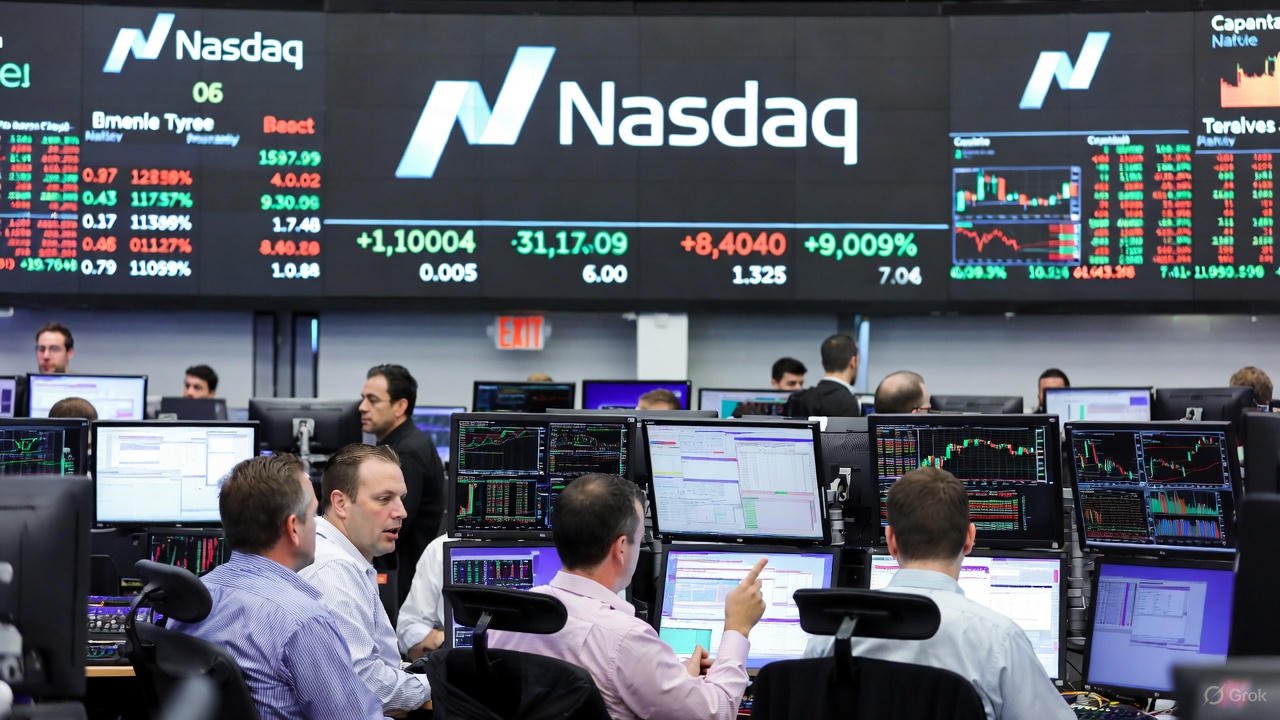
In a welcome twist to what has been a bruising month for investors, the Nasdaq Composite Index surged ahead on Monday, pulling the broader market higher and igniting cautious hopes for a rebound from steep November losses. As trading wrapped up, the tech-laden benchmark climbed 1.1%, outpacing gains in the Dow Jones Industrial Average (up 0.3%) and the S&P 500 (up 0.7%). This performance not only capped a volatile week but also offered a glimmer of relief after the Nasdaq had tumbled more than 6% so far this month, dragged down by concerns over artificial intelligence hype cooling off and lingering economic jitters.
The Nasdaq’s resilience stood out like a beacon in an otherwise foggy market landscape. Closing at 22,659.82, the index notched a solid gain of 386.74 points, or 1.74%, from Friday’s close of 22,273.08. It opened at 22,482.16, dipped briefly to a low of 22,478.27, but quickly recovered to hit an intraday high of 22,708.15 before settling in positive territory. Volume came in at a brisk 1.76 billion shares, signaling robust participation from traders eager to shake off last week’s pessimism. For context, this marked the Nasdaq’s strongest single-day advance since mid-October, when similar rate-cut whispers from the Federal Reserve had briefly lifted spirits.
What made this move particularly noteworthy was the Nasdaq’s role as the market’s pace-setter. While the Dow, often seen as a barometer for old-economy stalwarts, managed only a modest 0.3% increase to close around 46,738.52—adding about 493 points from its previous level—the index’s 30 blue-chip components reflected a more subdued mood, with gains concentrated in a handful of names like Boeing and Goldman Sachs. The S&P 500, straddling both tech and traditional sectors, fared better at 0.7%, pushing to 6,602.99 with a 64.23-point rise. Yet, it was the Nasdaq that stole the show, underscoring how investor sentiment is increasingly tethered to the fortunes of innovation-driven companies.
This leadership from the Nasdaq isn’t happening in a vacuum. November has been a punishing stretch for equities, with the index shedding over 6% month-to-date amid a perfect storm of headwinds. A hotter-than-expected inflation reading earlier in the month reignited fears that the Fed might pause its easing cycle, while disappointing guidance from Big Tech giants like Meta and Alphabet fueled doubts about the sustainability of AI investments. The previous week alone saw the Nasdaq drop 2.7%, extending a four-day skid that wiped out nearly $2 trillion in market value across the Magnificent Seven stocks. Comparatively, the Dow fell almost 2% over the same period, and the S&P 500 declined 2%, leaving all three major averages nursing monthly losses of 3% or more.
But Monday’s action suggested a potential inflection point. Futures trading overnight had already hinted at optimism, with Nasdaq-100 contracts jumping 0.7%, outstripping Dow futures (up 0.2%) and S&P 500 futures (up 0.5%). By mid-morning, the index was up 1.4% at one point, driven by a rotation back into growth stocks as bargain hunters scooped up shares beaten down by recent volatility. “We’re seeing a classic relief rally,” noted Sarah Thompson, chief market strategist at Vanguard Investments. “The Nasdaq’s outperformance reflects renewed faith in tech’s long-term story, especially with the Fed’s dovish signals providing a tailwind.”
Speaking of the Fed, a key catalyst emerged over the weekend when a senior official from the central bank reiterated support for a December rate cut. In a CNBC interview aired Sunday evening, Fed Governor Lisa Cook emphasized that recent data showed “inflation cooling faster than anticipated,” paving the way for policymakers to deliver a 25-basis-point reduction at their next meeting. This commentary echoed earlier remarks from Chair Jerome Powell, who has stressed the need for “prudent normalization” without derailing growth. Bond yields reacted swiftly, with the 10-year Treasury dipping to 4.12% from 4.18% late Friday, easing borrowing costs and making high-growth Nasdaq names more attractive relative to fixed-income alternatives.
Tech stocks, the Nasdaq’s lifeblood, responded with gusto. The sector as a whole rose 1.8%, led by semiconductor powerhouses. Nvidia, fresh off a rollercoaster earnings week, added 2.5% to close at $142.30, rebounding from a 3% Friday dip triggered by profit-taking. Despite whispers of an AI “bubble,” Nvidia’s CEO Jensen Huang doubled down in a post-earnings call on the company’s dominance in data center chips, projecting 35% revenue growth for the fiscal year. Fellow chipmaker AMD surged 3.1%, while Broadcom climbed 2.2% on reports of expanded partnerships with cloud providers.
Beyond semis, the “Magnificent Seven” showed signs of mending fences. Apple, which had lagged peers amid iPhone sales concerns in China, eked out a 0.8% gain to $228.45. Microsoft, buoyed by Azure cloud momentum, rose 1.6%, and Amazon’s AWS division helped lift the e-commerce giant 1.9%. Even Tesla, notorious for its swings, popped 2.8% on buzz around its Cybercab robotaxi unveil, though Elon Musk’s latest X post about “full self-driving by year-end” drew equal parts excitement and skepticism. These moves helped the Nasdaq-100, a subset focused on non-financial giants, outperform the broader composite by jumping 1.62% to 24,632.95.
Not everything was rosy, however. Consumer discretionary lagged with a 0.4% dip, as retailers like Nike and Starbucks grappled with holiday spending fears. Energy stocks, tied to the Dow more closely, barely budged amid flat oil prices hovering at $68 per barrel for WTI crude. And while the Nasdaq led the charge, its smaller-cap constituents—think biotech and software startups—underperformed, rising just 0.9% as venture funding dried up in a high-rate environment.
Zooming out, this rally comes against a backdrop of macroeconomic crosscurrents. The U.S. economy expanded at a 2.8% annualized clip in Q3, per recent GDP revisions, but consumer confidence surveys paint a murkier picture. The Conference Board’s index fell to 98.7 in November, the lowest since mid-2023, as households fretted over job security and election-year uncertainties. With the presidential race heating up—polls showing a tight contest between incumbents and challengers—markets are pricing in policy wild cards, from tax hikes to trade tariffs.
Yet, the Nasdaq’s bounce underscores a deeper narrative: technology’s unyielding grip on investor portfolios. Since its inception in 1971, the index has evolved from a niche tech tracker to a $25 trillion behemoth, representing over 3,000 companies across software, biotech, and consumer tech. Its weighted structure favors behemoths like the FAANG crew, which account for nearly 40% of its market cap, making it hypersensitive to innovation cycles. Critics argue this concentration breeds fragility—witness the 2022 bear market when the index cratered 33%—but proponents point to historical returns: an average annual gain of 11.5% over the past decade, trouncing the Dow’s 8.2%.
Looking ahead, analysts see this uptick as a potential turning point, but caution abounds. “The Nasdaq’s leadership today is encouraging, but sustainability hinges on earnings delivery,” says Mike Wilson, global chief investment officer at Morgan Stanley. Upcoming reports from Cyber Monday darlings like Shopify and Snowflake could either solidify the rebound or expose cracks. Moreover, with Thanksgiving tomorrow and markets closing early Friday, thin holiday volume might amplify swings.
Globally, the mood was sympathetic. Europe’s STOXX 600 rose 0.6%, buoyed by luxury goods firms, while Asia’s Nikkei 225 added 1.2% on exporter strength. Emerging markets, however, remained choppy, with China’s Hang Seng down 0.3% amid property sector woes.
For everyday investors, Monday’s action offers a tactical breather. Those holding Nasdaq-focused ETFs like Invesco QQQ (up 1.2%) saw quick wins, while options traders piled into calls on volatile names like Coinbase, which jumped 4.1% on crypto rally hopes. But as always, diversification reigns supreme—blending Nasdaq exposure with Dow stability could buffer against sector-specific storms.
In sum, the Nasdaq Index’s commanding performance on November 24 served as a rallying cry for bruised bulls. By leading the Dow and S&P 500 out of the red, it not only stemmed November’s bleeding but also reignited debates about tech’s enduring allure. Whether this sparks a full-fledged rebound or merely a head-fake remains to be seen. For now, though, Wall Street exhaled, eyes fixed on the horizon where rate cuts, earnings, and innovation promises converge. In the ever-shifting sands of the market, today’s gains remind us: hope, like code, often compiles after a few debug sessions.