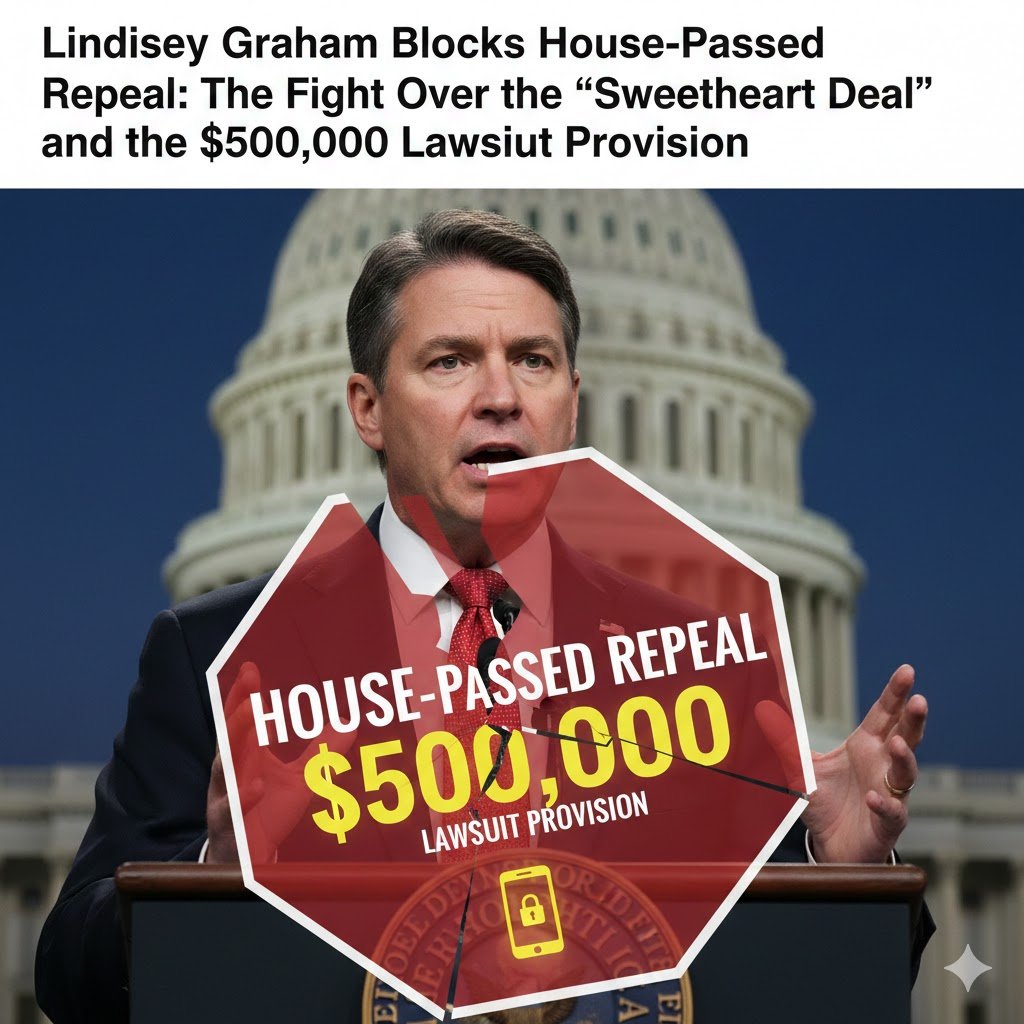
When Congress pushed through a last-minute funding package to end the recent government shutdown, lawmakers expected criticism, debate, and political friction. What they did not expect was a firestorm surrounding a quietly inserted clause—one that allows certain U.S. senators to sue the federal government for up to $500,000 if their phone or office data was accessed without proper notification. Overnight, this little-known clause exploded into a national controversy. Critics called it a “sweetheart deal,” supporters called it accountability, and in the middle of the chaos stands Senator Lindsey Graham, who has forcefully blocked a House-passed bill aimed at repealing the provision.
The battle has become one of the most contentious legal and political dramas in recent congressional history. To understand its impact, one must examine what the provision actually does, who benefits, why the House united against it, and why Lindsey Graham is determined to block its repeal.
What Exactly Is the $500,000 Lawsuit Provision?
Buried in the funding bill that ended the shutdown was a clause dealing with data transparency and privacy protections for U.S. senators. On paper, the clause requires that federal agencies and telecom companies notify senators if their phone records or office data are obtained through subpoenas, search warrants, or other investigative actions—unless the senator is the target of an investigation.
The controversial part, however, is this:
If the notification requirement is violated, a senator may sue the federal government for damages of up to $500,000 per violation. Not only that, but the clause is retroactive to 2022, meaning a senator can sue over data that was obtained years ago.
For many observers, this sounded less like routine privacy protection and more like a potential cash windfall.
Supporters argue it is a necessary safeguard to prevent government overreach. But critics say the provision is uniquely tailored to benefit a handful of senators whose records were reportedly accessed during federal investigations.
Why This Clause Sparked Unprecedented Backlash
The backlash was immediate, bipartisan, and unusually intense. Members of the House said they were blindsided by the discovery that this language had made its way into a massive, must-pass shutdown bill with almost no public discussion or committee hearings.
1. Accusations of Self-Dealing
Because the provision applies only to senators, not House members or the general public, critics say it creates a protected class within Congress. They call it a blatant case of lawmakers writing financial benefits for themselves.
2. Retroactive Payouts Raise Eyebrows
Retroactivity is especially controversial because it overlaps with federal investigations that took place after the 2020 election. This timing has fueled accusations that the clause was written specifically to help a small group of senators seek compensation for past data seizures.
3. Taxpayer Money Is on the Line
If several senators sue the government and win $500,000 settlements, the bill will ultimately be paid by the American public. Critics call this a misuse of taxpayer dollars, especially in an era of rising deficits and economic pressure.
4. Lack of Transparency
The fact that the provision was inserted into a shutdown bill with minimal public scrutiny has only deepened suspicion. Lawmakers in the House called it “quiet lawmaking at its worst.”
5. Unequal Legal Protection
Perhaps the sharpest criticism is that ordinary Americans have no equivalent right. If their data is seized improperly, they do not get a guaranteed pathway to sue the government for half a million dollars. Why should senators enjoy such privilege?
House Response: A Rare 427–0 Vote
In a time of extreme political division, Congress rarely agrees unanimously on anything. Yet the backlash to the provision united the House in a stunning 427–0 vote to repeal it. Conservative Republicans, progressive Democrats, and every faction in between agreed the clause should be removed.
House leaders said this was not about punishing senators but about preserving fairness and preventing a dangerous precedent: lawmakers granting themselves exclusive financial protections.
The repeal bill sailed through the House. All eyes then turned to the Senate.
Enter Lindsey Graham: One Senator Stops the Process
When the repeal arrived in the Senate, lawmakers expected swift approval—until Senator Lindsey Graham rose to object.
In the Senate, a single objection can block a “unanimous consent” motion, and Graham used that procedural power to halt the repeal instantly.
Graham argued that:
- His phone records were accessed without his knowledge.
- He wants answers and accountability.
- This provision gives senators a legal tool to demand that accountability.
- The repeal is premature and politically motivated.
To Graham, the clause is not a “sweetheart deal.” It is a safeguard against abuse of investigative power and a line of protection for the legislative branch.
He insisted that if the government can seize a senator’s records without proper process, then no one in the legislative branch is safe from executive overreach.
Why Graham Might Personally Benefit
Graham’s forceful defense of the provision has raised questions because he is reportedly one of the senators whose phone records were collected during past investigations.
Under the retroactive clause, he could theoretically sue the government and receive up to $500,000 in damages.
Critics say this is exactly why the provision must be repealed. They argue Graham should not block legislation that could personally benefit him. Graham, however, rejects that idea and maintains he is acting out of principle.
John Thune’s Compromise Proposal
Senate Majority Leader John Thune attempted to defuse the controversy with a compromise:
He proposed modifying the provision so that any financial damages would go to the U.S. Treasury, not to individual senators.
This would preserve the accountability mechanism while eliminating personal financial gain. Some senators welcomed the idea, while others argued it still fails to address deeper structural issues in the provision.
The Senate remains divided on the path forward.
The Stakes: Why This Fight Matters
The conflict is not merely about money. This debate touches on larger issues of government power, transparency, congressional privilege, and public trust.
1. Separation of Powers
Supporters believe the clause is necessary to protect legislative independence from potential misuse of investigative authority by the executive branch.
2. Oversight vs. Overreach
Opponents worry the clause allows senators to weaponize their grievances and potentially intimidate federal investigators.
3. Public Trust in Government
Many Americans already feel Congress protects itself more than the public. A financial benefit exclusively for senators widens that trust gap.
4. Precedent for Future Laws
If Congress establishes that lawmakers can be compensated retroactively for investigations, what prevents future carve-outs, privileges, or financial protections?
Why Lindsey Graham Is Willing to Take the Heat
Blocking a unanimous repeal puts Graham in a politically risky position. Yet he appears ready to accept the criticism. He argues that:
- Federal investigators must be held accountable.
- Senators should not be kept in the dark about data seizures.
- Transparency must be enforced through legal consequences, even costly ones.
- Without such a law, intrusive investigations could become normalized.
Graham has openly suggested he may sue under the provision. Critics say this proves the clause serves personal interests. Supporters counter that personal stakes do not invalidate the broader principle of protecting the legislative branch.
What Happens Next?
Several outcomes are possible:
1. Full Repeal
If Senate leadership gathers enough support, they could override Graham’s objection through formal votes. This would require time and political capital.
2. Modified Reform
The Senate could keep the general idea but remove the financial payout. This option has growing support.
3. Status Quo
The provision remains in effect, and eligible senators—including Graham—retain the right to sue.
Which path is chosen will reveal how Congress views its own privileges—and how willing senators are to accept public scrutiny.
Why the Public Should Pay Attention
This controversy is about more than a single clause or a single senator. It raises deeper questions:
- Should lawmakers create legal tools that benefit only themselves?
- Should taxpayer dollars compensate senators for investigative actions?
- How transparent should Congress be about its own privilege?
- Who watches the watchers?
The outcome of this dispute will shape how the American public perceives Congress’s integrity and priorities.
Conclusion
The fight over the $500,000 lawsuit provision has become a symbolic battle over congressional privilege, government transparency, and the balance of power between branches. Lindsey Graham’s decision to block the House repeal has turned a quiet clause into a national debate.
For critics, it is a “sweetheart deal”—a self-serving carve-out inserted under the cover of crisis.
For supporters like Graham, it is a necessary check on government power, ensuring that senators are not silently targeted or surveilled.
The struggle is far from over. Whether Congress repeals, reforms, or keeps the provision will have lasting consequences—not just for senators, but for how Americans view fairness, privilege, and accountability in their government.