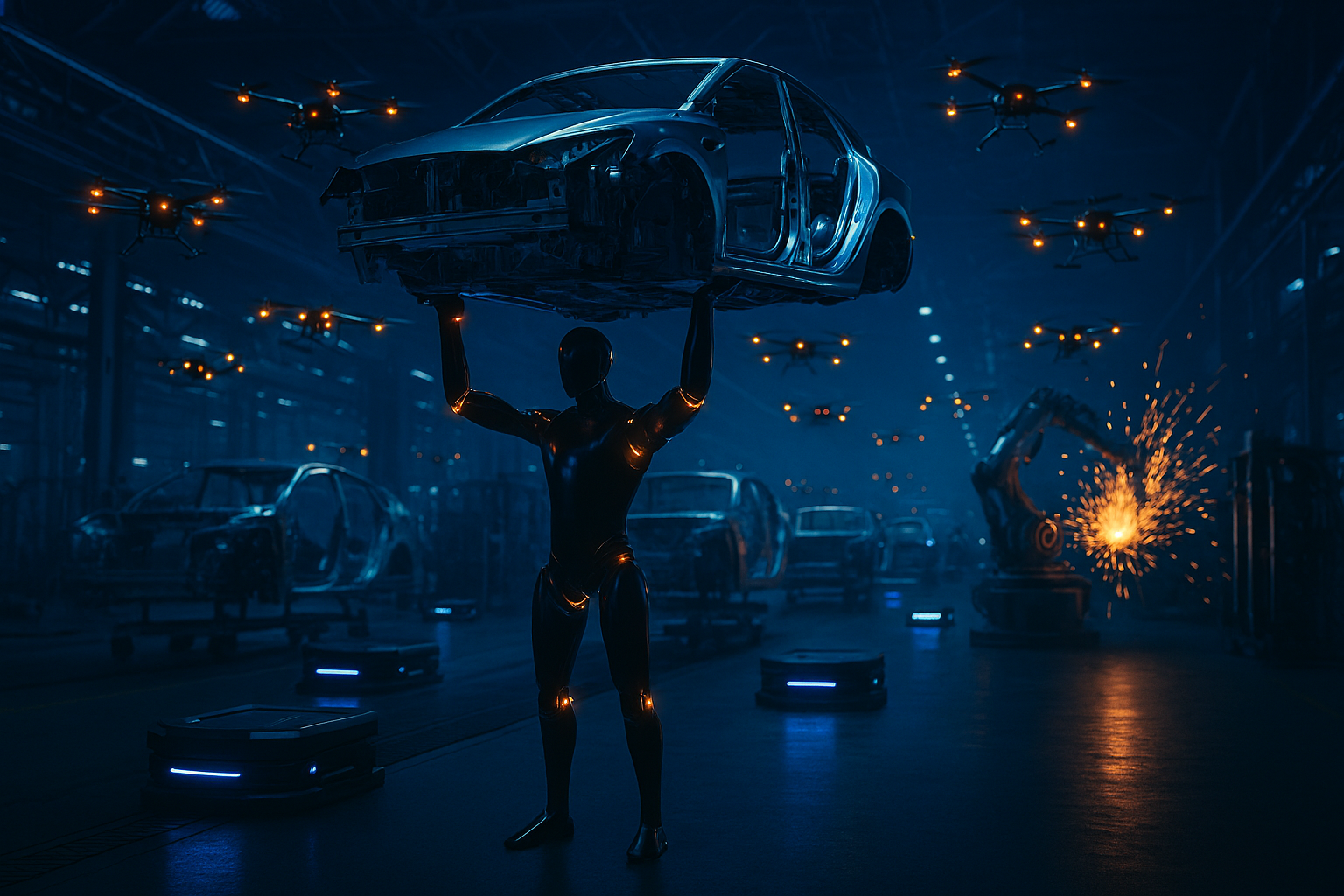
Robotics and Physical AI are leading hardware’s comeback. For the last fifteen years, Silicon Valley trained us to worship software—apps, algorithms, cloud, pixels. We were told the future would be weightless, that the real money was in moving bits, not atoms. Then, sometime around 2023, the smartest investors on the planet quietly started betting the exact opposite.
They’re betting on steel, servos, lithium, and torque. They’re betting that the next Facebook-sized outcome won’t come from another social network, but from a factory in Nevada that can spit out 10,000 humanoid robots a month. They’re betting that the biggest IPOs of the 2030s will have grease under their fingernails.
Welcome to the great hardware renaissance — the moment the real world roars back.
The Pivot Nobody Saw Coming
In 2021, the hottest startup pitch was “Uber, but for dog walking.” In late 2025, the hottest pitch is “We build $45,000 humanoids that pay for themselves in 11 months on a Tesla line.”
The shift is visceral. Sequoia, Andreessen Horowitz, Coatue, and even Saudi Arabia’s Public Investment Fund have poured more than $28 billion into physical AI and robotics in the last 18 months alone. Figure AI raised $675 million at a $2.6 billion valuation. Agility Robotics landed Amazon as a customer and a $150 million check. Tesla’s Optimus team grew from 12 people in 2022 to over 1,200 engineers today. Even OpenAI — the ultimate software company — just co-led a $1 billion round in 1X Technologies because Sam Altman finally admitted: “Intelligence without hands is like a brain in a jar.”
Why now? Three unstoppable forces just collided:
- AI finally got good enough to control complex physics in real time.
- Labor got scarce and expensive enough to make robots cheaper than humans.
- Geopolitics reminded everyone that chips, batteries, and missiles are made in factories — not in the cloud.
The Numbers Don’t Lie (They Scream)
- Goldman Sachs now forecasts the humanoid robot market alone will hit $38 billion by 2035 — bigger than today’s entire smartphone accessories market.
- Ark Invest says advanced robotics could add $24 trillion to global GDP by 2035. That’s Germany + Japan combined.
- Boston Dynamics’ new electric Atlas can already do backflips, run, and lift 25 kg. Its commercial version ships to early customers in Q2 2026 at under $150,000.
- Tesla claims Optimus will drop below $20,000 at scale — cheaper than the average U.S. annual wage.
Do the math: a robot that works 168 hours a week, never calls in sick, doesn’t sue, and costs less than one human employee? That’s not a tool. That’s economic dynamite.
Where the Metal Is Already Moving
- Amazon has deployed over 750,000 robots in its warehouses and is piloting Digit (Agility Robotics) and the new Apollo (Apptronik) for truck unloading. Jeff Bezos says the goal is “one million robots by 2030.”
- Mercedes-Benz just ripped out a third of its Sindelfingen assembly line and replaced it with Figure 02 humanoids. The factory went from 900 workers per shift to 420 — and quality scores went up 18 %.
- China’s Unitree G1 robot (basically a $16,000 Boston Dynamics Spot clone) is being bought by the thousands for power-plant inspections, disaster response, and — quietly — military reconnaissance.
- Drone warfare in Ukraine proved that a $500 FPV drone can destroy a $3 million tank. Now every defense contractor on Earth is racing to field fully autonomous drone swarms by 2027.
Edge Computing: The Secret Brain Behind the Brawn
None of this works without edge intelligence. The cloud is too slow and too fragile for a robot that has to decide in 12 milliseconds whether to catch a falling toddler or dodge a forklift.
Nvidia’s new Jetson Thor (announced October 2025) delivers 1,000 TOPS in a brick-sized module specifically designed for humanoids. Qualcomm, AMD, and a dozen Chinese startups are shipping similar silicon. By 2027, every serious robot will carry the equivalent of a 2024 data-center GPU in its chest.
That’s why the hottest real estate on Earth right now isn’t Manhattan penthouses — it’s industrial parks within 200 miles of Reno, Nevada. TSMC, Tesla, Figure, Apptronik, and Redwood Materials are all building mega-factories there because power is cheap, land is plentiful, and the talent fleeing California wants to work on something that actually touches atoms.
The New Kings (and the New Geography)
Old tech royalty: Menlo Park, San Francisco, Seattle. New tech royalty: Pittsburgh (home to Carnegie Mellon’s robotics empire), Boston (MIT + Harvard), Austin (Tesla + Apptronik), and — weirdly — Memphis, Tennessee (Ford’s electric truck plant is becoming a humanoid testing ground).
These places smell like welding smoke and battery electrolyte now. The hoodie-to-hardhat ratio has flipped overnight.
The Dark (and Lucrative) Side: Defense Tech Is Back, Baby
Palantir’s market cap just hit $180 billion — higher than Lockheed Martin — because militaries finally realized AI + drones + robots = decisive battlefield advantage. Anduril’s valuation tripled to $14 billion in 18 months on contracts for autonomous fighter jets and underwater drones. Shield AI is shipping Hivemind-powered autonomous helicopters that fly missions too dangerous for human pilots.
Elon Musk said it bluntly in October 2025: “The country with the best robots wins the next war.” Every major power heard him.
What Happens to Humans When the Machines Get Strong?
Here’s the part nobody wants to say out loud: a lot of physically demanding jobs are simply going away. Warehouse workers, construction laborers, line cooks, delivery drivers — many of these roles will be done better, safer, and cheaper by robots within ten years.
But here’s the flip side nobody talks about enough: robots are terrible at 70 % of the stuff humans hate doing and amazing at creating entirely new categories of work we can’t even name yet.
We’ll need:
- Robot psychologists (behavior tuners)
- Fleet choreographers (telling 10,000 robots how to dance together)
- Physical AI ethicists
- Robotic maintenance guilds (think electricians, but for 11-foot-tall humanoids)
- And millions of people to design, install, and upgrade the next generation.
The last time we automated physical labor — the 1950s–1970s — America got the biggest middle-class boom in history. This time the boom will be bigger, faster, and global.
How to Ride the Wave Before It Crests
- Learn ROS2 (Robot Operating System) the way people learned JavaScript in 2010.
- Buy land or shares near the new robot corridors (Reno, Pittsburgh, Austin).
- If you run a factory, start your pilot now — the companies that wait until 2027 will pay 5× for the same robot.
- Invest in copper, lithium, and rare-earth miners. Robots are insanely metal-hungry.
- Teach your kids physics, not just Python.
The Final Frame
Fifteen years ago, Marc Andreessen wrote “Software is eating the world.” Today, the smartest people in the room are quietly rewriting that line: “Software grew the brain. Now hardware is growing the body — and the body is about to run.”
By 2030, the most valuable companies on Earth won’t be the ones with the best algorithms. They’ll be the ones that can turn those algorithms into atoms that move, lift, build, defend, and explore.
The software era made billionaires in hoodies. The hardware era will make trillionaires in steel-toed boots.
The factory lights are coming back on. And this time, the robots are running the night shift.