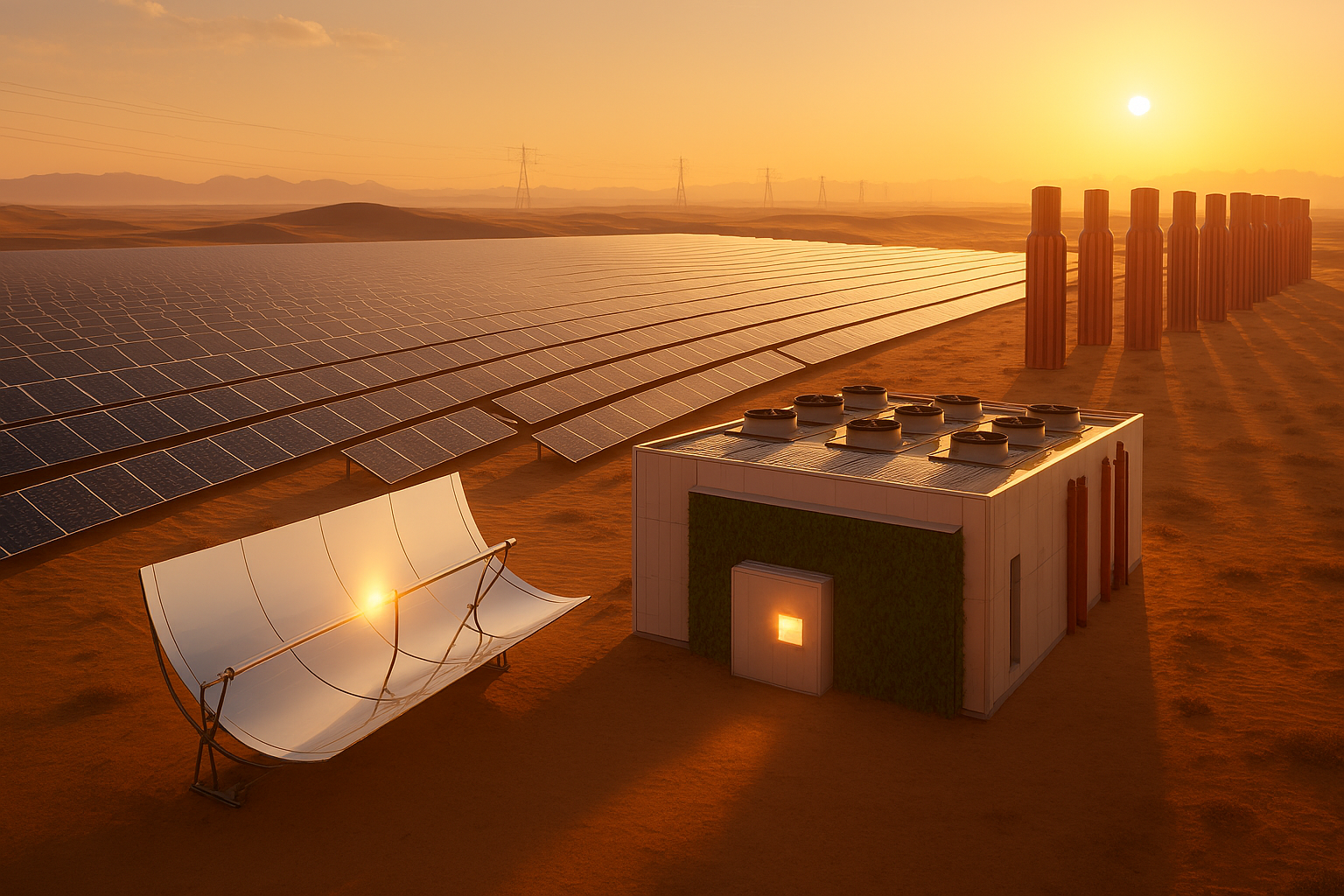
Green Tech is becoming more critical than ever. For years, the dirty little secret of the AI revolution was this: every time you asked a chatbot for a poem about cats, a coal plant somewhere coughed harder.
Training a single large language model in 2023–2024 consumed as much electricity as 15,000 American households do in a year. Data centers already eat 3–4% of global electricity, and that number is on pace to hit 10% by 2030 if nothing changes. Meanwhile, Bitcoin mining, AI training, and electric-vehicle charging are all screaming for more gigawatts at exactly the moment the world is trying to shut down fossil plants.
But something remarkable is happening right now, in late 2025: the energy problem and the climate solution are becoming the same thing.
A new generation of scientists, engineers, and improbably profitable startups have stopped apologizing for AI’s thirst and started building an entirely new, greener, and frankly more abundant energy stack from the ground up. The result? We are on the verge of the biggest positive surprise in climate history: a future where artificial intelligence doesn’t cook the planet — it helps cool it.
The Perfect Storm That Forced Innovation
Three things happened at once:
- AI power demand exploded faster than anyone modeled. Microsoft, Google, and Meta alone signed contracts for more than 30 GW of new power — equivalent to the entire grid of Sweden.
- Permitting new natural-gas plants in the U.S. and Europe became politically impossible.
- Battery, solar, and grid tech finally crossed the cost cliff where they beat fossil fuels on pure economics — no subsidies required.
The result is the largest peacetime build-out of energy infrastructure since the 1950s, and this time it’s green from the first shovel.
The New Holy Trinity of Green Tech
- Next-Gen Solar That Actually Works 24/7 Perovskite-silicon tandem cells (Oxford PV, Swift Solar, Trina) are shipping at 31–34 % real-world efficiency in 2025, versus 22 % for the best traditional panels five years ago. That single jump is the equivalent of giving every rooftop 50 % more free real estate. Meanwhile, companies like Aeromine (rooftop wind turbines with no blades) and Ubiquitous Energy (transparent solar windows) are turning every surface into a power plant.
- Batteries That Don’t Need Lithium Form Energy’s iron-air batteries store power for 100 hours at one-tenth the cost of lithium. They’re literally rusting and un-rusting iron in giant shipping containers outside Boston right now. Sodium-ion (Northvolt, CATL, HiNa), flow batteries (Redflow, ESS Tech), and sand batteries (Polar Night Energy in Finland) are all scaling past the pilot stage in 2025–2026. The killer app? These cheap, long-duration batteries turn intermittent renewables into baseload power — the holy grail that coal and nuclear used to own.
- AI-Specific Green Infrastructure Microsoft just signed a deal to build a 1 GW data center in Wisconsin entirely powered by a new 837 MW solar farm plus 400 MWh of iron-air storage. Google’s new “Project Sunroof 2.0” uses AI to design micro-grids that match hyperscale compute loads to local renewable production down to the minute. Crusoe Energy is taking stranded natural-gas wells in Wyoming, flaring the methane through turbines, capturing the CO₂, and running AI training on-site — cutting emissions 63 % versus grid power while making money on wasted gas nobody wanted.
The Places Where the Future Is Already Running
- Morocco now exports solar power to the UK through a 3.6 GW undersea cable. By 2027, the same desert will host a 5 GW AI compute campus for European customers who want carbon-negative inference.
- Denmark’s Energy Islands — artificial islands ringed with 10 GW of offshore wind — will be the primary power source for Meta’s and Apple’s European AI clusters.
- Chile’s Atacama Desert is becoming the new Saudi Arabia of clean energy. Antofagasta Minerals is selling renewable electrons to Amazon and Google for less than 1.8 ¢/kWh — cheaper than any coal plant on Earth.
The Surprise Winner: Geothermal 2.0
While everyone argued about nuclear, a quiet revolution happened underground. Companies like Fervo Energy and Sage Geosystems are using fracking technology — yes, the same tech oil companies perfected — to drill deep, hot rocks and pump water through them. Result: 24/7 carbon-free power anywhere on the planet with a drill rig. Fervo’s Project Red in Nevada delivered 400 °C steam in July 2025 and is on track for 5 GW of signed AI data-center contracts by 2028. Google and Nvidia are both investors.
How Cheap Clean Energy Unlocks Everything Else
Once electricity drops below 2 ¢/kWh at scale (and it will by 2028 in sunny/windy places), entire new industries become profitable overnight:
- Direct-air carbon capture finally makes sense (Climeworks and Carbon Engineering are already signing 10-year offtake deals with Microsoft).
- Green hydrogen for steel, shipping, and aviation becomes cheaper than fossil versions.
- Desalination plants can run flat-out, ending water wars in the Middle East and Southwest U.S.
- Bitcoin miners switch to 100 % clean power and become the shock absorbers of the grid — soaking up excess solar at noon and selling it back at night.
The Human Stories Nobody Expected
In Lubbock, Texas, former oil roughnecks now make $110k/year operating solar farms and flow-battery sites — same hard hats, better sunsets. In Kenya, off-grid solar-plus-battery microgrids power AI literacy schools in villages that never had reliable electricity. In Sweden, the old Vattenfall coal mine outside Stockholm is being flooded to create a giant underground thermal battery that will heat the city with stored summer sun.
The Investment Tsunami
The numbers are almost ridiculous:
- Global clean-energy investment hit $2.2 trillion in 2025 — more than oil and gas for the first time ever.
- BlackRock’s new “Energy Transition” ETF became the fastest fund to $100 billion in history.
- Even oil majors are pivoting: Exxon’s $12 billion acquisition of battery-material companies in 2025 shocked Wall Street.
What Still Scares People (and Why They’re Wrong)
Myth 1: “Renewables take too much land.” Reality: Covering 0.4 % of the Sahara with today’s panels would power the entire world. Agrivoltaics (sheep grazing under solar panels) actually increases farmland productivity.
Myth 2: “Batteries need rare metals we’ll run out of.” Reality: Sodium, iron, and zinc are literally the most common metals in the Earth’s crust. We’re switching to them faster than anyone predicted.
Myth 3: “The grid can’t handle it.” Reality: Smart inverters, AI demand-response, and vehicle-to-grid tech turn millions of EVs into a distributed battery bigger than all pumped hydro combined.
How to Position Yourself Before the Boom Peaks
- Buy boring: transmission companies, copper miners, and transformer manufacturers are the new oil stocks.
- Learn energy modeling the way people learned Excel in the 90s.
- If you’re a founder, build anything that turns wasted heat or excess renewable power into money.
- Move to (or invest in) sunny, windy, geologically boring places — Arizona, West Texas, coastal Chile, western Australia. That’s where the new Silicon Valleys of energy will rise.
The Final Picture
Ten years ago, climate tech was charity with bad economics. Today, in late 2025, it’s the most profitable megatrend on the planet — and the only one that actually fixes the problem it profits from.
We are living through the moment when humanity stops fighting over the last barrels of oil and starts racing to capture the next terawatt of sunlight.
The age of scarcity is ending. The age of green abundance is loading.
And for the first time in a long time, the machines aren’t just getting smarter — they’re helping us keep the planet livable while they do it.