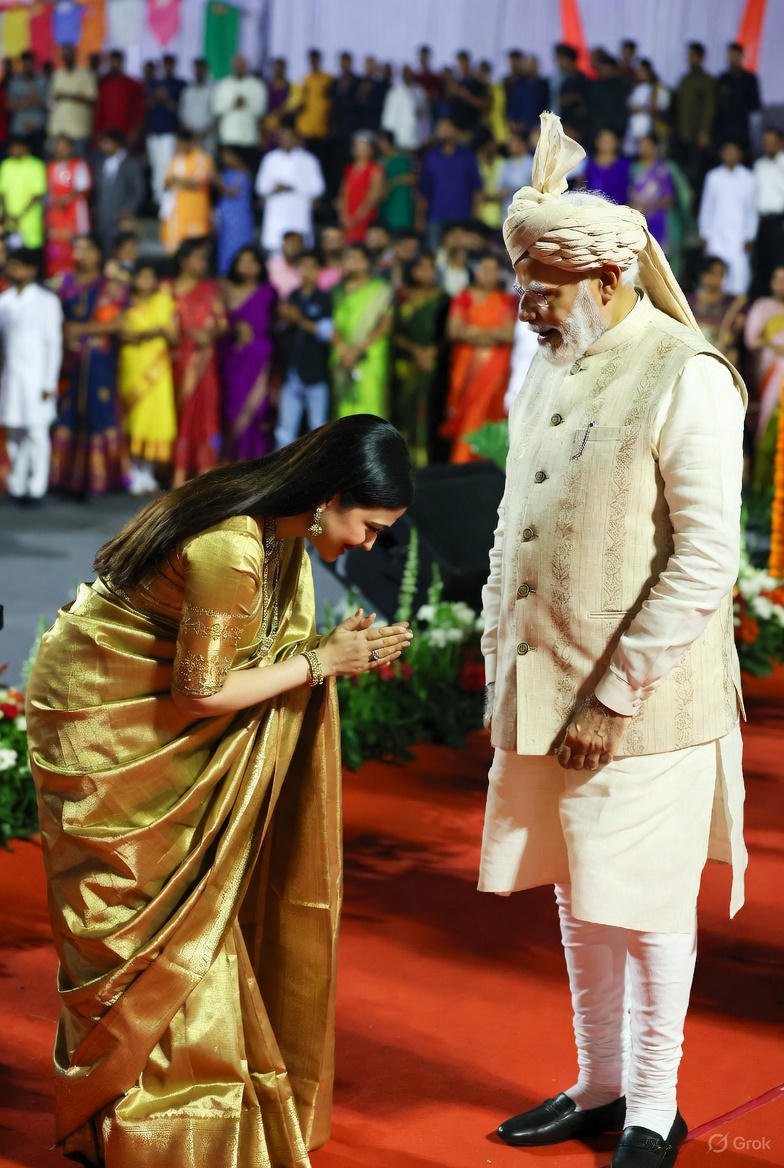
In a moment that blended Bollywood glamour with profound spiritual humility, Sri Aishwarya Rai Bachchan left an indelible mark at the grand centenary celebrations of the revered spiritual leader Sri Sathya Sai Baba. Held on November 19, 2025, in the sacred town of Puttaparthi, Andhra Pradesh, the event drew thousands of devotees, dignitaries, and celebrities to honor the birth of the iconic figure who touched millions through his teachings of love, service, and unity. But it was Aishwarya’s poignant speech—delivered with the poise of a global icon and the sincerity of a lifelong devotee—that stole the spotlight, followed by her touching gesture of seeking blessings from Prime Minister Narendra Modi by touching his feet. This act, captured in viral videos and photos, resonated deeply in a world often divided, reminding us of the enduring power of sanskar, or cultural values, in modern life.
The centenary was no ordinary commemoration. Sri Sathya Sai Baba, born on November 23, 1926, in Puttaparthi, emerged as a beacon of hope in post-independence India. From a young age, he exhibited miraculous abilities and a profound wisdom that attracted followers from all walks of life. His philosophy, encapsulated in the simple yet revolutionary mantra “Love All, Serve All,” transcended religious boundaries, emphasizing human values like truth (Sathya), righteousness (Dharma), peace (Shanti), love (Prema), and non-violence (Ahimsa). Over his lifetime, Baba established a vast network of educational institutions, hospitals, and water projects that served the underprivileged without discrimination. The Sri Sathya Sai Central Trust, under his guidance, continues this legacy, funding initiatives that have transformed rural India. The centenary, spanning several days, featured bhajans, cultural performances, and discourses, culminating in a high-profile gathering where leaders and artists paid homage to his eternal message.
Amid this sea of saffron robes and chanting voices, Sri Aishwarya Rai Bachchan arrived like a vision from the silver screen. Draped in a luxurious golden saree embroidered with intricate zari work that caught the morning light, she embodied elegance rooted in tradition. Her presence wasn’t mere celebrity endorsement; it was personal. Aishwarya, often hailed as the “Queen of Bollywood” for her roles in films like Devdas, Jodhaa Akbar, and the epic Ponniyin Selvan series, has long been connected to Sai Baba’s teachings. As a child in Mangalore, she participated in the Bal Vikas program—a youth initiative by the Sai Trust that instills moral education through stories from ancient scriptures. “Once a Bal Vikas student, always a Bal Vikas student,” she would later quip in her speech, a line that endeared her further to the audience.
The stage, a colossal mandapam overlooking the verdant hills of Puttaparthi, buzzed with anticipation. Seated alongside heavyweights like Andhra Pradesh Chief Minister N. Chandrababu Naidu, his deputy Pawan Kalyan—a Tollywood star turned politician—and cricket legend Sachin Tendulkar, Aishwarya waited her turn. The air was thick with the fragrance of jasmine garlands and the rhythmic beats of traditional drums. When her name was announced, she ascended the steps with measured grace, microphone in hand, her eyes reflecting a mix of nervousness and resolve. What followed was not a scripted monologue but a heartfelt outpouring that wove personal anecdotes with universal truths, clocking over ten minutes and leaving the crowd in rapt silence.
Sri Aishwarya began by invoking the divine aura of the occasion. “On this historic and sacred day marking the centenary of Bhagawan Sri Sathya Sai Baba,” she said, her voice steady yet laced with emotion, “my heart overflows with devotion and profound gratitude.” She painted a vivid picture of Baba’s enduring legacy: how, even a hundred years after his birth, his principles pulsed through the veins of humanity like an unbreakable thread. “His presence, his guidance, his boundless compassion—they echo in the souls of millions across the globe,” she continued. Turning to the Prime Minister, she extended a warm acknowledgment: “I offer my deepest thanks to our Honorable Prime Minister Narendra Modi ji for gracing us today. Your words, always so wise and motivating, promise to inspire us once more. Being here elevates this celebration, echoing Swami’s wisdom that leadership is but selfless service, and serving humanity is serving the divine.”
As she delved deeper, Aishwarya shared glimpses of her formative years. The Bal Vikas classes, she recalled, were more than lessons; they were lifelines. Held in modest community halls, these sessions taught children to navigate life’s complexities through the lens of Sanathana Dharma—the eternal way of righteous living. Stories of Lord Rama’s valor or Krishna’s compassion weren’t just tales; they were blueprints for character-building. “Those early mornings of prayer and play shaped me,” she admitted, her smile nostalgic. “They taught me that spirituality isn’t confined to temples but lived in every act of kindness.”
The heart of her address, however, lay in dismantling divisions that plague society. In a bold yet gentle stroke, Aishwarya declared, “There exists but one true caste: the caste of humanity itself. One religion alone: the religion of pure love. One language that binds us: the language of the heart. And one God, omnipresent, watching over all.” These words, drawn straight from Sai Baba’s sermons, landed like a clarion call. In an era of caste-based politics and religious strife, her message was a salve—a reminder that unity isn’t a lofty ideal but a daily practice. She elaborated on Baba’s “Five Ds,” qualities he championed for a fulfilling life: Discipline to anchor one’s routines, Dedication to pursuits of good, Devotion to the higher power, Determination to overcome obstacles, and Discrimination to choose wisely between right and wrong. “These aren’t abstract virtues,” she emphasized. “They are tools Swami gifted us to forge a world of harmony.”
Her speech wasn’t without contemporary relevance. Aishwarya subtly nodded to India’s evolving landscape under leaders like Modi, whose initiatives like Swachh Bharat and Ayushman Bharat mirror Sai Baba’s service ethos. “In our Prime Minister’s vision for a Viksit Bharat—a developed India—we see echoes of Swami’s dream: education for all, health for the needy, water for the parched,” she noted. This bridge between spiritual heritage and national progress elicited nods from the dais, particularly from Naidu, known for his tech-driven governance in Andhra.
As applause thundered—devotees rising in unison, some with tears glistening—Aishwarya descended the stage. But the moment that would etch itself into collective memory came next. Approaching PM Modi, who sat composed in his signature kurta, she paused briefly, then bent low in the traditional pranam. Her fingers lightly touched his feet, a gesture of profound respect in Indian culture, symbolizing the surrender of ego to wisdom. Modi, ever the statesman, placed a gentle hand on her shoulder, offering blessings with a paternal smile. The exchange, brief yet electric, was captured from multiple angles: her dupatta trailing like a golden river, the PM’s eyes twinkling with approval. In that instant, Aishwarya wasn’t the Miss World of 1994 or the Cannes darling; she was every daughter of Bharat, honoring a father figure.
The gesture sparked an online frenzy. Social media erupted with hashtags like #AishwaryaSanskar and #SaiCentenaryMagic. Fans, cutting across generations, hailed her as “the picture of sanskar”—a term evoking ingrained cultural refinement. One viral tweet read, “In a time when humility is rare, Sri Aishwarya reminds us: true stars bow to greater lights. Touching PM Modi’s feet? Pure grace.” Another user, a young professional from Mumbai, shared, “Her speech on one caste, one love—it’s the TED Talk India needed. And that pranam? Tissues for everyone.” Bollywood peers chimed in too; Rekha, her mentor from Umrao Jaan, posted a heart emoji with “Timeless devotion,” while Riteish Deshmukh quipped, “Aishwarya ji: Making reverence look effortless since ’94.”
Critics, however, were quick to contextualize. Some pointed out the optics— a high-profile actress aligning with political figures—but most saw it as authentic. After all, Aishwarya’s public life has been a tapestry of philanthropy: from her work with the Eye Bank Association to UN ambassadorships on child rights. Her involvement with Sai institutions dates back decades, including inaugurating schools in his name. This wasn’t performative; it was personal.
PM Modi’s own address later that morning amplified the theme. Speaking in his measured baritone, he lauded Sai Baba as “a karmayogi whose life was a sermon.” He recounted how Baba’s water projects quenched the thirst of Anantapur district, drawing parallels to his own Jal Jeevan Mission. “Swami taught us Seva is Dharma,” Modi said, “and today, in his centenary, we pledge to carry that forward.” His words, interspersed with anecdotes of meeting Baba in the 1990s, wove a narrative of continuity—from the seer’s era to modern India’s ascent.
Sachin Tendulkar, another highlight, shared how Sai Baba’s emphasis on focus mirrored a cricketer’s mindset. “Discipline and devotion—those Ds Aishwarya mentioned? They’re why I faced 200 Tests,” he joked, lightening the mood. Pawan Kalyan, with his actor-politician duality, spoke of youth empowerment, echoing Aishwarya’s Bal Vikas nod.
Beyond the stars, the event’s true pulse lay in the masses. Pilgrims from Kerala to Kashmir, many in simple veshtis, shared testimonies: a farmer crediting Sai’s free hospitals for his family’s survival, a teacher attributing her school’s ethos to his books. The celebrations included a massive yagna, where 100,008 lamps were lit, symbolizing enlightened souls. Cultural troupes from across India performed fusion dances blending Bharatanatyam with folk beats, all under the watchful statue of Baba, his iconic afro-hair a silhouette against the sun.
For Sri Aishwarya, this was more than an appearance; it was a homecoming. In interviews post-event, she reflected, “Swami’s message isn’t frozen in time—it’s alive in acts like today’s.” Her family—husband Abhishek Bachchan and daughter Aaradhya—watched from afar, proud of her balance of reel and real. As whispers of her next project swirl (rumors point to a spiritual biopic), this moment cements her as a cultural custodian.
In retrospect, the Puttaparthi gathering was a microcosm of India: diverse, devout, dynamic. Sri Aishwarya’s speech and gesture bridged the chasm between fame and faith, urging us toward Baba’s vision of “one family under God.” As the sun set over Prasanthi Nilayam—the abode of supreme peace—the echoes lingered: one caste, one love. In a fractured world, such reminders are gold.