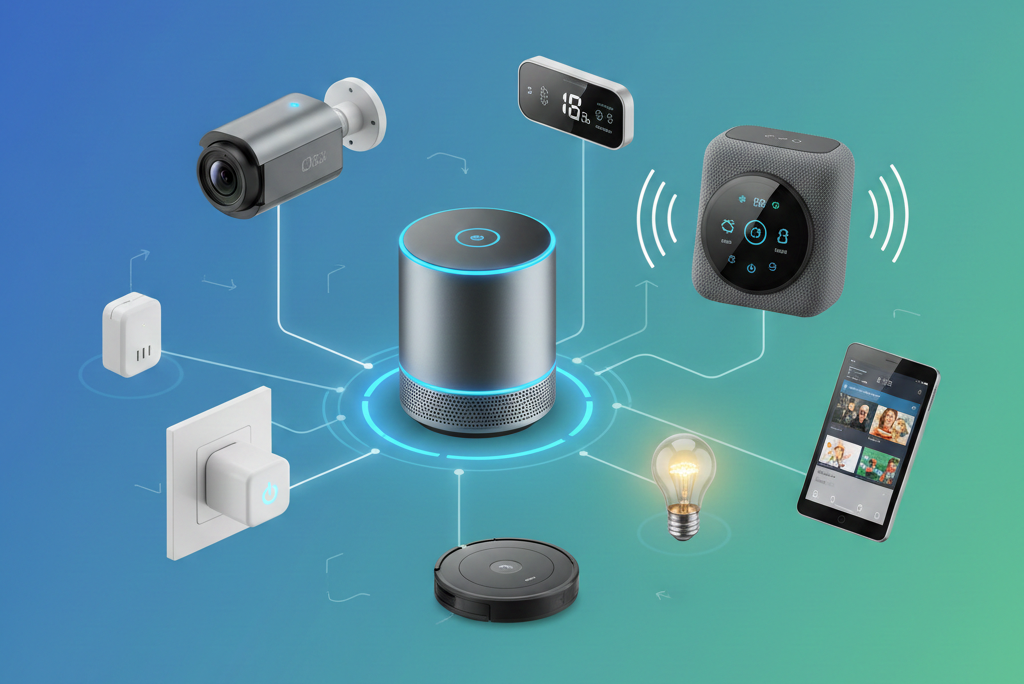
The race to make everyday living more convenient, efficient and — crucially — safer took a big step forward this month as major standards groups, retailers and device makers unveiled updates that promise simpler setup, broader compatibility and more local intelligence inside home gadgets. From Matter’s long-awaited camera support to upgrades in Zigbee and a fresh push for “zero-trust” security practices for home networks, 2025 is shaping up to be the year smart homes move from fiddly hobbyist projects into mainstream household infrastructure.
Matter 1.5: cameras, closures and smarter energy controls
The biggest headline comes from the Connectivity Standards Alliance — the steward of Matter — which released Matter 1.5, an update that expands what “universal” smart home interoperability can actually cover. For the first time the standard includes native support for security cameras, more precise controls for doors and windows (so-called “closures”), and new hooks for energy and water management that can make HVAC systems and EV chargers more responsive to changing electricity tariffs and utility signals. For users that have been waiting for a single, reliable way to mix and match devices without juggling vendor apps, this is a major step.
Manufacturers and platform players are already moving. Media reports and vendor announcements indicate Matter-compatible cameras will hit the market in the coming months, and some companies are promising firmware updates to widen the range of Matter device types they support. That momentum will make it easier to build systems where your doorbell, your Nest or HomePod, and a third-party security camera all cooperate without fragile integrations.
Wireless standards evolve: Zigbee 4.0 and the war for simple pairing
While Matter aims to be the common language between ecosystems, the underlying wireless standards that devices use are also evolving. Zigbee — a long-standing mesh protocol used by many lights, sensors and hubs — announced major improvements with Zigbee 4.0, including better security, longer battery life through smarter scheduling, and a simplified setup flow that lets phones commission devices directly over Bluetooth (a feature now increasingly common across standards). This helps older ecosystems stay relevant even as Thread, Wi-Fi and Matter gain traction.
For consumers, the practical outcome is fewer hubs and fewer moments of “why won’t this light talk to that switch?” — at least when vendors ship devices that take advantage of the new features. Backward compatibility is being emphasized, so a lot of existing hardware will still work, but buying devices certified to the newest revisions will reduce hassle over time.
AI goes local: edge processing reshapes privacy and latency
If the past decade was about putting sensors in everything, the next phase is about where that sensor data is processed. Cloud-based voice and vision processing powered many early smart home experiences, but consumers and companies are increasingly favoring edge AI — models and logic that run on local devices — because it reduces latency, cuts cloud costs and limits how much raw personal data leaves the home. Edge AI enables cameras to classify motion, thermostats to make split-second decisions, and voice assistants to act without a round trip to a distant server. Analysts project rapid growth in AI for smart home applications as more capable chips and leaner models arrive.
That shift is also a privacy win: local processing means less continuous streaming of private audio and video to remote servers, and it lets devices behave sensibly even when the internet is spotty. Expect major smart speaker and camera makers to advertise “on-device intelligence” as a headline feature going forward.
Energy, water and the home as a flexible grid asset
Beyond convenience, smart home solutions are increasingly positioned as tools for sustainability and grid efficiency. Matter 1.5’s new energy management features and vendor roadmaps that integrate dynamic tariff management promise homes that automatically shift HVAC, EV charging and other heavy loads to cheaper or greener windows of time. This not only lowers bills for consumers but also helps utilities balance demand — an outcome companies and regulators are eager to encourage. Soil sensors and smarter irrigation add water savings to the list.
Retailers and large manufacturers are taking note. Big box chains and furniture brands are releasing product lines that are Matter-compatible from the outset so consumers can add cost-saving devices without a technical degree. The business case is clear: smarter homes can be marketed as lower-running-cost homes.
Security finally gets the attention it deserves
With more devices in homes, security has become a frontline concern. Cybersecurity experts and industry reports are pushing “zero-trust” principles into the residential space: treat every device and every access attempt as potentially hostile unless explicitly verified. That means segmenting smart home networks, using strong credentials and certificates, applying regular firmware updates, and favoring local authentication where possible. Practical guidance for consumers includes putting IoT devices on separate Wi-Fi networks, using unique passwords, and buying from vendors with a clear security policy.
Product makers are responding with hardware-level improvements, better update channels, and clearer labeling of security features. The hope is to move the conversation from “which gadget has the neatest trick” to “which gadget will not turn my home into an entry point for attackers.”
Retail and ecosystem moves: IKEA, Aqara and the democratization of smart homes
The smart home market is no longer only for early adopters. IKEA’s recent launch of a 21-product Matter-compatible range is a sign that affordable, design-first smart devices are becoming standard retail fare — lighting, sensors and simple controllers that fit into everyday interiors. At the same time, specialty manufacturers like Aqara are expanding Matter support across dozens of device types and offering bridging strategies that preserve advanced features while opening interoperability to broader platforms. Those complementary approaches — big retailers offering easy entry points and specialist vendors offering depth — are crucial to mass adoption.
For homeowners, that translates to more affordable entry points and fewer dead ends when trying to add a new sensor or switch to an existing setup. The familiar furniture aisle is becoming a smart device aisle, and that shift will normalize connected home technology for a much wider audience.
The new installation math: fewer apps, more reliable hubs
A persistent user complaint has been the fragmentation of control apps — a different app for each brand or product type. The interplay of Matter, improved Zigbee flows and more capable hub hardware is simplifying the picture. Centralized controller apps (or a single voice assistant) will continue to be the dominant user interface for now, but installation experiences will look smoother: batch commissioning, direct phone pairing and more plug-and-play devices are replacing cliff-edge setup failures. Industry surveys find a strong consumer preference for single-app control and central hubs, which is influencing where vendors invest their R&D dollars.
Installer businesses and prosumer communities will still be important — for whole-home automation, security system integration or complex energy setups — but average users should find day-to-day configuration less painful.
What to buy and what to wait for
If you’re shopping now, prioritize devices that:
- Support Matter (or have a clear upgrade path).
- Offer on-device (edge) intelligence for privacy-sensitive tasks.
- Come from vendors with a public security policy and regular firmware updates.
If your home already has a sprawling collection of smart gadgets, focus on consolidating control behind a Matter-capable hub or a single voice assistant, and segment the network to isolate legacy IoT devices from critical computers and phones. That small step dramatically reduces attack surface and simplifies troubleshooting.
The outlook: a pragmatic, interoperable smart home
2025’s developments point toward a practical phase in the smart home story. Interoperability efforts (Matter) plus incremental improvements to established stacks (Zigbee) and the arrival of capable local intelligence (edge AI) combine to make smart homes more useful, less fragile, and—if consumers follow recommended security practices—safer. Retailers are packaging these technologies for mainstream buyers, and utilities are beginning to treat homes as flexible assets that can participate in demand-side programs. The technology is maturing; the challenge now is to make the user experience and security baseline match that maturity.