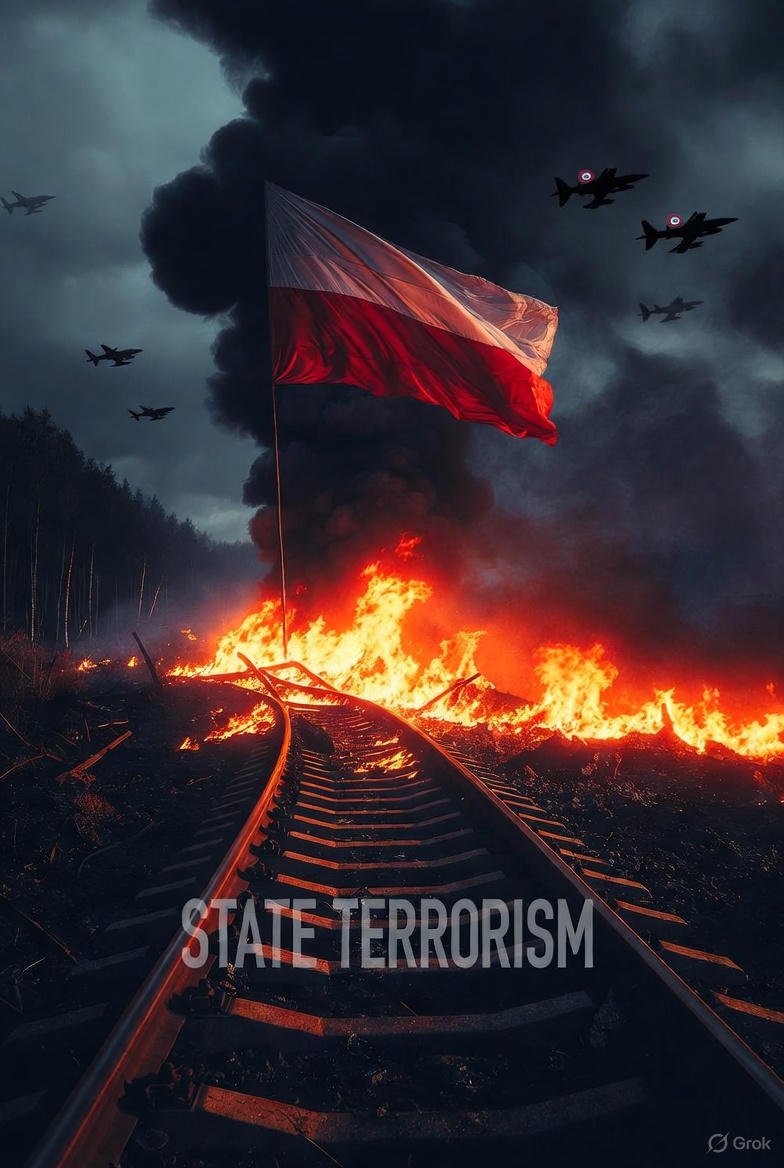
Warsaw, Poland – November 22, 2025 – In the shadow of Europe’s ongoing geopolitical storm, Poland stands at the epicenter of a fresh crisis that has sent shockwaves through the continent. A devastating explosion on a critical railway line in eastern Poland over the weekend has not only disrupted vital supply routes to war-torn Ukraine but has also ignited accusations of outright “state terrorism” leveled directly at Russia. Polish leaders, from Prime Minister Donald Tusk to Foreign Minister Radosław Sikorski, have pulled no punches, framing the incident as a deliberate escalation in Moscow’s hybrid warfare tactics. With NATO allies scrambling to assess the fallout, Poland’s resolve is hardening, promising a response that could redefine the alliance’s eastern flank.
The blast occurred late on November 16, 2025, near the town of Małaszewicze, a key border hub where Polish rails connect seamlessly to Ukraine’s beleaguered infrastructure. This line isn’t just any stretch of track—it’s a lifeline, ferrying everything from humanitarian aid to military hardware that has kept Kyiv’s defenses afloat amid Russia’s grinding invasion. Eyewitnesses described a thunderous detonation that lit up the night sky, followed by the screech of derailing freight cars and acrid smoke billowing across the fields. Miraculously, no lives were lost, but the damage was severe: twisted metal, cratered earth, and a severed connection that halted dozens of trains bound for the front lines. Polish investigators quickly zeroed in on the cause—an improvised explosive device, sophisticated enough to suggest professional orchestration.
What elevated this from mere sabotage to an international flashpoint was Poland’s unyielding attribution to the Kremlin. In a blistering address to the Sejm, Poland’s parliament, on November 20, Foreign Minister Sikorski didn’t mince words. “This time it was not just an act of sabotage as before, but an act of state terror with the clear intention of causing casualties,” he declared, his voice echoing through the chamber like a war drum. Sikorski, a veteran diplomat with a reputation for sharp rhetoric, went further, announcing the immediate closure of Russia’s last remaining consulate in Kraków. “When the purpose of espionage and sabotage activities is to cause casualties, we are no longer dealing with sabotage, but with state terror,” he added, vowing that Poland’s retaliation would extend “more than just diplomatically.”
Prime Minister Tusk echoed this fury just days later, on November 21, labeling the attack “an unprecedented act of sabotage” orchestrated by Russian intelligence services. In a televised statement from Warsaw, Tusk painted a grim picture of Moscow’s intentions: to “destroy human life and destabilize the foundations of the Polish state.” Under his centrist government, which took power in late 2023 after ousting the populist Law and Justice party, Poland has positioned itself as Europe’s staunchest Ukraine supporter. Billions in aid, hosting over a million Ukrainian refugees, and relentless calls for tougher EU sanctions—Poland’s commitment has made it a thorn in Russia’s side. But this incident, Tusk warned, crosses a red line, transforming covert meddling into overt aggression.
The suspects in the plot read like a spy thriller gone wrong: two Ukrainian nationals, long embedded in Poland’s migrant communities, allegedly recruited by Russia’s Federal Security Service (FSB). According to prosecutors, the pair had been collaborating with Moscow for months, planting the device under cover of night before fleeing across the border into Belarus—a Russian satellite state that has become a notorious conduit for such operations. Polish border guards reported the men’s hasty exit hours after the blast, their vehicle loaded with tools and electronics that forensics teams now link to the explosive’s timer. Warrants have been issued, but with Belarus’s Lukashenko regime offering safe harbor, extradition seems a pipe dream. “These weren’t lone wolves; they were Kremlin proxies,” said a senior Polish intelligence official, speaking anonymously to reporters. “The fingerprints of state sponsorship are everywhere—from the explosive’s military-grade components to encrypted communications traced back to Russian servers.”
As dawn broke on the investigation, Poland’s military swung into high gear. Fighter jets from the Polish Air Force’s 22nd Tactical Aviation Base roared into the skies over the eastern border, a precautionary scramble that NATO’s integrated air defense command in Uedem, Germany, quickly synchronized. “We are on heightened alert,” confirmed a NATO spokesperson in Brussels, underscoring the alliance’s collective defense clause—Article 5—that treats an attack on one member as an assault on all. While no formal invocation has been made, the rhetoric from Warsaw has allies on edge. U.S. Secretary of State Antony Blinken, in a hurried call with Tusk, pledged “unwavering support,” while German Chancellor Olaf Scholz urged de-escalation but quietly boosted troop rotations along the Oder River.
Poland’s vulnerability to such strikes isn’t new; it’s a pattern etched into the nation’s recent history. Since Russia’s full-scale invasion of Ukraine in February 2022, Warsaw has weathered a barrage of hybrid threats: arson at power grids, cyberattacks on state media, and even GPS jamming that grounded flights near the border. A similar rail sabotage in April 2024 near the same Małaszewicze junction delayed Ukrainian arms shipments for weeks, prompting Sikorski to quip at the time that “Russia’s favorite hobby is blowing up our trains.” But experts argue this latest blast marks a lethal upgrade. “Previous incidents aimed to disrupt; this one sought to kill,” notes Dr. Anna Visvizi, a security analyst at the Warsaw-based Visegrad Group think tank. “By targeting a passenger-freight hybrid line at peak hours, Moscow signaled it’s willing to gamble on civilian blood to deter Poland’s Ukraine aid.”
Delving deeper into the geopolitical undercurrents, one can’t ignore Poland’s outsized role in the broader European security architecture. As NATO’s eastern bulwark, the country hosts over 10,000 U.S. troops at bases like Redzikowo, a missile defense site that’s long irked the Kremlin. Poland’s defense spending, hovering at 4.1% of GDP—the highest in the alliance—has fueled a modernization frenzy: F-35 stealth fighters, Abrams tanks, and HIMARS rocket systems now dot its landscape. Yet, this militarization has a human cost. In rural Podlachia, where the blast occurred, farmers and railway workers live with the constant hum of patrols and the shadow of invasion fears. “We thought the war was next door, not in our backyard,” lamented Jan Kowalski, a 58-year-old engineer who helped clear the wreckage. “Now, every rumble feels like the end.”
International reactions have poured in, a mix of solidarity and caution. Ukraine’s President Volodymyr Zelenskyy, from his bunker in Kyiv, hailed Poland as “Europe’s shield,” promising joint intelligence sharing to unmask more Russian agents. The European Union, led by Ursula von der Leyen, convened an emergency foreign ministers’ meeting in Brussels, where sanctions on Belarusian rail officials were floated as a pressure tactic. Britain and France, NATO’s other heavyweights, dispatched liaison officers to Warsaw, while Turkey—ever the alliance’s wildcard—offered mediation, citing its Black Sea grain deal brokering as proof of neutral bona fides. Russia, predictably, denied everything. Kremlin spokesman Dmitry Peskov dismissed the accusations as “Russophobic hysteria,” accusing Poland of staging the blast to justify more arms to “neo-Nazis” in Kyiv—a tired trope that’s lost none of its venom.
Yet, beneath the bluster lies a chilling strategic calculus. Analysts in Warsaw’s chancelleries whisper that this rail blast is no isolated spasm but part of a “gray zone” campaign to erode NATO cohesion. With U.S. elections looming in 2026 and fatigue setting in over Ukraine aid, Moscow might be testing resolve—poking the bear to see if it bites back weakly. “Poland’s accusation of state terrorism forces the West’s hand,” says Jakub Wiśniewski, a former Polish defense attaché now at the Atlantic Council in Washington. “If we treat this as business as usual, we invite more. But overreaction risks wider war.” Indeed, simulations run by NATO’s Joint Warfare Centre in Stavanger, Norway, earlier this year warned of exactly this: a sabotage spiral that spirals into skirmishes, drawing in Belarus and even Kaliningrad’s exclave.
For everyday Poles, the incident stirs a potent brew of defiance and dread. In Kraków, protesters gathered outside the soon-to-be-shuttered Russian consulate, waving blue-and-yellow Ukrainian flags alongside Poland’s white-and-red. “Solidarity isn’t a slogan; it’s survival,” read one banner, evoking the 1980s trade union that toppled communism. Veterans of the anti-Soviet underground, now gray-haired sentinels, shared stories of past occupations, drawing parallels to today’s shadows. Younger generations, weaned on TikTok dispatches from the Donbas, channeled their anger into crowdfunding for rail repairs—over 2 million zloty raised in 48 hours via platforms like Siepomaga.pl.
Economically, the blast’s ripples extend far beyond the border. Małaszewicze handles 80% of Poland’s eastbound freight, a conduit for EU goods funneled to Ukraine’s reconstruction. Delays have idled warehouses in Łódź and spiked grain prices in Gdańsk’s ports, where Ukrainian wheat once flowed freely. The Polish government has airlifted emergency supplies via Rzeszów-Jasionka airport, but experts forecast weeks of bottlenecks. “This isn’t just about tracks; it’s about choking Europe’s resolve,” warns economist Marta Lewandowska of the Polish Economic Institute. With inflation still biting at 5.2%, such disruptions could fuel domestic unrest, testing Tusk’s coalition.
As NATO convenes virtual tabletop exercises this weekend, the alliance grapples with a pivotal question: how to deter without detonating? Enhanced forward presence battlegroups in Poland and the Baltics are already beefing up with Danish and Swedish reinforcements, while cyber defenses get a lithium boost from U.S. tech firms. Yet, whispers of asymmetric responses—targeted sanctions on Russian oligarchs’ yachts or drone surveillance over Belarus—circulate in back channels. Sikorski, in a rare moment of candor with CNN, hinted at “creative countermeasures,” fueling speculation about everything from asset freezes to covert ops.
In the end, this rail blast isn’t merely a crater in Polish soil; it’s a mirror reflecting Europe’s fractured peace. Poland, once partitioned and plundered, has risen as a sovereign force, its 38 million people unbowed by history’s tempests. Accusing Russia of state terrorism isn’t hyperbole—it’s a clarion call, demanding the world reckon with hybrid threats that blur war’s edges. As winter grips the continent, with snow blanketing the scarred tracks, Warsaw’s message resonates: Poland will not yield. Not to bombs, not to denials, not to the Kremlin’s long shadow. In standing firm, it reminds NATO—and the free world—that vigilance is the price of vigilance.
For now, repair crews toil under floodlights, welding steel and mending what was broken. But the true mending? That lies in unity, resolve, and a refusal to let terror dictate tomorrow. Poland’s story, etched in resilience, urges us all: the rails may bend, but they will not break.