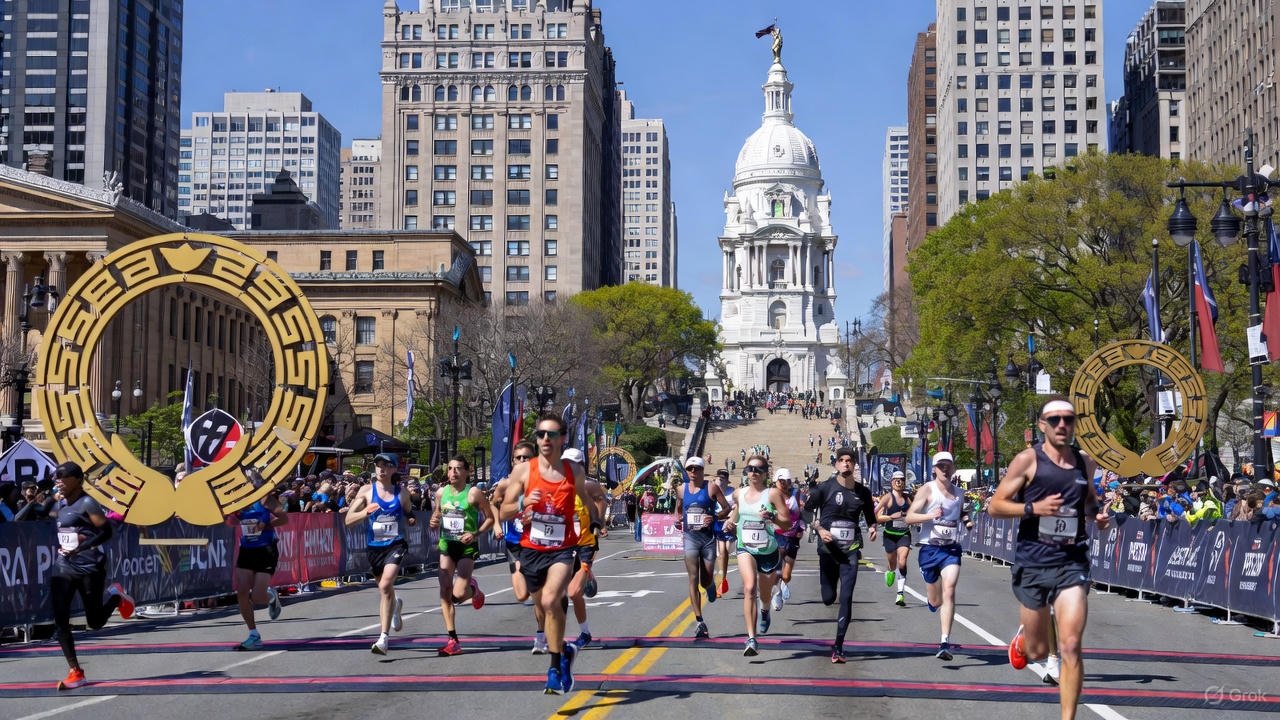
Philadelphia, the City of Brotherly Love, has always had a knack for blending its gritty urban pulse with moments of pure inspiration. On a crisp November morning in 2025, the streets of Philly are alive with that familiar hum of anticipation—the kind that only a major marathon can ignite. As the Philly Marathon 2025 weekend officially launches, it’s not just another edition of this beloved event; it’s a milestone. Organizers are bracing for a staggering 37,000 participants flooding the city, shattering previous attendance records and turning Benjamin Franklin Parkway into a global stage for endurance and camaraderie. But amid the sea of neon running shoes and high-fiving spectators, there’s a poetic nod to the marathon’s ancient roots: golden olive wreaths, meticulously handcrafted in the sun-baked hills of Marathon, Greece, waiting to crown the elite finishers. This infusion of Hellenic heritage isn’t just ceremonial flair—it’s a bridge across millennia, reminding every pounding footfall that the 26.2-mile journey we’re celebrating today echoes the legendary run of Pheidippides in 490 BC.
For locals and out-of-towners alike, the Philly Marathon 2025 feels like a homecoming wrapped in sweat and cheers. The event, now in its 32nd year, has evolved from a modest gathering of 1,500 die-hard runners into one of America’s top 10 marathons, drawing elite athletes, weekend warriors, and families chasing their first finish line. This year’s surge in numbers speaks volumes about the race’s magnetic pull. The full marathon and half-marathon sold out faster than ever before—more than two months ahead for the full distance and nearly four weeks early for the half—leaving would-be entrants scrambling for charity spots or next year’s bibs. “We’re seeing runners from nearly 60 countries and every corner of the U.S.,” shares race director Rick Lovett in a pre-event briefing. “It’s a testament to how Philly welcomes everyone, no matter where you’re from or how fast you run.”
The weekend’s kickoff on Friday, November 21, set the tone at the Pennsylvania Convention Center, where the two-day Health & Fitness Expo buzzed like a beehive on energy gels. Vendors hawked everything from compression socks to plant-based recovery shakes, while motivational speakers took the stage to dish on mental toughness and injury prevention. One booth, tucked in the corner, drew curious crowds: a display of those elusive golden wreaths, gleaming under soft lights like relics from an Olympian vault. Crafted by artisans in the very Greek village that birthed the modern marathon, each wreath is woven from olive branches dipped in 24-karat gold leaf—a symbol of victory that’s as timeless as it is tactile.
This Greek touch wasn’t born in a boardroom; it stemmed from a diplomatic spark earlier in the year. During a ceremonial handover at City Hall, Iphigenia Kanara, the Consul General of Greece in New York, presented the first batch of wreaths to Philadelphia’s mayor, her voice carrying the weight of history. “I’m truly honored to initiate this new connection with the City of Philadelphia, one we hope to repeat for years to come,” she said, her words bridging the Atlantic. The gesture honors the Philly Marathon’s commitment to authenticity, transforming a simple finisher’s medal into something profound. Imagine crossing the line after hours of grit, only to have a wreath of olive and gold placed upon your head—it’s not just a prize; it’s a whisper from antiquity, saying, “You’ve done what heroes do.”
As Saturday, November 22, dawned with a forecast of partly cloudy skies and temps hovering in the mid-40s—ideal for layering up without overheating—the action ramped up. The Rothman Orthopaedics 8K, a flat-and-fast loop through Fairmount Park, drew over 10,000 entrants eager to shake out pre-marathon jitters. Runners like Sarah Jenkins, a 34-year-old teacher from nearby Ardmore, laced up with a mix of nerves and nostalgia. “This is my fifth Philly Marathon weekend,” she confides over a pre-race coffee, her bib pinned crookedly to her jacket. “But the 8K? It’s my warm-up ritual. You get that park air, the Schuylkill River sparkling beside you—it’s magic.” Jenkins, who qualified for Boston last year on these very streets, embodies the event’s spirit: accessible yet aspirational.
Not far behind in start times was the Dietz & Watson Philadelphia Half Marathon, a 13.1-mile jaunt that snakes past the Philadelphia Museum of Art’s iconic “Rocky Steps” and along the Delaware River waterfront. With waves starting as early as 7 a.m., the course quickly filled with a rainbow of outfits—think turkey-themed costumes for the Thanksgiving vibe and glow-in-the-dark gear for the cooler runners. Organizers reported a 15% uptick in half-marathon sign-ups alone, fueled by hybrid training apps and the post-pandemic running boom. “People are craving community,” notes Lovett. “This isn’t just a race; it’s a reunion.”
By midday, the expo had morphed into a full-blown festival, with live DJ sets pumping bass-heavy remixes of “Eye of the Tiger” and food trucks slinging Philly staples like cheesesteaks and soft pretzels. Families wandered the aisles, kids clutching mini finisher medals from the Nemours Children’s Health Philadelphia Kid’s Run booth—a one-mile fun run scheduled for Sunday that promises capes for all finishers. It’s these touches that make the Philly Marathon 2025 more than metrics and miles; it’s a tapestry of ages, abilities, and accents.
Diving deeper into the Greek infusion reveals layers of cultural synergy. The wreaths aren’t mere props—they’re the culmination of a partnership between the marathon’s organizing committee and the Hellenic Republic, timed to coincide with the event’s growing international profile. In Marathon, Greece—a coastal town still scarred by the Battle of Marathon’s ancient echoes—local craftspeople spent weeks harvesting wild olive branches, twisting them into laurel-like crowns, and gilding them for durability. Shipped across the ocean in protective cases, they arrived in Philly just days ago, unveiled during a low-key reception at the Greek Consulate’s pop-up exhibit near Rittenhouse Square.
Kanara’s involvement adds a personal flair. A Philadelphia native with deep ties to both worlds, she recalls childhood visits to the Acropolis and weekend jogs along the Ben Franklin Bridge. “The marathon’s route mirrors life’s unpredictability—hills like the ‘Rocky Steps,’ flats by the river, and that final push through Old City,” she explains. “Pairing it with our heritage feels right, like closing a circle.” For elite contenders, the wreaths elevate the stakes. Defending champion Keira D’Amato, the American record holder eyeing a sub-2:15 finish, joked in a presser that the gold might just shave seconds off her splits. “Who wouldn’t run faster for a piece of history?”
Sunday’s marquee events—the AACR Philadelphia Marathon and the Kid’s Run—promise the weekend’s crescendo. The full marathon, starting at 7 a.m. sharp on Benjamin Franklin Parkway, will weave 26.2 miles through the city’s soul: past the Liberty Bell, under the shadow of City Hall’s clock tower, and over the South Street Bridge with its skyline views. Road closures, mapped meticulously by the Philadelphia Police Department, stretch from 4 a.m. to 4 p.m., affecting major arteries like I-676 and Kelly Drive. Spectators are urged to stake out prime spots early—think the Art Museum steps for that cinematic cheer or LOVE Park for family-friendly vibes. Apps like the official Philly Marathon tracker let fans follow friends in real-time, turning passive watching into interactive hype.
What drives this record turnout? Post-2020, running surged as a pandemic-proof outlet, and Philly’s course—certified flat with just enough elevation for drama—has become a bucket-list staple. Virtual qualifiers from Tokyo to Toronto fed into the frenzy, with charity teams raising millions for causes from cancer research (shoutout to sponsor AACR) to youth fitness programs. One standout story: the “Philly Phlashers,” a group of 200 first-timers training via community runs in Kensington. Led by coach Jamal Rivera, a former Marine, they’re not chasing PRs but proving resilience. “Philly taught me to keep moving,” Rivera says. “Now we’re paying it forward.”
The economic ripple can’t be ignored either. Hotels from the Ritz-Carlton to boutique spots in Fishtown are at capacity, restaurants buzzing with carb-loading crowds, and local shops peddling “I Survived the Rocky Steps” tees. Visit Philly estimates a $50 million boost, underscoring how the marathon cements the city’s rep as a runner’s paradise. Yet it’s the intangible wins that linger: strangers forming pace groups, volunteers handing out water with genuine grins, and that electric moment when the gun cracks and 15,000 marathoners surge forward like a living heartbeat.
As dusk falls on Saturday, with half-marathoners trickling across the finish line to the strains of “Sweet Caroline,” the air thickens with possibility. Runners swap war stories over post-race brews at nearby bars, their legs jelly but spirits soaring. The Greek wreaths, now safely stored for tomorrow’s victors, serve as a quiet promise: endurance isn’t solitary; it’s shared, celebrated, eternal.
In the grand scheme, the Philly Marathon 2025 isn’t just about records or rituals—it’s a love letter to perseverance, penned in sweat across cobblestones and expressways. Whether you’re toeing the line at dawn or lining the barriers with cowbells, this weekend reminds us why we run: to connect, to conquer, to carry a flame from ancient Greece straight through the heart of America. With 37,000 stories unfolding by Sunday night, Philly’s streets will echo long after the last finisher fades. Lace up, cheer loud, and let the tradition unfold.