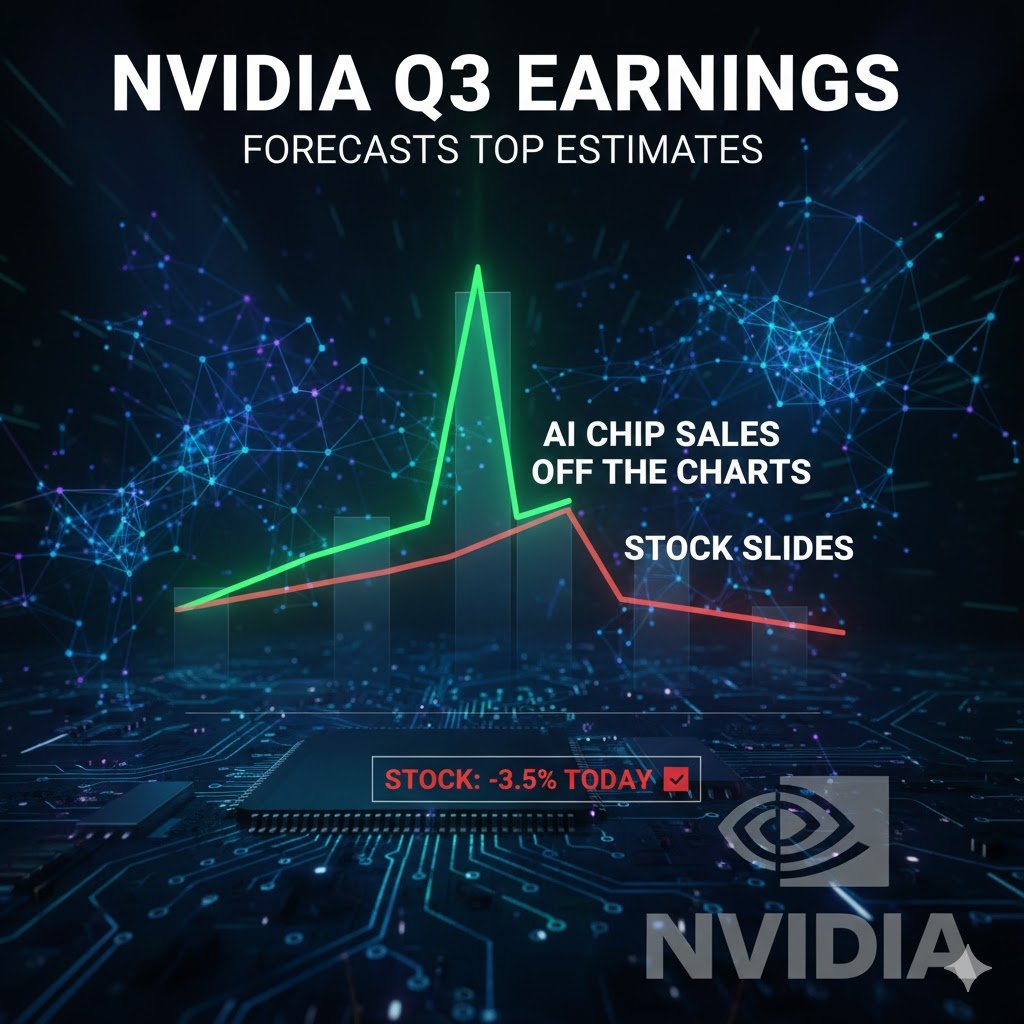
In the electrifying arena of tech stocks, few companies command the spotlight quite like NVIDIA. On November 19, 2025, the AI powerhouse unveiled its fiscal third-quarter results for 2026, painting a picture of unrelenting dominance in the artificial intelligence landscape. Revenue rocketed to a staggering $57 billion, smashing analyst expectations of $55.4 billion, while adjusted earnings per share clocked in at $1.30, edging out the forecasted $1.26. Guidance for the next quarter? A bold $65 billion in sales, well above the Street’s $61.66 billion whisper number. And let’s not gloss over the crown jewel: sales of NVIDIA’s cutting-edge AI chips, particularly the Blackwell platform, were described by CEO Jensen Huang as “off the charts,” with cloud GPUs completely sold out.
Yet, in a twist that underscores the fickle nature of Wall Street, NVIDIA’s stock (NVDA) didn’t join the party. Shares dipped 3.15% on November 20, closing at $180.64—down from a late-October peak of $207.04 and marking a 12.75% retreat from recent highs. After an initial after-hours pop of up to 5%, the enthusiasm fizzled amid broader market tremors and lingering fears of an AI spending bubble. This paradox—a blowout report met with a sell-off—highlights the double-edged sword NVIDIA wields: unparalleled growth potential clashing with investor anxiety over sustainability. As the chipmaker hurtles toward what could be half a trillion dollars in AI chip bookings through 2026, questions swirl: Is this a temporary hiccup, or the first crack in the AI edifice?
Unpacking the Numbers: A Quarter of Unmatched Momentum
NVIDIA’s Q3, ending October 26, 2025, wasn’t just good—it was a testament to the company’s iron grip on the AI revolution. Total revenue surged 62% year-over-year and 22% quarter-over-quarter, fueled primarily by the data center segment, which ballooned to $51.2 billion. That’s a 66% leap from the prior year, accounting for nearly 90% of overall sales. Gaming revenue, a legacy staple, ticked up modestly to $3.1 billion, while automotive and professional visualization added $1.2 billion and $760 million, respectively. But the real story lurks in the silicon heart of it all: AI accelerators like the Hopper and Blackwell families.
Huang didn’t mince words during the earnings call. “Blackwell sales are off the charts, and cloud GPUs are sold out,” he declared, emphasizing how demand for compute power is “accelerating and compounding.” The company’s gross margins held firm at 73.6% on a non-GAAP basis, a hair below the mid-70s but still the envy of the industry, thanks to pricing power and efficient supply chains. Net income? A jaw-dropping $31.9 billion, underscoring NVIDIA’s transformation from a graphics card maker to an AI infrastructure behemoth.
What makes these figures sing is their context. NVIDIA now boasts visibility into $500 billion in revenue from Blackwell and the upcoming Rubin platforms alone, spanning from early 2025 through the end of 2026. CFO Colette Kress elaborated that this pipeline could even exceed expectations, with four major customers—likely the usual suspects like Microsoft, Amazon, Google, and Meta—driving 61% of data center sales, up from 56% last quarter. It’s a concentration that raises eyebrows about dependency risks, but for now, it’s a moat wider than the Grand Canyon.
Diving deeper, the Blackwell architecture didn’t just meet hype; it shattered benchmarks. Independent tests from SemiAnalysis crowned it the top performer in inference tasks, delivering 10x the throughput per megawatt compared to predecessors. NVIDIA also teased expansions into supercomputing, partnering with Oracle to power the U.S. Department of Energy’s Solstice and Equinox systems—monsters packing 100,000 and 10,000 Blackwell GPUs, respectively. These aren’t side projects; they’re harbingers of AI’s sprawl into government and enterprise realms, far beyond chatbots and image generators.
The Market’s Moody Response: Why the Slide?
If earnings were a fireworks show, the stock’s reaction was more like a sudden rainstorm. After hours on November 19, NVDA surged as much as 6%, dragging fellow AI darlings like Meta and Microsoft into the green. Optimism peaked as Huang swatted down “AI bubble” chatter, insisting the boom is “incredible” and far from over. But by Thursday’s close, the narrative flipped. Broader indices wobbled on inflation data and geopolitical whispers, and NVIDIA bore the brunt—shedding value despite the positives.
Analysts point to a cocktail of factors. First, the bar was sky-high. NVIDIA’s stock has ballooned nearly 40% year-to-date and over 1,300% in five years, pricing in perfection. Even a beat felt like a breather, not a breakthrough. Second, growth deceleration whispers grew louder: Q3’s 62% year-over-year jump, while robust, marks the first slowdown in seven quarters, dipping from triple-digit frenzy. Compute and networking segments showed softening from 92% growth rates earlier in the year. Third, external headwinds loom large. U.S. export curbs to China, NVIDIA’s former 13% revenue slice ($17.1 billion in 2024), remain a thorn, though Bloomberg hints at a Trump administration pivot to allow H200 chip sales—potentially unlocking billions.
Then there’s the elephant: AI fatigue. Investors, burned by past tech manias, are scrutinizing capex from hyperscalers. Will Microsoft and pals keep pouring $100 billion-plus annually into data centers if returns lag? Huang’s retort—”Things just work”—resonates, but markets crave proof. As one trader quipped on X (formerly Twitter), “NVIDIA’s printing money, but at what velocity? The pedal’s to the metal, yet the brakes are whispering.”
AI Chips: The Unstoppable Engine
At the core of NVIDIA’s saga is its AI silicon supremacy. The Blackwell platform isn’t just chips; it’s the neural backbone for everything from drug discovery to autonomous fleets. Q3 sales exploded as enterprises raced to build sovereign AI clouds, with Rubin teased as the next leap—promising even denser inference and training capabilities. Huang’s “off the charts” quip isn’t hyperbole; it’s arithmetic. Data center revenue alone could propel NVIDIA past $200 billion in annual sales for FY2026, rivaling ExxonMobil’s oil empire but powered by electrons, not crude.
This surge ripples globally. In Europe, NVIDIA’s fueling green data centers with energy-efficient designs, while in Asia, partnerships like those with TSMC ensure supply chains hum. But challenges persist: talent wars for AI engineers, ethical debates on model biases, and regulatory scrutiny. The FTC eyes NVIDIA’s 80-90% GPU market share, murmuring about monopolies. Yet, Huang’s vision endures: AI as the “new industrial revolution,” with NVIDIA as its forge.
Voices from the Street: Analysts Weigh In
Wall Street’s reaction was a chorus of upgrades, tempered by caution. Goldman Sachs and JPMorgan hiked price targets to $250, citing the “robust” guidance. Evercore ISI went bold at $352—80% above current levels—betting on $500 billion in backlog realization. Wedbush’s Dan Ives dismissed bubble fears as “way overstated,” calling the report a “pop-the-champagne moment.” Even bears like KeyBanc nudged targets from $250 to $275, acknowledging AI’s “compounding” tailwinds.
Not everyone’s toasting. Some at BofA flag customer concentration and China risks, while Mizuho trimmed from $245 to $235 on valuation grounds—NVDA trades at 35x forward earnings, premium but not absurd for a growth machine. Jefferies holds at $250, praising Blackwell but warning of “waning AI hype” if enterprise ROI falters. Consensus? Bullish, with an average target around $260, implying 44% upside.
| Analyst Firm | Previous Target | New Target | Rating |
|---|---|---|---|
| Evercore ISI | $261 | $352 | Outperform |
| Goldman Sachs | $240 | $250 | Buy |
| JPMorgan | $235 | $250 | Overweight |
| KeyBanc | $250 | $275 | Sector Weight |
| Mizuho | $245 | $235 | Outperform |
| Jefferies | $240 | $250 | Buy |
This table snapshots the post-earnings recalibration, blending optimism with prudence.
Broader Ripples: AI’s Economic Tsunami
NVIDIA’s Q3 isn’t isolated; it’s a bellwether for the $1 trillion AI economy by 2030. Hyperscalers’ spending—projected at $300 billion in 2026—underpins it, but spillovers abound. From Hollywood’s generative tools to Detroit’s self-driving dreams, NVIDIA’s ecosystem (CUDA software, Omniverse platform) locks in loyalty. Yet, cracks show: AMD and Intel nip at heels with cheaper alternatives, while custom ASICs from Google (TPUs) and Amazon (Trainium) erode margins.
Geopolitics adds spice. A potential U.S.-China thaw on H20/H200 exports could juice Q4 by billions, per Bloomberg, but Beijing’s push for domestic chips (via Huawei) poses long-term threats. Environmentally, AI’s power hunger—data centers guzzling 8% of global electricity by 2030—spurs NVIDIA’s efficiency pledges, like Blackwell’s 10x power savings.
For investors, the slide is a buy-the-dip siren. At $180, NVDA yields a forward P/E dwarfed by its 60%+ CAGR. But timing matters: Wait for Fed cuts or capex clarity?
Looking Ahead: NVIDIA’s Infinite Game
As November 22 dawns, NVIDIA stands at AI’s apex—stock wobbles notwithstanding. Q3 proves the boom endures, with Blackwell and Rubin as accelerators. Huang’s half-trillion vision isn’t fantasy; it’s booked orders. Sure, slides happen in bull markets, but NVIDIA’s trajectory? Steeply upward.
Investors, take note: In the AI gold rush, NVIDIA isn’t selling picks and shovels—it’s mining the motherlode. The charts may dip, but the chips? They’re off the charts.