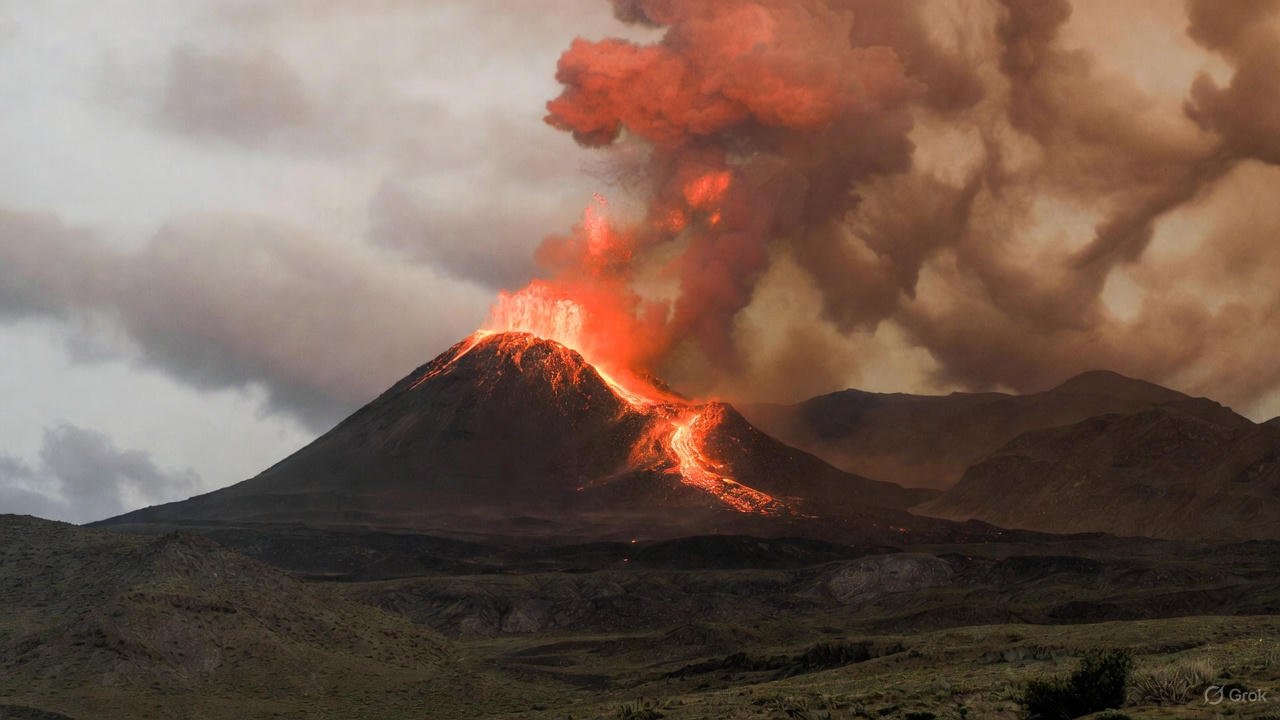
In the scorched, otherworldly expanse of Ethiopia’s Danakil Depression, where temperatures soar past 50 degrees Celsius and the ground cracks like shattered glass underfoot, nature has a way of reminding us who’s really in charge. On November 23, 2025, that reminder came in the form of a thunderous roar from Hayli Gubbi, a long-dormant shield volcano that had slumbered for over 10,000 years. For the first time in recorded history, this unassuming peak unleashed a massive explosive eruption, hurling a colossal ash plume skyward and blanketing the horizon in a veil of gray fury. The event, captured in stunning detail by satellites, marks not just a geological milestone but a stark illustration of Earth’s restless underbelly stirring to life.
Hayli Gubbi, standing at a modest 521 meters tall, isn’t the kind of volcano that dominates postcards or headlines. Tucked away in the Afar Rift, about 15 kilometers southeast of its more infamous neighbor, Erta Ale—the “Gateway to Hell” with its perpetual lava lake—it’s been little more than a footnote in volcanic studies. Yet, in a single morning, it transformed from obscurity to infamy. As ash clouds the size of Portugal drifted eastward toward Yemen and Oman, aviation authorities scrambled, scientists marveled, and locals in the remote Afar region braced for the unknown. This wasn’t just an eruption; it was a resurrection.
The Volcano That Time Forgot
To understand the shockwaves—literal and figurative—rippling from Hayli Gubbi, we need to zoom out to its rugged home. The Danakil Depression, often called the “cradle of humanity” for its ancient fossils, is also a cauldron of tectonic drama. Straddling the East African Rift, where the African continent is slowly tearing itself apart at a rate of a few centimeters per year, this below-sea-level hellscape is one of the hottest, driest, and most inhospitable places on Earth. It’s here, amid salt flats, lava fields, and neon-acid pools, that Hayli Gubbi resides as the southernmost sentinel of the Erta Ale volcanic chain.
Geologically, Hayli Gubbi is a classic shield volcano, built from fluid basaltic lavas that spread out like pancake batter over eons. Its summit, a shallow graben—a sunken block of land flanked by faults—hosts a symmetrical scoria cone with a 200-meter-wide crater, where faint fumaroles have occasionally hissed steam for decades, hinting at unrest below. To the north, older shield remnants lie buried under fresh fissure-fed lava flows, while southward, a 10-kilometer-long axial fissure snakes like a scar, dotted with spatter cones and pit craters. These fissures have spewed lavas that once cascaded onto the Giulietti Plain, burying sediments dated to 8,200 years ago. But that’s ancient history; no eruptions have scarred the record since the Holocene epoch began around 12,000 years ago.
Experts like those at the Smithsonian Institution’s Global Volcanism Program had long classified Hayli Gubbi as inactive in the modern era, its last credible activity lost to the mists of prehistory. The rift’s intermediate crust, 15 to 25 kilometers thick, acts like a pressure cooker, fueled by the African Superplume—a massive upwelling of hot mantle rock that drives the region’s volatility. Neighboring Erta Ale, with its twin lava lakes bubbling since 1906, has been the star of the show, erupting intermittently and drawing adventure seekers despite the dangers. Hayli Gubbi? It was the quiet sibling, overlooked amid the fanfare.
That changed abruptly on a sweltering Sunday morning.
A Morning of Mayhem: The Eruption Unfolds
It started subtly, around 8:30 a.m. local time (5:30 UTC), with a low rumble that built into a cataclysmic blast. Satellite imagery from NASA’s Aqua/MODIS and Planet Labs caught the drama in real time: a dark plume erupting from the summit crater, surging to heights of 9 to 15 kilometers (30,000 to 49,000 feet)—enough to punch into the stratosphere and rival the cruising altitude of jetliners. Thermal spikes lit up sensors like fireworks, signaling molten rock shattering through the surface. Within minutes, the ash column leaned northeast, propelled by winds at 25 knots, expanding into a sprawling cloud roughly the size of Portugal.
Eyewitness accounts from the sparse Afar communities were scarce—the region’s remoteness means few venture there without purpose—but social media buzzed with satellite clips and expert breakdowns. “This is a rare historic event,” tweeted volcanologist Simon Carn, sharing images of the towering column laced with sulfur dioxide (SO2), a gas that could acidify rains for hundreds of miles. Pyroclastic flows—rivers of superheated gas and rock—cascaded northward at high speeds, hugging the volcano’s contours, though their reach was limited by the terrain. By afternoon, the Toulouse Volcanic Ash Advisory Center (VAAC) issued urgent alerts, coding the event “red” and warning of ash drifting toward the Arabian Peninsula, potentially disrupting flights from Addis Ababa to Dubai.
What triggered this beast? Clues point to a domino effect from Erta Ale. Just months earlier, in July 2025, Erta Ale had unleashed a fissure eruption and a 35-kilometer dike intrusion—a slab of magma slicing underground—toward Hayli Gubbi’s base. That event, which sank part of Erta Ale’s caldera, may have overstressed the shared plumbing system, snapping a “magma dam” 50 kilometers long and channeling pressure southward. A magnitude 4.7 earthquake struck nearby three hours post-eruption, underscoring the rift’s seismic tantrums. As one YouTube analyst put it, “Pressure has been building for decades across the East African Rift… this could be the first signs of large-scale release.”
On X (formerly Twitter), reactions poured in like the ash itself. Users shared clips of the plume’s eerie glow from space, with one post garnering thousands of views: “Volcano Hayli Gubbi erupted today in Ethiopia. It’s its first eruption ever.” French accounts translated the frenzy: “L’éruption historique du volcan Hayli Gubbi,” complete with videos of the column’s relentless climb. Even astrologers chimed in, linking the blast to Mars opposing Uranus—a cosmic nod to “sudden earth-release.” Amid the awe, a thread of concern: Could this herald a chain reaction in the rift?
Ripples of Risk: Immediate and Far-Reaching Effects
So far, the human toll appears mercifully light. No deaths or major injuries have been reported, thanks to the area’s low population density—fewer than 1.5 million people live near the broader rift volcanoes, mostly nomadic herders eking out a living on the fringes. Yet, ashfall dusted nearby settlements, prompting complaints of breathing difficulties and irritated eyes. Social media posts from Afar locals described a “gray snow” coating camel pens and salt pans, with children coughing through masks improvised from scarves. The Ethiopian government, already stretched by droughts and conflicts, mobilized health teams with respirators and urged residents to seal homes.
Aviation felt the sharper sting. The ash plume, laced with abrasive glass shards, posed a grave threat to engines—recall the 2010 Eyjafjallajökull shutdown in Europe that grounded 100,000 flights. Here, routes over the Red Sea and Arabian Sea saw diversions, with Emirates and Qatar Airways rerouting a handful of flights. The VAAC’s advisories extended as far as Pakistan and India, though no widespread cancellations ensued. “No significant flight disruptions… so far,” noted one report, but pilots were warned: Fly at your peril.
Environmentally, the eruption’s fingerprints are subtler but potent. SO2 plumes could seed acid rain, harming fragile rift ecosystems—think flamingos fleeing hypersaline lakes or acacia groves wilting under sulfurous drizzle. The ash, rich in nutrients, might ironically boost soil fertility for distant farms, but short-term, it chokes air and water. Climate watchers eye the plume’s stratospheric reach: Could it cool regional temperatures slightly, mimicking Pinatubo’s 1991 global chill? Unlikely on that scale, but it’s a wildcard in an era of erratic weather.
Echoes from the Rift: What This Means for East Africa
Hayli Gubbi’s awakening isn’t isolated; it’s a symptom of the African Superplume’s growing restlessness. This mantle anomaly, a thermal blob the size of Mars, pumps heat and magma into the rift, accelerating continental divorce. Erta Ale’s recent antics—lava fountaining in 2021-2022, the July dike—suggest interconnected systems, where one volcano’s hiccup triggers another’s belch. “Hayli Gubbi snapped next,” as one geoblogger quipped, with deformation maps showing a deeper dike snaking 20 kilometers south toward Lake Afrera’s salt basins.
For Ethiopia, already grappling with famine and political strife, this adds insult to injury. The Afar region’s potash mines and geothermal dreams could face setbacks from ash-clogged vents, while tourism—drawn to Erta Ale’s infernal allure—might boom or bust depending on access. Globally, it underscores volcanic unpredictability: The Danakil’s harsh veil has left geologic records spotty, so who knows what other giants lurk?
Experts like Erik Klemetti, a volcanology professor, urge caution. “This bimodal beast—basalt flows plus explosive trachydacite—could signal more unrest,” he posted, sharing plume visuals. Carn echoed: A “significant new eruption from one of the lesser-known volcanoes,” with SO2 levels hinting at sustained vigor. On Reddit, enthusiasts dissected interferograms, debating if caldera collapse looms. One X user summed the sentiment: “NatureUnleashed #HayliGubbi.”
A Wake-Up Call from the Depths
As the sun sets on November 24, 2025, Hayli Gubbi simmers, its plume thinning but stubborn. Observatories monitor for fresh pulses, while drones and seismic nets—scarce in this frontier—fill data gaps. This eruption, the first etched in Hayli Gubbi’s modern ledger, isn’t just a spectacle; it’s a harbinger. In a world racing toward net-zero dreams, it reminds us that some forces defy taming.
Ethiopia’s resilient people, forged in the rift’s fire, will adapt—as they always have. But for scientists, adventurers, and the rest of us glued to screens, Hayli Gubbi’s roar lingers: Earth is alive, unpredictable, and unapologetic. In the Danakil’s cauldron, the next chapter brews. Will it whisper or thunder? Only the mantle knows.