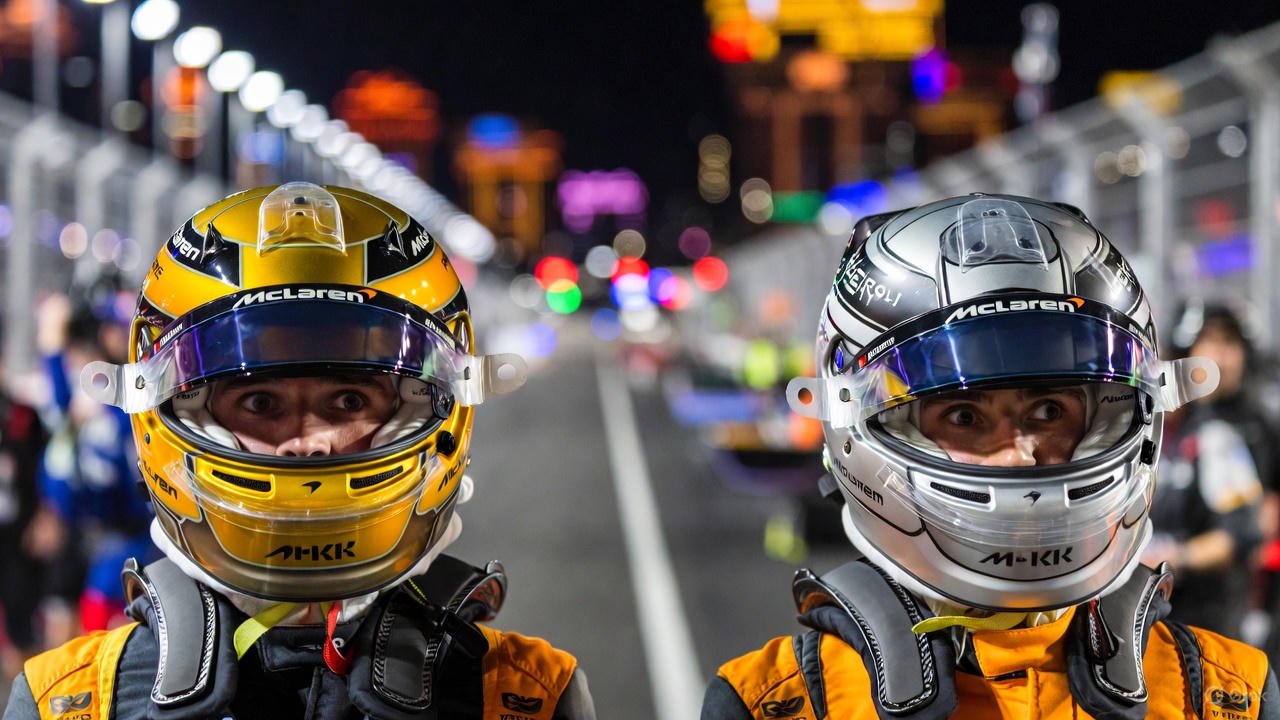
In the glittering chaos of the Las Vegas Strip, where Formula 1’s high-octane spectacle collides with the city’s neon-fueled extravagance, McLaren had every reason to celebrate. Lando Norris had clawed his way to a hard-fought second place, while his teammate Oscar Piastri rounded out a solid fourth. It was a statement performance for the papaya squad, one that seemed to cement their resurgence as genuine title contenders in the 2025 season. But just hours after the checkered flag, the FIA dropped a bombshell that reshaped the entire grand prix results: both drivers were disqualified for illegal plank wear on their cars. This dramatic turn in F1 news has left fans reeling, McLaren protesting, and the drivers’ championship wide open once more.
The Las Vegas Grand Prix, now in its third year on the calendar, has always been a race of extremes—brutal street circuit demands, blistering desert heat by day, and a party atmosphere that rivals Monaco. Saturday night’s event under the artificial glow of LED billboards and casino lights delivered on all fronts. Max Verstappen, the imperious Red Bull driver, stormed to victory, extending his lead in the standings. But it was McLaren who stole the show in the midfield battle, with Norris fending off late charges from Ferrari’s Charles Leclerc and Mercedes’ George Russell. Piastri, the young Australian sensation, had battled wheel-to-wheel with Alpine’s Esteban Ocon before securing P4 in a display of mature racecraft that belied his relative inexperience.
As the drivers climbed from their cockpits amid the confetti and cheers, the post-race buzz was all about McLaren’s momentum. Team principal Andrea Stella beamed in interviews, praising his duo’s “flawless execution” on a track notorious for its unforgiving barriers and abrasive surface. Norris, ever the charismatic Brit, joked about trading his podium champagne for a slot machine pull, while Piastri reflected on the learning curve of navigating Vegas’s unique layout. Little did they know, the real gamble was just beginning back in the paddock, where FIA technical delegates were poring over the scrutineering data.
The disqualification stemmed from a perennial F1 headache: the skid plank, that unassuming strip of wood (yes, actual wood, often Baltic birch plywood) affixed to the underside of every car. Introduced in the late 1990s to curb teams from running cars too low to the ground—gaining an aerodynamic edge at the expense of safety—the plank must measure 10mm thick when new, with a tolerance for wear down to 9mm by race end. Measurements are taken at specific points, including the peripheries of designated holes, to ensure uniformity. Exceed that 1mm allowance, and you’re out. It’s a rule that’s tripped up giants before, from Michael Schumacher’s Ferrari in 2001 to more recent dramas involving Red Bull and Mercedes.
In this case, the FIA’s Jo Bauer, the technical delegate, reported stark violations on both McLaren MCL39 chassis. For Norris’s car (number 4), the front right-hand side plank clocked in at a razor-thin 8.88mm, while the rear right dipped to 8.93mm. Piastri’s machine (number 81) fared marginally better but still fatally short: 8.96mm on the front left, a concerning 8.74mm front right, and 8.90mm rear right. These fractions of a millimeter—less than the thickness of a credit card—were enough to invoke Article 3.5.9 e) of the 2025 Technical Regulations. The stewards, after a swift hearing, had no choice but to strip the results, promoting Leclerc to second, Russell to third, and shuffling the points down the order.
McLaren’s response was swift and unapologetic. In a statement released late Saturday, Stella acknowledged the breach but vowed to appeal, calling it a “genuine oversight in setup optimization.” “We pushed the limits as every team does in the pursuit of performance,” he said, “but this doesn’t reflect any intent to circumvent the rules. Our focus now is understanding why our wear projections were off and ensuring it doesn’t happen again.” The Italian-born boss, known for his data-driven approach since taking the helm in 2023, hinted at environmental factors: Vegas’s freshly laid asphalt, combined with the circuit’s high kerb strikes and the MCL39’s aggressive ride height setup, may have accelerated degradation beyond simulations.
Norris, speaking from his hotel suite overlooking the Sphere, sounded gutted but philosophical. “It’s gut-wrenching, mate. You pour everything into a weekend, feel the car alive under you, and then… poof. Gone.” The 26-year-old, who entered the weekend 22 points behind Verstappen, saw his championship deficit balloon to 52 overnight. That lost second place? Twenty-five points vanished. “We’ve been so close all year—Silverstone, Spa, Monza—and this feels like the universe’s way of saying ‘not yet.’ But we’ll bounce back. Qatar’s next, and I’ll be hungrier for it.” His candor, laced with that signature Norris wit, endeared him further to fans already rallying with #JusticeForLando on social media.
Piastri, meanwhile, took the hit with his trademark stoicism. The 24-year-old, in his third full F1 season, dropped from a potential 12 points to zero, but he framed it as a harsh lesson. “Disappointing, yeah, but these are the margins that define champions. We learned something valuable about the car’s behavior on this track. Onto the next one.” Off-track, Piastri’s star is rising; his post-race presser detour to a fan meet-and-greet at the Bellagio fountains underscored his grounded appeal amid the Vegas glitz.
The fallout rippled far beyond Woking. Rivals were quick to weigh in, with varying degrees of schadenfreude. Verstappen, fresh off his 18th win of the season, quipped in the media pen, “Tough break for Lando and Oscar. Planks, eh? Always the quiet killers.” But beneath the levity, Red Bull’s Christian Horner couldn’t hide his relief: “It keeps the fight alive, that’s for sure. McLaren’s been nipping at our heels; this buys us breathing room.” Ferrari’s Fred Vasseur, now the beneficiary with Leclerc’s upgraded podium, was more measured: “Sympathies to McLaren—this sport thrives on fair play, and these checks keep us all honest.”
Mercedes, ever the moral compass in technical debates, saw technical director James Allison draw parallels to their own 2021 plank woes in Turkey. “It’s a reminder that innovation walks hand-in-hand with compliance. We’ve all been there; the key is adapting.” Indeed, the plank rule, born from the ground-effect controversies of the ’90s, remains a lightning rod. Teams obsess over wear modeling via laser scanners and CFD simulations, yet variables like track temperature (Vegas hit 28°C under lights) and debris can throw curves. McLaren’s double whammy is rare—last seen in 1994 with Benetton’s twin disqualifications—but it underscores the pressure cooker of 2025’s hyper-competitive grid.
Zooming out, this F1 news bombshell injects fresh drama into a season that’s already been a rollercoaster. Verstappen’s Red Bull has dominated, but McLaren’s MCL39 has been the revelation, blending raw speed with reliability. Entering Vegas, Norris trailed by a slender margin, with Piastri lurking as a dark horse for 2026’s regulation reset. Now, with three races left—Qatar, Abu Dhabi, and a sprint in Brazil—the title chase feels alive again. Leclerc jumps to third in the standings, 68 points adrift but motivated, while Russell’s Mercedes edges closer to constructors’ glory.
For McLaren, the pain is acute. Losing 37 combined points stings, but it’s the psychological toll that looms largest. Zak Brown, the team’s irrepressible CEO, fired off a memo to staff emphasizing resilience: “We’ve turned setbacks into setups before. This is just fuel.” Behind the scenes, engineers are dissecting telemetry, questioning whether a softer suspension tweak or alternative plank material could mitigate future risks without sacrificing lap time. The appeal, lodged Sunday morning, argues for procedural leniency, citing the minimal exceedance and no performance gain—planks wear faster on straights, not corners, so the infraction likely cost them grip, not speed.
Fan reaction has been a whirlwind. X (formerly Twitter) lit up with memes: Norris photoshopped as a Vegas gambler folding a bad hand, Piastri stoically flipping a coin that lands on tails. Podcasts dissected the “plank curse,” with The Race’s Gary Anderson calling it “F1’s most pedantic rule—vital, yet comically precise.” Vegas locals, treated to the spectacle for the first time since 2023’s debut, shrugged it off as “just another high-stakes bust,” but global audiences decried the timing. Why announce post-midnight, when half the paddock’s nursing hangovers? The FIA insists on thoroughness, but whispers of “showbiz over substance” persist.
Historically, plank disqualifications have been championship pivots. Recall 2001: Schumacher’s San Marino DQ handed points to his brother Ralf, delaying Mika Hakkinen’s title defense. Or 2021’s Abu Dhabi farce, where plank scrutiny could’ve altered the Lewis Hamilton-Max saga. McLaren’s 1998 Monza mishap with Mika Salo cost them dearly. Each case reinforces the rule’s intent: level the playing field, prevent “flying” cars that skim dangerously close to sparks and flames. In 2025, with ground effects back in vogue, the plank’s relevance is amplified—teams like McLaren, chasing Red Bull’s aero wizardry, are tempted to shave millimeters for downforce.
Yet, amid the technical tedium, there’s poetry in the plank’s humility. In a sport of billion-dollar budgets and carbon-fiber exotica, a humble wooden slat humbles the mighty. It reminds us that F1 isn’t just about who crosses the line first, but who does so within the lines—literal and regulatory. For Norris and Piastri, this Vegas velvet rope denial is a rite of passage. Norris, once the prodigy, now the nearly-man; Piastri, the cool head in papaya pressure.
As dawn broke over the Strip on Sunday, McLaren’s garage hummed with quiet determination. The appeal hearing looms in Geneva, but win or lose, the message is clear: adapt or perish. Qatar’s Losail circuit, with its smoother sands and night-race familiarity, offers redemption. Verstappen may sleep easier tonight, but the papaya pursuit endures. In F1 news, where fortunes flip faster than a roulette wheel, McLaren’s story is far from over. It’s just taking a detour through the desert of disappointment, en route to potential glory.
This saga also spotlights broader F1 evolution. The 2026 regs promise active aero and sustainable fuels, but core tenets like the plank endure, ensuring governance keeps pace with innovation. Liberty Media’s entertainment empire thrives on such narratives—heroes felled by hubris, underdogs rising from ashes. Vegas, with its theme of risk and reward, was the perfect stage. Attendance hit record highs, TV ratings soared, and merchandise flew off shelves. Even in defeat, McLaren sold more caps than ever.
Looking ahead, the constructors’ battle tightens. Red Bull leads by 142 points, but Mercedes lurks 28 back, Ferrari another 15. McLaren, now fourth after the DQ, must claw 92 to podium. Piastri’s consistency—zero retirements this year—could be key, while Norris’s raw pace demands harnessed. Stella’s mantra: “Data over drama.” Yet drama sells tickets, and F1 news like this keeps the circus rolling.
In the end, the Las Vegas GP 2025 will be remembered not for Verstappen’s procession, but for McLaren’s midnight meltdown. It’s a chapter that humanizes the sport: drivers as gladiators, teams as tinkerers, rules as unrelenting referees. Norris and Piastri, disqualified but undeterred, embody F1’s eternal allure—where a millimeter’s mistake can rewrite history, but resilience rebuilds it. As the circus packs up for Doha, one thing’s certain: the plank may have grounded McLaren, but it won’t clip their wings. Not yet.