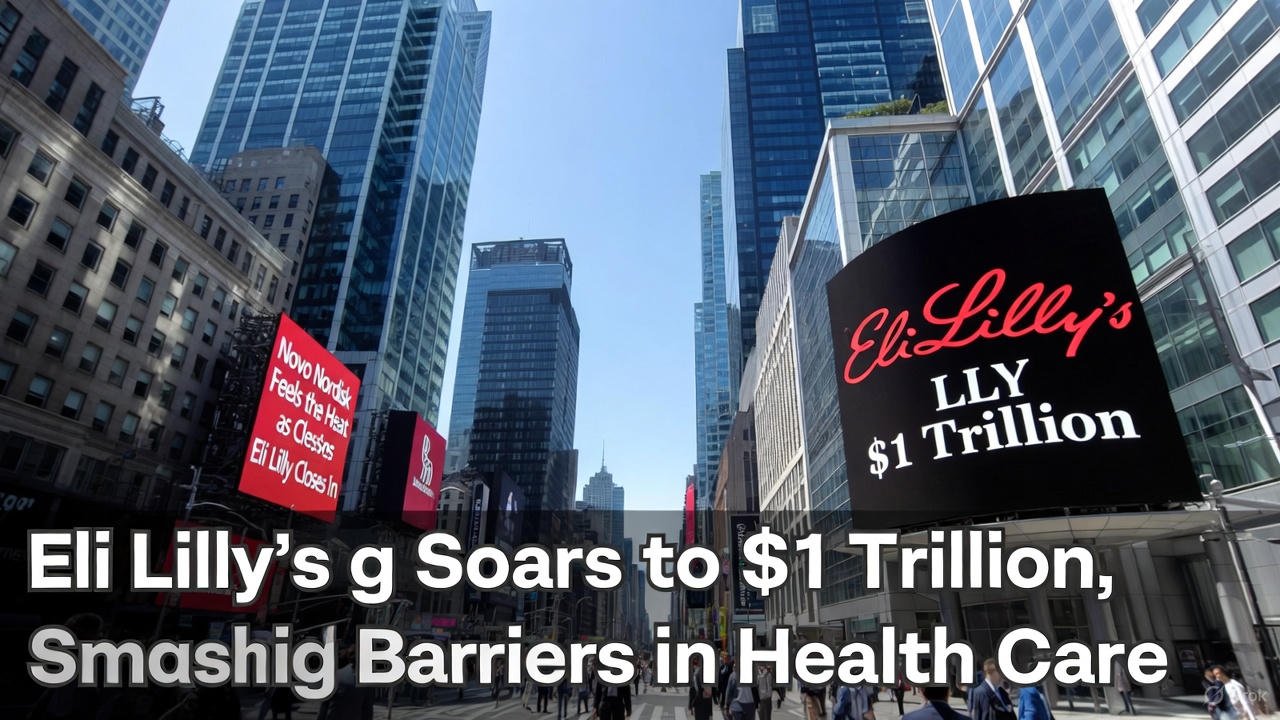
In a landmark moment for the pharmaceutical world, Eli Lilly and Company (LLY stock) has shattered expectations by crossing the $1 trillion market capitalization threshold, becoming the first health care company ever to achieve this feat. On November 21, 2025, shares of the Indianapolis-based giant closed at just under $1,060, marking a modest 1.5% daily gain but propelling the company’s total value into uncharted territory. This milestone isn’t just a number—it’s a testament to the explosive demand for innovative treatments tackling obesity and diabetes, two of the most pressing health crises of our time. Yet, as Lilly basks in this glow, its arch-rival, Novo Nordisk, finds itself in freefall, with shares tumbling nearly 10% in a single session amid fresh trial disappointments. The contrast couldn’t be starker: one pharma titan ascends to trillion-dollar heights, while the other grapples with setbacks that have erased over half its market value this year alone.
For investors eyeing LLY stock, this surge feels like the culmination of a relentless upward trajectory. Year-to-date, the stock has climbed more than 36%, outpacing broader market indices and leaving peers in the dust. It’s a story of scientific breakthroughs meeting societal needs at precisely the right moment. But how did a 150-year-old company, founded by a Civil War colonel no less, evolve from a steady insulin producer into a trillion-dollar behemoth? And what does Novo’s stumble mean for the cutthroat race in weight-loss drugs? Let’s dive into the details, unpacking the drivers, the drama, and the dollars behind this seismic shift.
A Century-Old Legacy Meets Modern Miracles
Eli Lilly’s journey to $1 trillion reads like a classic American success tale, laced with innovation and impeccable timing. Established in 1876, the company cut its teeth on insulin production after acquiring rights to the hormone in the 1920s, a move that saved countless lives and cemented its reputation in diabetes care. Fast-forward to the 2020s, and Lilly has reinvented itself yet again, riding the wave of glucagon-like peptide-1 (GLP-1) receptor agonists—drugs that mimic hormones to curb appetite, regulate blood sugar, and shed pounds.
At the heart of LLY stock’s rally are two blockbuster products: Mounjaro, approved for type 2 diabetes, and its weight-loss sibling, Zepbound. Both harness tirzepatide, a dual-action molecule that targets not just GLP-1 but also glucose-dependent insulinotropic polypeptide (GIP), offering superior efficacy over single-hormone rivals. The results? Transformative for patients and lucrative for shareholders. In the third quarter of 2025 alone, Mounjaro raked in $6.52 billion in revenue—a staggering 109% jump from the prior year—while Zepbound exploded to $3.59 billion, up 184%. Looking back at 2024’s full-year figures, Mounjaro hit $11.54 billion and Zepbound $4.93 billion, numbers that would make most industries envious.
This isn’t mere hype; it’s backed by real-world impact. Clinical trials have shown tirzepatide users losing up to 20% of their body weight, far outstripping competitors’ offerings. As obesity rates climb globally—over 1 billion adults affected, per World Health Organization estimates—insurers and governments are warming to coverage, unlocking even broader access. For LLY stock holders, these tailwinds translate to a valuation trading at about 50 times forward earnings, a premium that Wall Street justifies with bets on sustained demand.
But Lilly’s ascent isn’t solely about pills and injections. Strategic moves have fortified its position. Earlier this year, the company shelled out $1.3 billion for Verve Therapeutics, snapping up gene-editing tech aimed at heart disease prevention—a nod to the cardiovascular risks tied to obesity. Another $2 billion deal bolstered its pipeline in Alzheimer’s and beyond. These acquisitions signal Lilly’s ambition: not just dominate the GLP-1 space but expand into adjacent therapies where metabolic health intersects with longevity.
The Rivalry That Defines an Industry
No discussion of Eli Lilly’s triumph is complete without spotlighting the foil: Novo Nordisk, the Danish powerhouse that once ruled the GLP-1 roost. For years, Novo’s semaglutide—branded as Ozempic for diabetes and Wegovy for weight loss—captured the imagination, spawning memes, shortages, and a stock surge that minted billionaires. At its peak, Novo was the world’s most valuable company by market cap, a fairy-tale rise from a modest insulin maker.
Yet, as Lilly’s LLY stock vaulted toward $1 trillion, Novo’s narrative soured. Year-to-date through late November 2025, its shares have cratered nearly 45%, with U.S.-listed ADRs down over 50% from January highs. The latest blow landed on November 24, when Novo disclosed failures in two late-stage trials (EVOKE and EVOKE+) testing oral semaglutide for early Alzheimer’s disease. The drug, hoped to slow cognitive decline by 20%, showed no statistically significant benefits over placebo, prompting discontinuation of the studies. Shares plunged 10% in premarket trading, erasing billions in value overnight and underscoring the perils of diversification bets gone awry.
This Alzheimer’s flop is just the tip of Novo’s troubles. Back in early November, third-quarter earnings missed expectations, with revenue at 75 billion Danish kroner (about $10.8 billion) versus forecasts of 76.5 billion, and earnings per share at 4.5 kroner against 4.99 anticipated. The company slashed its full-year guidance, citing slower growth in GLP-1 sales amid pricing pressures and supply constraints. Worse, Novo is bleeding market share to Lilly: prescriptions for Mounjaro and Zepbound have eclipsed Ozempic and Wegovy in key U.S. markets, thanks to tirzepatide’s edge in weight loss—up to 5-10% more effective in head-to-head studies.
Internal turmoil has compounded the pain. Novo ousted its long-time CEO in a leadership shake-up, followed by mass layoffs as the firm restructures to stem costs. A fierce bidding war for obesity upstart Metsera, which Pfizer ultimately won for $10 billion, highlighted how even Novo’s deep pockets couldn’t fend off hungrier rivals. Analysts now whisper of “peak pain” for Novo in 2025, with temporary hits from restructuring masking underlying strength—but the stock’s valuation, down to more reasonable multiples, screams opportunity for contrarians.
The Lilly-Novo duel has reshaped pharma dynamics. Once a sleepy sector, health care now pulses with tech-like fervor, where a single drug can redefine fortunes. Lilly’s dual-hormone innovation gave it the upper hand, but Novo’s missteps—overreliance on semaglutide, ambitious but risky forays into neurology—have widened the gap. As one portfolio manager quipped, the Alzheimer’s trial was “a nail in the coffin” for Novo’s side ventures, forcing a refocus on core obesity assets.
Ripples Through the Health Care Pond
Eli Lilly’s $1 trillion club entry isn’t isolated—it’s a bellwether for an industry awakening to trillion-dollar potential. Health care has long lagged tech in market caps; only now, with biotech’s promise, are we seeing parity. Lilly joins an elite cadre: Apple, Microsoft, Nvidia, and a smattering of others, plus non-tech outlier Berkshire Hathaway as the other U.S. non-tech member. At $1 trillion, Lilly’s worth eclipses Walmart’s and rivals two-thirds of Meta’s valuation, a mind-bender for a firm whose shares hovered under $100 just seven years ago.
This milestone amplifies investor appetite for GLP-1 plays. Exchange-traded funds (ETFs) heavy on LLY stock, like those tracking biotech or pharma indices, have surged in tandem, drawing retail and institutional money alike. Broader implications? Accelerated R&D spending across the sector, as players like Pfizer and even tech crossovers (think Amazon’s pharmacy push) chase the obesity gold rush. The global weight-loss market, pegged at $150 billion by the early 2030s, could balloon further if next-gen therapies pan out.
Yet, challenges loom. Supply shortages persist for injectables, regulatory scrutiny on side effects (like gastrointestinal woes) intensifies, and pricing battles rage—especially with compounded versions flooding gray markets. For LLY stock, these are navigable hurdles; for Novo, they’re existential threats amid its tumble.
Charting the Course Forward
Peering ahead, Eli Lilly’s horizon brims with catalysts. Come 2026, an oral tirzepatide variant hits shelves, ditching needles for pills and easing manufacturing bottlenecks—a game-changer for patient adherence and scalability. Pipeline expansions into cardiovascular, liver disease (like MASH), and even oncology could diversify revenues beyond GLP-1s, which currently account for over 40% of sales. Analysts project 20-25% annual earnings growth through the decade, justifying that lofty P/E ratio.
Novo Nordisk, meanwhile, isn’t down for the count. Upcoming launches like an oral Wegovy and next-gen CagriSema—a combo drug promising even steeper weight loss—could spark a rebound. Cost savings from layoffs and a leaner structure might boost margins, with some seeing 14-15% upside to $56 per share in the next year. But reclaiming Lilly’s lead? That’ll demand flawless execution in a market where second place feels like losing.
For the health care sector, this saga underscores a pivotal truth: in an era of chronic disease epidemics, innovation isn’t optional—it’s the ultimate currency. Eli Lilly’s trillion-dollar validation proves pharma can rival Silicon Valley’s glamour, provided it delivers real cures.
A New Dawn for Weight Warriors and Investors Alike
As the dust settles on Lilly’s historic leap, one can’t help but marvel at the human stories woven into these balance sheets. Millions grappling with obesity and diabetes now have tools to reclaim their lives, all while LLY stock rewrites corporate lore. Novo’s stumbles serve as a cautionary tale: even giants falter without agility. In this high-stakes pharma thriller, Eli Lilly emerges not just richer, but revolutionary—proving that in health care’s grand arena, the boldest bets yield the biggest breakthroughs. For investors, the message is clear: in LLY stock, you’re not just buying shares; you’re staking a claim in humanity’s fight against its own biology. The trillion-dollar question? What’s next for this unlikely trailblazer?