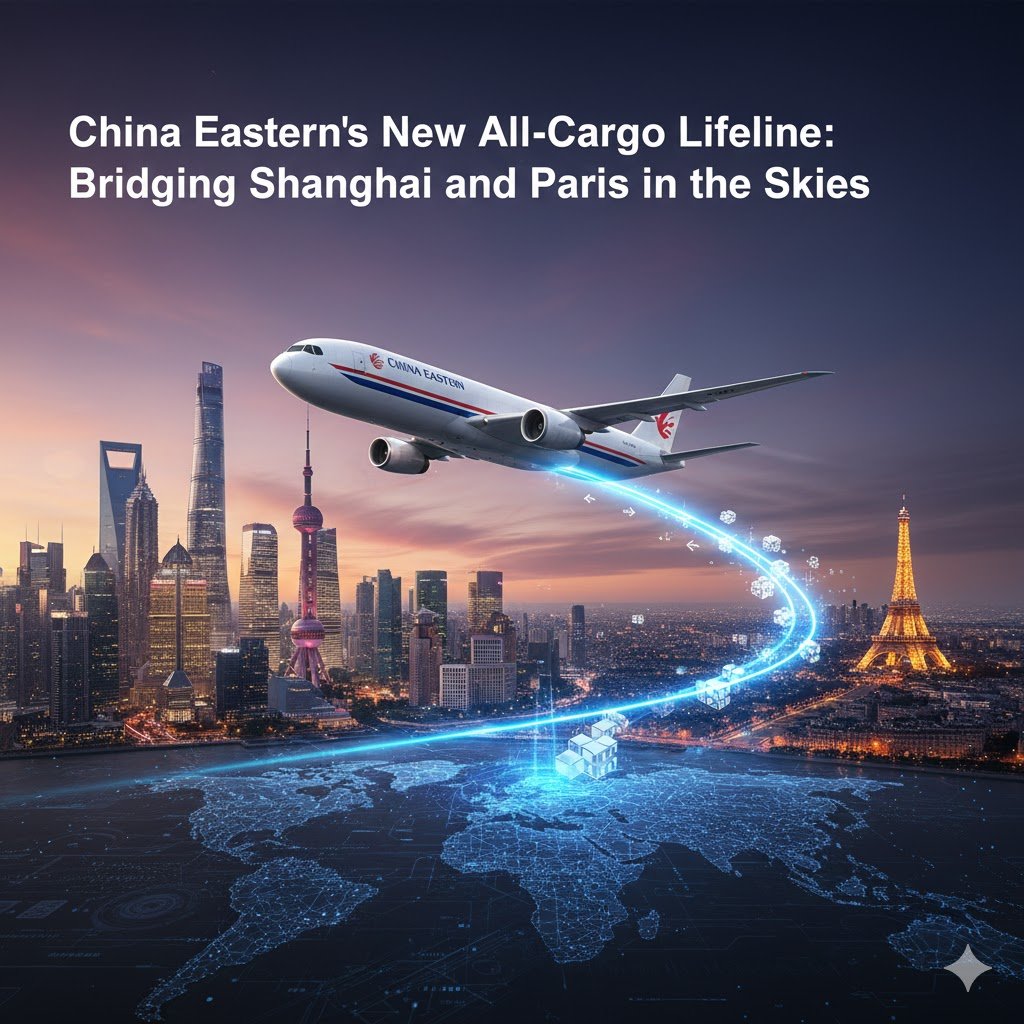
In the ever-evolving world of global trade, where speed and reliability are the lifeblood of commerce, Shanghai once again proves why it’s the beating heart of Asia’s logistics revolution. On November 20, 2025, China Eastern Airlines’ dedicated cargo arm, Eastern Air Logistics Co., touched down a milestone in the aviation sector by inaugurating a direct all-cargo flight route connecting the bustling metropolis of Shanghai to the romantic city of Paris. This isn’t just another flight path etched on a map; it’s a strategic artery pumping vitality into the economic veins linking China and France, and by extension, the broader Eurasian trade network.
Shanghai, with its towering skyscrapers piercing the clouds and its ports humming with the ceaseless rhythm of container ships, has long been synonymous with progress and connectivity. As China’s crown jewel in international aviation, the city’s Pudong International Airport stands as a testament to this ambition—a sprawling gateway that handled over 4.5 million tons of cargo in 2024 alone, cementing its status as the world’s busiest air freight hub. The launch of this Shanghai-Paris all-cargo service underscores Shanghai’s pivotal role in the global supply chain, offering businesses a swifter, more dependable conduit for goods traversing the vast expanse between East and West.
Imagine the scene: a sleek Boeing 777 freighter, its belly brimming with precision-engineered machinery and vibrant textiles from Shanghai’s factories, lifting off from the rain-slicked runways of Pudong under the watchful gaze of the Oriental Pearl Tower. Hours later, it descends into the crisp Parisian air at Charles de Gaulle Airport, unloading cargoes that will fuel industries from haute couture workshops to high-tech labs along the Seine. This route, operating three round trips weekly, isn’t merely about moving boxes; it’s about accelerating dreams, fostering collaborations, and shrinking the world in ways that echo Shanghai’s unyielding spirit of innovation.
As we delve deeper into this development, it’s clear that the timing couldn’t be more fortuitous. With geopolitical tensions easing and post-pandemic recovery in full swing, demand for efficient air cargo has surged. Chinese exports to France have climbed steadily over the past few years, driven by everything from consumer electronics to sustainable fashion. This new link arrives like a well-timed courier, promising to slash transit times and bolster the resilience of supply chains that have been tested by disruptions far too many times.
But to truly appreciate the magnitude of this launch, we must rewind the clock a bit. China Eastern Airlines, headquartered in the vibrant district of Changning in Shanghai, has been a cornerstone of the nation’s aviation prowess since its founding in 1988. Born from the ashes of the former East China Civil Aviation Bureau, the airline quickly ascended to become one of China’s “Big Three” carriers, alongside Air China and China Southern. Today, it boasts a fleet exceeding 800 aircraft—one of the youngest and most modern in the skies—serving over 1,000 destinations across 177 countries. Shanghai isn’t just a base for China Eastern; it’s the soul of its operations, with dual hubs at Hongqiao and Pudong fueling both passenger dreams and cargo imperatives.
The cargo division, Eastern Air Logistics, represents the airline’s bold pivot into the freight frontier. Established as a full-fledged subsidiary in 2011 through the merger of assets from China Cargo Airlines, Great Wall Airlines, and Shanghai Airlines Cargo, it has grown into a powerhouse tailored for the demands of modern logistics. Based squarely in Shanghai, the world’s largest air cargo market, Eastern Air Logistics leverages the city’s unparalleled infrastructure to orchestrate symphony-like movements of goods. Over the years, it has pioneered routes that weave through the Belt and Road Initiative’s intricate tapestry, from the silk-scented markets of Central Asia to the tech-savvy ports of Southeast Asia.
What sets this Shanghai-Paris venture apart is its roots in familiarity. For more than two decades, China Eastern has been ferrying passengers along the Shanghai-Paris corridor, building a legacy of trust and efficiency with its Boeing 777-300ER widebodies slicing through the skies 12 times a week. That passenger expertise—honed through countless sunrises over the Himalayas and sunsets over the Alps—has now been repurposed for freight, transforming leisure travelers’ paths into thoroughfares for commerce. It’s a seamless evolution, one that draws on Shanghai’s deep well of aviation know-how to ensure that every shipment arrives not just on time, but in prime condition.
Let’s zoom in on the nuts and bolts of this airborne bridge. The inaugural flight, christened with a nod to Franco-Chinese camaraderie, departed from Shanghai Pudong International Airport (PVG) bound for Paris Charles de Gaulle (CDG). Piloted by a seasoned crew attuned to the nuances of long-haul freight, the Boeing 777 freighter—affectionately dubbed the “Queen of the Skies” for its cavernous hold capable of swallowing up to 110 tons of payload—will ply this route thrice weekly. Departures from Shanghai are slated for Tuesdays, Thursdays, and Saturdays, with arrivals in Paris the following morning after an approximate 12-hour journey. Return legs mirror this cadence, touching down in Shanghai to replenish the cycle.
Cargo manifests paint a vivid picture of bilateral trade in motion. Outbound from Shanghai, expect a bounty of high-value items: state-of-the-art machinery humming with automation, electronic components destined for French assembly lines, and apparel that blends Shanghai’s manufacturing finesse with Parisian flair—think silk scarves and designer linens ready to grace the runways of Fashion Week. These goods, often time-sensitive and perishable in their urgency, benefit immensely from air transport’s velocity, outpacing sea routes by days or even weeks.
On the inbound trajectory, Paris contributes its own treasures: fine chemicals essential for Shanghai’s booming pharmaceutical sector, raw materials like specialty dyes for textiles, and aerospace parts that feed into China’s burgeoning aviation industry. This reciprocal flow isn’t arbitrary; it’s a reflection of complementary economies. France, with its storied legacy in chemistry and engineering, supplies the building blocks, while Shanghai’s factories transmute them into finished marvels. The route’s design—direct, with no unnecessary layovers—ensures that these exchanges happen with minimal friction, reducing costs and carbon footprints alike.
Beyond the flight specifics, the economic ripples of this launch are profound, particularly for Shanghai. As the epicenter of the Yangtze River Delta economic zone, Shanghai’s GDP soared past 4.7 trillion yuan in 2024, propelled by exports that account for nearly 30% of the city’s output. Air cargo plays an outsized role here, with Pudong’s cargo throughput growing 15% year-over-year, fueled by e-commerce giants like Alibaba and manufacturing behemoths in electronics and biotech. The Paris route injects fresh momentum, potentially adding millions in trade volume annually.
Consider the broader canvas: China-France bilateral trade hit 100 billion euros in 2024, a figure poised for exponential growth. Sectors like renewable energy, where French expertise in nuclear tech meets Shanghai’s solar panel production, stand to gain. Luxury goods, too—from Bordeaux vintages airlifted to Shanghai’s upscale malls to Shanghai-sourced jade jewelry adorning Parisian boutiques—will flow more fluidly. And let’s not overlook the intangibles: enhanced people-to-people ties, as cargo crews and logistics pros forge bonds over shared croissants and xiaolongbao during layovers.
This initiative dovetails beautifully with China’s Belt and Road Initiative (BRI), which envisions an “Air Silk Road” stitching continents with aerial threads. Shanghai, as the BRI’s eastern anchor, is perfectly positioned to lead. The Paris route extends this vision westward, circumventing chokepoints and diversifying pathways amid global uncertainties. For French counterparts, it’s a boon to their “France 2030” plan, which emphasizes supply chain sovereignty and green transitions—areas where Shanghai’s scale and speed can accelerate progress.
Delving into Shanghai’s aviation ecosystem reveals why it’s the ideal launchpad for such endeavors. Pudong International Airport, a marvel of modern engineering opened in 1999, sprawls across 40 square kilometers, boasting three runways and a cargo terminal that rivals Singapore’s Changi in efficiency. In 2025, it’s projected to handle 5.5 million tons of freight, thanks to investments in automation like AI-driven sorting systems and cold-chain facilities for perishables. Shanghai Hongqiao, the domestic counterpart, complements this by feeding regional cargo into the international stream.
The city’s logistics backbone is equally robust. Free trade zones like the Shanghai Pilot Free Trade Zone streamline customs, slashing clearance times to hours. High-speed rail links whisk goods from inland factories to Pudong in under four hours, while the Yangtze River port— the world’s busiest—handles overflow via multimodal synergy. Shanghai’s workforce, a blend of tech-savvy millennials and grizzled supply chain veterans, ensures that every flight like this one is a well-oiled machine.
It’s not all about volume; sustainability threads through Shanghai’s narrative. China Eastern, a pioneer in green aviation, equips its freighters with fuel-efficient tech and lightweight materials, cutting emissions by up to 20% per flight. Initiatives like “Light Flight” optimize loads for minimal drag, while partnerships with biofuel providers eye a net-zero future. For the Shanghai-Paris run, this means not just faster deliveries but greener ones, aligning with EU carbon border taxes and China’s dual-carbon goals.
Shifting gaze to Paris, Charles de Gaulle Airport emerges as a fitting terminus. As Europe’s second-busiest hub, CDG processed 2.2 million tons of cargo in 2024, with strengths in pharmaceuticals and luxury logistics. The airport’s cargo village, a hive of refrigerated warehouses and high-security vaults, caters to time-critical shipments. France’s aviation authority, buoyed by this route, anticipates a 10% uptick in Asia-Europe flows, invigorating local jobs in warehousing and distribution.
The synergy between Shanghai’s dynamism and Paris’s sophistication is poetic. Shanghai, the city that never sleeps, with its neon-veined Bund and innovation incubators in Zhangjiang Hi-Tech Park, contrasts yet complements Paris’s timeless allure—the Louvre’s whispers, the Champs-Élysées’ bustle. This cargo corridor doesn’t just transport goods; it ferries cultural exchanges, from French perfumes inspiring Shanghai perfumeries to Chinese teas gracing Parisian salons.
Looking ahead, this launch signals bolder horizons for China Eastern. Whispers in Shanghai’s boardrooms hint at extensions to other European nodes—Milan for fashion freight, Frankfurt for autos—while deepening BRI ties could spawn Shanghai-Dubai feeders. Eastern Air Logistics eyes fleet expansion, with more 777s and even A350 freighters on the horizon. For Shanghai, it reinforces its quest to be the world’s premier aviation city, outpacing Tokyo and rivaling Dubai.
In conclusion, the Shanghai-Paris all-cargo flight is more than a logistical feat; it’s a bridge of boundless potential, where Shanghai’s pulse meets Paris’s grace. As these Boeing behemoths carve silver trails across the heavens, they carry not just crates, but the promise of a more interconnected tomorrow. In a world craving connection, Shanghai leads the way—once again.