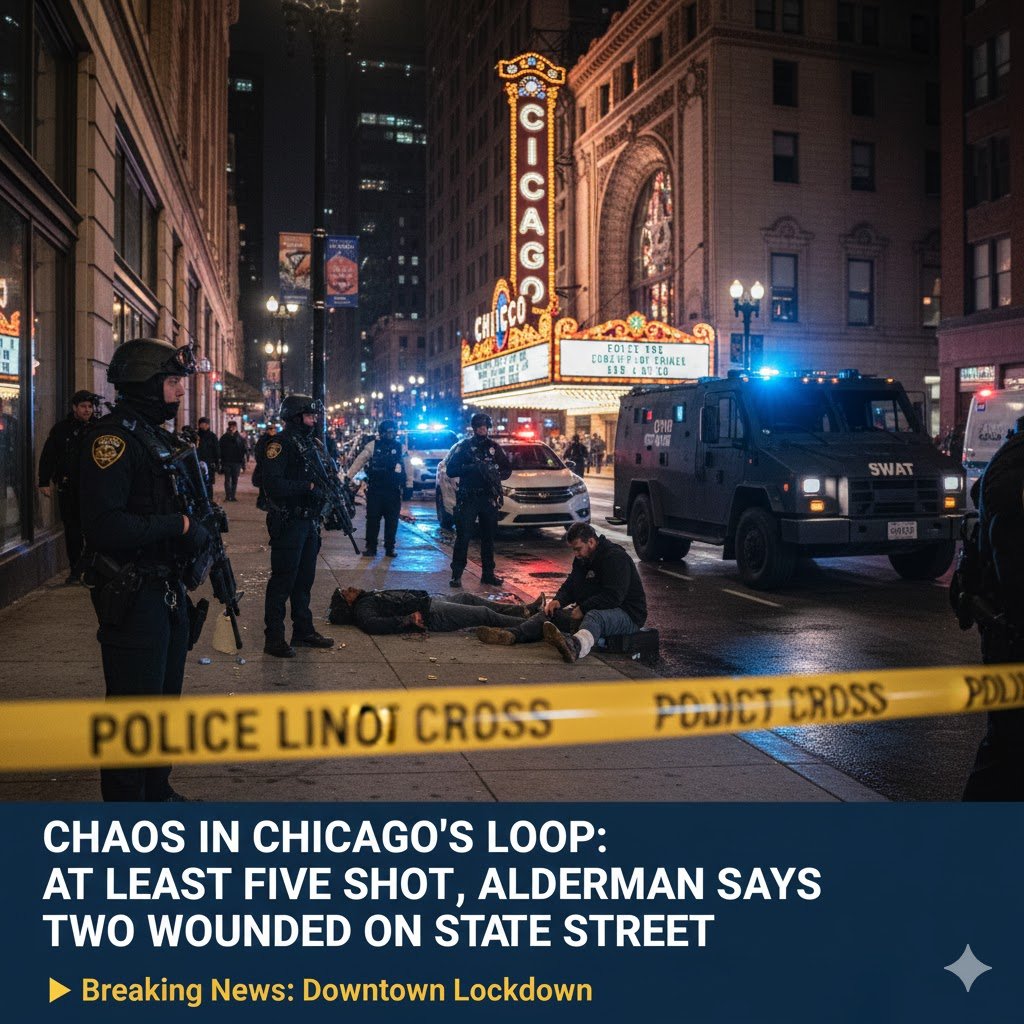
Gunfire Erupts in Chicago’s Loop: At Least Five Shot, Alderman Reports Rioting Crowd
Chicago shooting incidents shook the downtown Loop on a night that was supposed to be festive, turning celebrations into chaos. According to a city alderman, at least five people were shot, dozens of juveniles were reportedly rioting, and multiple police officers were injured during the unrest. While several details are still unconfirmed, the dramatic scenes have raised serious concerns about public safety, youth gatherings, and rising violence in one of Chicago’s busiest areas.
A Festive Night Turns Frightening
The trouble began just a few hours after Chicago’s annual Christmas tree lighting ceremony. Thousands had gathered in the Loop earlier in the evening, and the glow of the lights and holiday spirit seemed to promise a memorable community event. But by later in the night, the atmosphere had shifted dramatically.
By about 10:49 p.m., Brian Hopkins, the alderman for Chicago’s 2nd Ward, posted a dire message: he said roughly 300 juveniles were “rioting” in the Loop. He claimed that at least five people had been shot, one of them in “critical” condition with a life-threatening gunshot wound to the torso. Further, he reported that multiple police officers had been attacked using mace and stun guns, and at least one officer was hospitalized.
These were not small scuffles: according to the alderman, the violence was widespread, involving a large crowd and serious injuries.
Confirmations, Contrasts, and the Unknown
Despite the alderman’s vivid description, law enforcement has not confirmed all of his claims. Chicago Police did acknowledge that a shooting had taken place downtown, but they did not confirm how many people were wounded.
Independent media reports suggest a lower count: at least two people were shot near State Street, close to the Chicago Theatre and a TV station’s studios, according to eyewitnesses. These discrepancies between the alderman’s report and media accounts leave some key details unresolved — including exactly how many victims there are, what their conditions are, and whether all five reported by the alderman were actually injured by gunfire.
Police presence in the area was heavy shortly after the shooting was reported. Multiple ambulances arrived, crime-scene tape went up, and officers moved quickly to secure the surroundings. But as of now, names of the victims, their status, motives, or any arrests have not been publicly disclosed.
Crowd Behavior: Rioting or Gathering?
A striking part of the alderman’s account centers on the size and behavior of the crowd. He claimed that about 300 young people, mostly juveniles, were “rioting.” According to him, these youths weren’t simply loitering — some allegedly used mace and stun guns against officers, turning disorder into a violent confrontation.
If accurate, this raises deep concerns about youth conduct and policing strategies in public spaces. But police have not independently confirmed this scale of rioting or the specific acts of aggression described by Hopkins.
Some commenters and onlookers have expressed skepticism about the “300 juveniles” figure, given that large public disturbances generally draw significant media and police attention. Without full verification, part of the story remains a matter of public debate.
A Pattern of Youth-Driven Incidents
This is not the first time that large groups of young people have caused disruption in Chicago’s Loop. In recent months and years, there have been repeated incidents of big crowds gathering downtown, sometimes resulting in violence or arrests.
For example, there had been reports earlier of hundreds of teens congregating around State Street, leading to fights, bottles being thrown, and even gunfire. In another earlier gathering, two teenagers were shot during a crowd situation, according to police reports. Such scenes suggest a recurring tension between youthful, unsupervised downtown activity and public safety efforts.
These frequent gatherings have prompted city leaders, law enforcement, and community members to call for better strategies — including more proactive policing, youth outreach, and structured supervision — especially during major city events.
Impact on Police and Public Safety
If the alderman’s claims of officers being attacked are accurate, this would mark a worrying escalation. Police officers being assaulted with stun guns and mace suggests that the confrontation went beyond spontaneous chaos; it implies active hostility.
One officer was allegedly hospitalized, underscoring the risk that law enforcement personnel faced that night. The dynamics of the confrontation — officers responding to gunfire while also dealing with a large, unruly crowd — make for a highly complex situation.
From a public safety perspective, the incident highlights a fragile balance: protecting citizens from violence, managing large crowds, and ensuring that teenage gatherings do not turn dangerous.
Reactions from the Community
Residents, business owners, and citizens who frequent the Loop were shaken. Many described the downtown area — normally bustling with shops, offices, and theaters — as transformed by the night’s violence. For visitors who had come earlier to celebrate the tree lighting, the sudden shift to chaos was deeply unsettling.
Some local voices emphasized the need for more robust crowd-control measures and preventive policing during city events. They argue that without clear supervision and resources, downtown spaces become vulnerable to disorder.
Others urged caution, insisting that any response should be proportional and based on confirmed facts. They point out that while social media posts and alderman statements raise alarm, the full story should come from verified police reports.
What’s Next: Investigation Underway
Chicago Police Department has launched an investigation into the shooting and the reported unrest. Detectives are working to determine who fired shots, how many people were injured, and whether the crowd described by the alderman actively participated in violence.
Questions that remain central to understanding the incident include:
- Who were the shooters? Were they part of the larger crowd, or separate individuals?
- What was the motive behind the shooting? Was it a targeted attack, or random violence?
- How many people were truly shot, and what is their medical status?
- Were any arrests made, or will be made, in connection with the violence?
- What triggered the alleged rioting — and what role did the juveniles play?
City officials now face pressure to provide transparency and clarity. The alderman’s aggressive language and detailed allegations have raised expectations for a full accounting from law enforcement.
Broader Implications for Chicago
This incident is more than a one-night problem — it’s emblematic of deeper challenges the city faces. Growing gun violence, tensions between youth populations and authorities, and safety in public gathering spaces are all part of a complex matrix.
- Youth Engagement: If hundreds of juveniles can gather and allegedly riot, that signals a need for constructive engagement. Chicago may need to invest more in youth outreach, mentorship, and supervised public programming.
- Policing Strategy: The clash raises questions about police preparedness for mass disturbance. Are there enough officers deployed during big events? Is the current strategy effective in both deterring and responding to criminal behavior among large crowds?
- Public Safety Policy: City leaders might need to revisit policies around downtown events, curfews, or the use of public space to prevent similar escalations.
- Community Trust: Transparency will be key. The gap between political claims and official confirmation can erode public trust. For long-term change, community members need to believe that investigations are thorough, fair, and open.
Conclusion
A night meant to celebrate joy in downtown Chicago took a harrowing turn. According to one alderman, at least five people were shot, a large group of youths rioted, and police officers were injured. While not every claim has been independently verified, the core facts — that a shooting occurred and that there was a significant police response — are not in dispute.
As investigators dig deeper, Chicagoans are left grappling with the implications. How did a festive evening slide into chaos? Who was behind the shots, and how many were truly wounded? And perhaps most importantly: how can the city prevent such a conflagration of violence and disorder from reoccurring, especially in spaces that are meant to be centers of community and celebration?
For now, the investigation proceeds. But the questions raised by this incident may linger long after the bullet casings are cleared, touching on public safety, youth behavior, and the character of downtown Chicago itself.