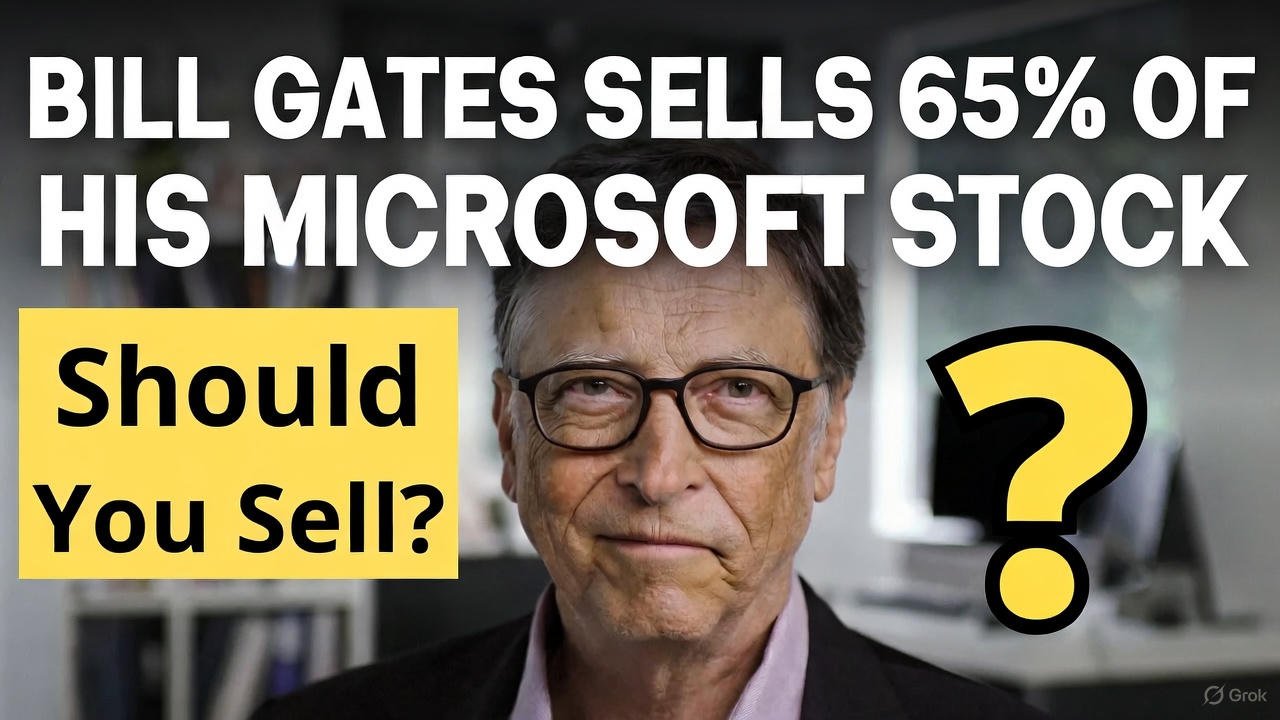
In the high-stakes world of Wall Street, few names carry the weight that Bill Gates does. The co-founder of Microsoft, once the world’s richest man, has long been synonymous with the tech giant that revolutionized computing. But on a crisp November morning in 2025, headlines exploded across financial news outlets: Bill Gates, through his Bill & Melinda Gates Foundation Trust, had offloaded nearly 65% of its massive Microsoft stake. That’s right—about 17 million shares, worth a staggering $8.7 billion, vanished from the portfolio in the third quarter alone. The move sent ripples through investor circles, sparking urgent questions about the health of Microsoft stock. Is this a red flag waving in the face of overvaluation? Or just another chapter in Gates’ long-planned philanthropy playbook?
As of today, November 24, 2025, Microsoft’s stock price hovers around $471.49, a slight dip of 0.13% from its previous close. It’s down from its all-time high of $541.06 hit back in October, but still up a respectable 21.7% year-to-date. For everyday investors glued to their brokerage apps, tracking the microsoft stock price isn’t just a hobby—it’s a lifeline. And with Gates’ dramatic exit making waves, the big dilemma looms: Should you hit the sell button too, or hold the line? In this deep dive, we’ll unpack the sale, Gates’ motivations, Microsoft’s rock-solid fundamentals, and what it all means for your portfolio. Buckle up; the truth might surprise you.
Unpacking the Bombshell Sale: What Exactly Happened?
Let’s start with the facts, because in investing, rumors can kill faster than a market crash. The Bill & Melinda Gates Foundation Trust, which manages the bulk of Gates’ fortune dedicated to global health and education initiatives, filed its latest 13F-HR report with the SEC for the quarter ending September 30, 2025. What it revealed was jaw-dropping: a 64.91% reduction in its Microsoft holdings. From a position valued at roughly $13.9 billion—comprising about 26 million shares—the trust trimmed it down to around $4.76 billion, or just 9 million shares. Sold at an average price of $510.13 per share during the quarter, this wasn’t a fire sale; it was a calculated liquidation that netted the foundation a cool $8.7 billion in cash.
This isn’t the first time Gates has lightened his load on Microsoft. He’s been steadily divesting since stepping away from the company’s board in 2020, amid personal and professional transitions. But the scale here feels seismic. Microsoft, once the crown jewel of the trust’s $37 billion portfolio (representing a third of its assets just a year ago), has tumbled to fourth place. It’s now overshadowed by stalwarts like Berkshire Hathaway ($10.9 billion stake), Waste Management, and Canadian National Railway. The trust also unloaded all its shares in Crown Castle and UPS, and trimmed Berkshire by over 2 million shares, signaling a broader portfolio rebalancing.
Market reaction? Muted, at least initially. Microsoft’s shares barely flinched on the news, closing the week after the filing with a modest 1.32% drop to $472.12. Why the calm? Savvy traders know Gates isn’t your typical insider. His foundation’s moves are driven by charitable imperatives, not quarterly earnings whispers. Still, for retail investors watching the microsoft stock price tick by tick, it’s hard not to wonder if the Oracle of Redmond sees storm clouds we don’t.
Why Would Gates Pull the Trigger Now? The Philanthropy Imperative Meets Smart Money Moves
Bill Gates isn’t hoarding cash for a rainy day yacht purchase. At 70 years old, with a net worth north of $106 billion, he’s on a mission to give it all away—99% of it, to be precise—before he shuffles off this mortal coil. The foundation, his primary vehicle for that ambition, burns through about $7 billion annually on everything from vaccine distribution in Africa to climate tech R&D. That $8.7 billion windfall? It’s rocket fuel for those efforts, especially as global challenges like pandemics and inequality show no signs of easing.
But there’s more to this than feel-good altruism. Diversification has always been Gates’ quiet mantra. Back in the 1990s, when Microsoft stock was his personal piggy bank, antitrust scrutiny nearly toppled the empire. Gates learned the hard way: Never put all your eggs in one silicon basket. Over decades, he’s funneled proceeds into a eclectic mix—think railroads for steady dividends, waste management for ESG appeal, and even stakes in McDonald’s for that ironic fast-food flair. This latest purge fits the pattern: reducing concentration risk in a single stock, no matter how blue-chip.
Timing-wise, Q3 2025 was ripe. Microsoft shares had surged 30% in the prior six months, fueled by AI hype and blockbuster earnings. Selling high locks in gains without timing the top perfectly. And let’s not forget macroeconomic headwinds: Inflation’s stubborn bite, geopolitical tensions in tech supply chains, and whispers of a Fed pivot could squeeze growth stocks like MSFT. Gates, advised by a team of Wall Street wizards, likely saw this as a “sell strength” moment. As one analyst quipped in a recent Barron’s piece, “Gates isn’t betting against Microsoft; he’s just betting on humanity a little more.”
Critics, though, smell something fishier. With AI investments ballooning—Microsoft’s poured billions into OpenAI—could Gates be wary of the capex black hole? Or is it personal? His 2021 divorce from Melinda French Gates reshuffled assets, and recent foundation board shakeups hint at internal shifts. Whatever the cocktail of reasons, one thing’s clear: This sale isn’t a referendum on Microsoft’s future. It’s a billionaire’s balancing act between legacy-building and liquidity.
Microsoft’s Fortress: Why the Stock Price Still Shines in 2025
Zoom out from Gates’ ledger, and Microsoft’s story is one of unrelenting dominance. As of November 24, 2025, the microsoft stock price sits at $471.49, reflecting a 20% year-to-date gain that outpaces the S&P 500’s 13%. Sure, it’s off the October peak of $541, but that’s par for the course in a year of AI euphoria followed by profit-taking. The 52-week range—from a low of $344.79 to a high of $555.45—tells a tale of volatility, but the uptrend is unmistakable.
What fuels this resilience? Start with the numbers from the just-reported fiscal Q1 2026 earnings (quarter ended September 30). Revenue rocketed 18% year-over-year to $77.7 billion, smashing Wall Street’s $75.33 billion forecast. Earnings per share clocked in at $4.13, a 23% jump and well above the $3.67 consensus. The star? Azure cloud, Microsoft’s cash cow, which grew 40%—more than double the overall cloud market’s pace. Intelligent Cloud revenue alone hit $30.9 billion, up 28%, as enterprises flock to Copilot AI tools and hybrid setups.
Broader fiscal 2025 was a banner year too. Full-year revenue topped $281.7 billion, a 15% increase, with operating income swelling 17% to $128.5 billion. Azure crossed $75 billion in annual run-rate, underscoring Microsoft’s pivot from legacy software to AI overlord. Productivity segments like Microsoft 365 added $33 billion in Q1 revenue, up 17%, while gaming and devices held steady despite Xbox headwinds.
Analysts remain bullish. The average 12-month price target? A juicy $634.33, implying 34% upside from here. High-end calls hit $730, betting on AI monetization. Risks? Sure—regulatory scrutiny over OpenAI ties and data privacy could sting. But with a fortress balance sheet (net cash of $80 billion) and 0.7% dividend yield, MSFT is the ultimate “set it and forget it” play.
In short, while Gates cashes out, Microsoft’s engine hums louder than ever. The microsoft stock price dip? Likely just noise in a symphony of growth.
Reading the Tea Leaves: Does Gates’ Move Signal Trouble?
Gates’ sale has ignited a firestorm of speculation. Is he the canary in the coal mine for Big Tech’s AI bubble? After all, he’s no stranger to Microsoft’s inner sanctum—his insights could flag overhyping in generative AI, where capex hit $20 billion last quarter alone. Some pundits point to the stock’s recent 12% pullback post-earnings, blaming Gates for spooking momentum traders. “When the founder sells big, listen,” warns a Motley Fool analysis, noting similar insider dumps preceded the 2022 tech rout.
Yet context matters. Gates’ trust has shed Microsoft shares annually since 2008, when he exited day-to-day ops. This 65% slice is aggressive, but the remaining $4.76 billion stake—still the fourth-largest holding—screams confidence, not capitulation. Compare it to Elon Musk unloading Tesla: Gates isn’t tweeting doom; he’s quietly reallocating for good causes. Moreover, institutional ownership in MSFT tops 70%, with Vanguard and BlackRock piling in. If smart money smelled rot, we’d see exodus, not inflows.
Broader market dynamics play in too. With the Nasdaq flirting with correction territory amid election jitters, value rotation favors Gates’ picks like railroads over frothy tech. But Microsoft’s moat—Windows’ 70% desktop share, Office’s ubiquity, Azure’s 25% cloud market slice—dwarfs peers. AI isn’t a gamble; it’s embedded, powering 85% of Fortune 500 firms via Copilot.
Bottom line: Gates’ dump is personal finance, not prophecy. For the microsoft stock price, it’s a blip, not a bust.
Should You Sell? Weighing the Case for Cashing Out vs. Holding Tight
Now, the million-dollar question: If you’re sitting on Microsoft shares, is it time to follow Gates out the door? Let’s break it down like a pro portfolio review.
The Sell Case: Momentum matters. MSFT’s P/E ratio at 35x forward earnings screams premium—higher than Apple’s 28x or Google’s 24x. With AI hype cooling (OpenAI’s valuation drama didn’t help), a 10-15% correction isn’t wild. Gates’ sale amplifies that: If the foundation needs cash for do-gooding, maybe markets are peaking. Add rising rates (10-year Treasury at 4.2%) squeezing growth multiples, and selling now locks in 2025’s gains before a potential 2026 slowdown. For risk-averse folks or those needing liquidity, it’s prudent—diversify into bonds or value plays like Gates’ Berkshire.
The Hold (or Buy) Case: Fundamentals trump headlines. Microsoft’s 15%+ revenue CAGR, 68% cloud margins, and $110 billion buyback authorization scream compounding machine. Analysts’ $634 target isn’t pie-in-the-sky; it’s backed by 17% EPS growth projected for FY2026. Volatility? Buy the dip—history shows MSFT rebounds 25%+ post-10% drops. And dividends: That quarterly payout, growing 10% annually, rewards patience. If you’re long-term (5+ years), Gates’ move is irrelevant; Microsoft’s AI moat will widen, potentially doubling the stock by 2030.
My take? Unless you’re over-allocated or short on cash, hold. Selling on one man’s philanthropy is emotional trading at its worst. Rebalance if MSFT exceeds 10% of your portfolio, but panic-selling? That’s how you miss the next leg up.
Final Thoughts: Gates’ Legacy Isn’t in Shares—It’s in the World He Builds
Bill Gates’ 65% Microsoft dump is a masterclass in intentional wealth: Selling high to fund low, trading stock certificates for real change. For Microsoft, it’s business as usual—a behemoth unfazed by its founder’s portfolio tweaks. The microsoft stock price, at $471 today, reflects a company primed for AI’s golden age, not Gates’ goodbye.
So, should you sell? Only if it fits your story, not his. In investing, as in life, chase your north star. Microsoft’s shines bright—keep it in your constellation, and watch it light the way.