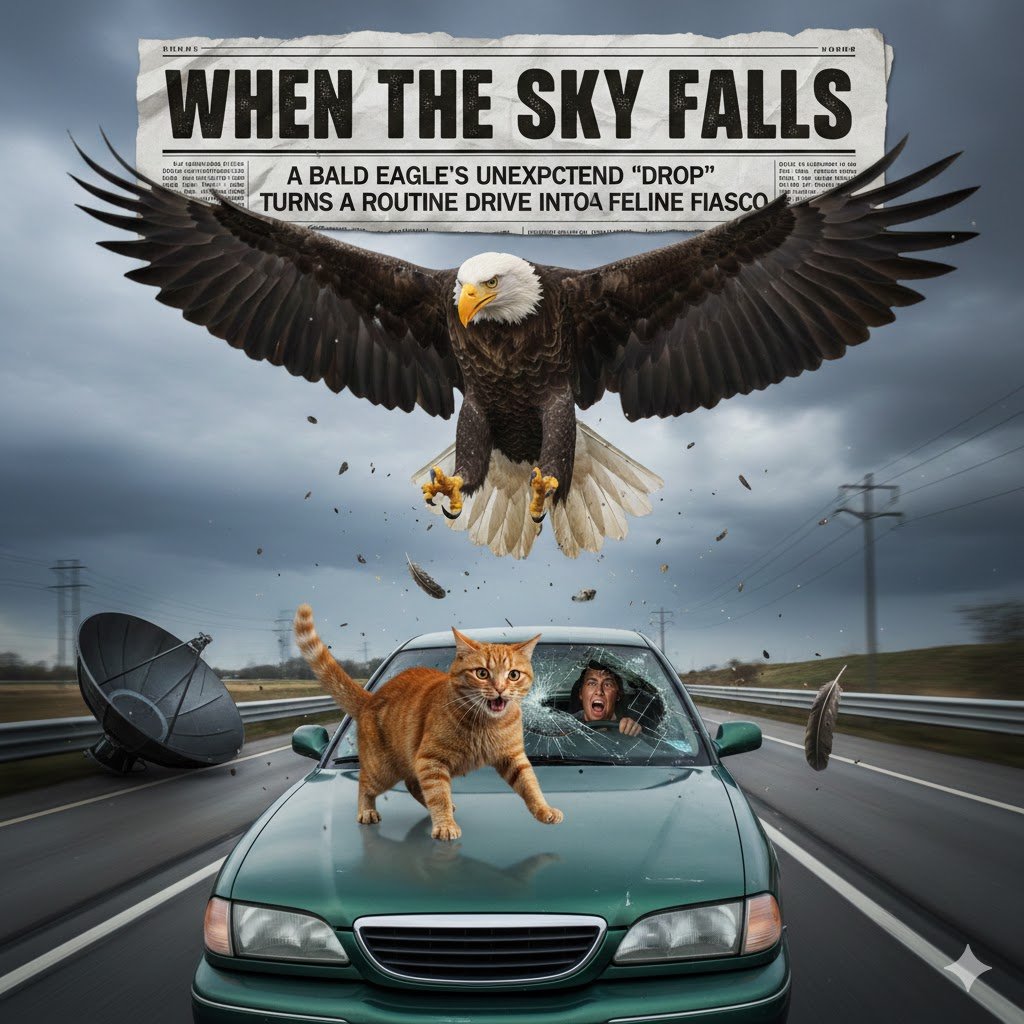
In the misty embrace of the Great Smoky Mountains, where the air hums with the secrets of ancient forests and the roads twist like forgotten trails, Melissa Schlarb thought she was just starting another ordinary Wednesday. At 28, the Bryson City resident was no stranger to the wild rhythms of western North Carolina—deer darting across highways, black bears rummaging through campsites, and the occasional hawk circling overhead like a sentinel. But nothing could have prepared her for the moment when a majestic bald eagle decided to make her windshield the unwitting stage for a mid-air mishap. “You may not believe me,” she stammered into her phone during a frantic 911 call, “but I just had a bald eagle drop a cat through my windshield.” What followed was a shatter of glass, a splatter of shock, and a story that’s rippling through the region like a stone skipped across a mountain stream.
It was around 8:17 a.m. on November 19, 2025, when Schlarb merged onto U.S. Route 74 in Swain County, a scenic stretch of asphalt that hugs the edges of the Great Smoky Mountains National Park. The highway, often dotted with leaf-peepers in fall and adventure-seekers year-round, was quiet that crisp autumn morning. Fog lingered in the valleys, and the first hints of sunlight pierced the canopy of hardwoods turning shades of amber and crimson. Schlarb, commuting to her job at a local tourism office, had her radio tuned to a classic country station, sipping coffee from a travel mug, and mentally mapping out her day. That’s when the sky intervened in the most literal—and feline—way possible.
From out of nowhere, a bald eagle—America’s iconic symbol of freedom, with a wingspan that can stretch up to seven feet—soared low over the roadway. In its talons? The limp form of a house cat, perhaps a stray or a feral wanderer that had crossed paths with the raptor one talon too many. Eagles, opportunistic hunters by nature, are known to snatch small mammals and birds mid-stride, but this one seemed to reconsider its breakfast menu at the worst possible altitude. Whether the cat was too heavy, too feisty in its final throes, or simply not to the eagle’s liking, the bird released its grip. And down it came, plummeting like a furry meteor straight toward Schlarb’s sedan.
The impact was instantaneous and deafening. The cat’s body collided with the passenger-side front windshield, exploding through the laminated glass in a cascade of shards and fur. Schlarb swerved instinctively, her heart pounding as adrenaline flooded her veins. “It was like a bomb went off in slow motion,” she later recounted to local reporters, her voice still laced with disbelief. The windshield buckled inward, a spiderweb of cracks radiating from the point of entry, but miraculously, the cat didn’t make it fully inside the vehicle. Instead, it tumbled onto the dashboard before rolling out through the breach and landing on the roadside, lifeless and matted with debris.
Schlarb pulled over, hands trembling on the steering wheel, and fumbled for her phone. Her call to Swain County emergency services captured the raw chaos of the moment. “Ma’am, are you okay?” the dispatcher asked calmly, her tone a lifeline amid the panic. “Yeah, but… oh my God,” Schlarb replied, the words tumbling out. She described the eagle’s graceful arc, the sudden drop, and the visceral thud that followed. The dispatcher, unfazed by years of fielding tales from the wilds of Appalachia, chuckled softly. “Okay, I do believe you, honestly.” Another motorist, trailing a few cars back, had witnessed the spectacle and stopped to check on her. “That is the craziest thing I’ve ever seen,” he told her, shaking his head. Schlarb, still processing, could only nod. “Really? Because I feel like I’m in some kind of nightmare.”
North Carolina State Highway Patrol troopers arrived within minutes, their lights flashing against the forested backdrop. They documented the scene: a gaping hole in the windshield roughly the size of a basketball, glittering glass fragments scattered across the shoulder, and the unfortunate cat’s remains respectfully removed for disposal. No citations were issued—after all, how do you ticket a bird of prey?—but the incident report painted a vivid picture of nature’s unscripted drama. Schlarb escaped without a scratch, though the emotional whiplash left her shaken. “I kept replaying it in my head,” she said. “One second, I’m thinking about my to-do list; the next, there’s literal guts on my dash. It’s a reminder that out here, the wild doesn’t care about your schedule.”
To understand why this drop happened at all, we have to delve into the world of the bald eagle, Haliaeetus leucocephalus, a species that has clawed its way back from the brink of extinction. Once nearly wiped out by DDT pesticides and habitat loss in the mid-20th century, bald eagles have staged a remarkable comeback, thanks to conservation efforts like the Endangered Species Act of 1973. Today, North Carolina boasts over 1,500 nesting pairs, with Swain County serving as a hotspot near the park’s abundant waterways and forests. Eagles here thrive on fish from the Oconaluftee River and Tuckasegee River, but they’re not above opportunistic grabs. “Eagles are like the ultimate scavengers-cum-hunters,” explains Dr. Elena Vasquez, a wildlife biologist with the U.S. Fish and Wildlife Service. “They’ll snatch rabbits, squirrels, or even roadkill if it’s fresh. Cats, especially ferals, are easy targets in rural areas where pets roam free.”
But the drop? That’s where things get intriguing. Eagles don’t always nail their landings—literally. Prey that’s too bulky or awkwardly gripped can slip free during transport, especially if the bird is flying low to scan for threats or better perches. In this case, the eagle might have misjudged the cat’s weight—house cats average 8 to 10 pounds, a hefty load for a bird topping out at 14 pounds itself—or encountered an unexpected gust from the mountain thermals. “It’s rare but not unheard of,” Vasquez notes. “We’ve documented eagles dropping fish back into lakes when they realize it’s spoiled, or discarding rodents mid-flight. Nature’s full of these little rejects.” In the Great Smoky Mountains, where human encroachment meets untamed wilderness, such encounters are on the rise. The park sees millions of visitors annually, and highways like US-74 act as corridors for both cars and critters, amplifying the odds of a crossover catastrophe.
Schlarb’s ordeal isn’t the first time an avian drop has turned heads—or windshields—in the U.S. Back in 2019, a Florida man reported a similar shock when an osprey hurled a mullet through his truck’s glass on the Tamiami Trail, leaving fish scales embedded in the seats. Closer to home, in 2022, a Tennessee driver near Gatlinburg dodged injury when a hawk released a squirrel onto his hood, causing a multi-car pileup. And let’s not forget the infamous 2015 incident in Alaska, where a bear cub tumbled from an eagle’s grasp onto a snowmobiler’s helmet—thankfully, more cartoonish than catastrophic. These stories, often shared on social media with hashtags like #EagleFail or #SkyDrop, highlight a quirky underbelly of wildlife rehabilitation: the rejects. “It’s evolution in action,” says wildlife rehabilitator Tom Hargrove from the Carolina Raptor Center. “Predators test, they err, and they learn. But for us humans, it’s a front-row seat to the food chain’s blooper reel.”
For Schlarb, though, the humor took a backseat to the hassle. With her car towed to a local garage for repairs—estimated at $1,200 for a full windshield replacement—she spent the day borrowing a colleague’s vehicle and fielding calls from concerned friends. Insurance covered the damage under comprehensive collision, classifying it as a “wildlife strike,” but the psychological toll lingered. “I love living here for the beauty and the quiet,” she admitted over coffee at a Bryson City diner, “but now every shadow overhead makes me flinch. It’s like the sky’s not safe anymore.” Her tale quickly went viral, amplified by the Highway Patrol’s release of the 911 audio and a stark photo of the shattered glass. Online, reactions poured in: memes of eagles as clumsy delivery services, puns about “cat-astrophic drops,” and earnest debates on feral cat populations. One X post quipped, “When your UberEats order arrives via bald eagle—extra fur included!” Another sparked a thread on spaying/neutering strays to reduce eagle snacks.
This drop also shines a light on broader issues in the Blue Ridge Mountains. Swain County, with its population of just 14,000, grapples with the double-edged sword of tourism and wildlife. The Great Smoky Mountains National Park, straddling the Tennessee-North Carolina border, draws 14 million visitors yearly, boosting local economies but straining ecosystems. Feral cats, descendants of domesticated pets gone wild, number in the thousands across the region, preying on native birds and small mammals while becoming prey themselves. “It’s a vicious cycle,” says local conservationist Maria Delgado, who runs a trap-neuter-release program through the Swain County Humane Society. “Eagles are doing what comes naturally, but we’re the ones tipping the scales by letting pets roam. Education and outreach are key—keep your cats indoors, support TNR efforts, and drive defensively in eagle country.”
Defensive driving takes on new meaning here. The North Carolina Department of Transportation recommends slowing down in known wildlife zones, using high beams judiciously at dawn and dusk, and staying alert for low-flying raptors. Signs along US-74 already warn of deer crossings, but perhaps it’s time for an “Eagle Overhead” advisory. Trooper Jenna Mills, who responded to Schlarb’s scene, echoes the sentiment: “We’ve seen it all—turkeys in the road, coyotes at midnight—but this? It’s a first. Slow down, eyes up, and remember: the mountains have eyes, wings, and occasionally, bad aim.”
As the sun set on that fateful Wednesday, Schlarb returned home to her cozy cabin overlooking the Nantahala River, the eagle’s drop still echoing in her mind. Friends rallied with casseroles and cat-themed gag gifts—a plush eagle clutching a toy mouse, a “I Survived the Sky Drop” mug. She laughed about it now, the terror softening into tale-spinning fodder for future bonfires. “In the end,” she reflected, “it’s a wild story from a wild place. North Carolina wouldn’t be the same without these moments that make you feel alive—glass shards and all.”
Yet beneath the chuckles lies a poignant truth: in our rush to conquer the landscape with highways and headlights, we brush shoulders with a world that operates on instinct, not itineraries. The bald eagle, once a harbinger of national pride, reminds us of our fragility in the grand tapestry. Its drop wasn’t malice or mayhem, but a fleeting fumble in the eternal hunt. For Melissa Schlarb, it was a wake-up call from above—one cat, one crash, one unshakable story. As winter approaches and the mountains cloak themselves in frost, drivers along Route 74 might glance skyward a little longer, wondering what the next drop might bring. In the Smokies, after all, the only predictable thing is the unpredictability.