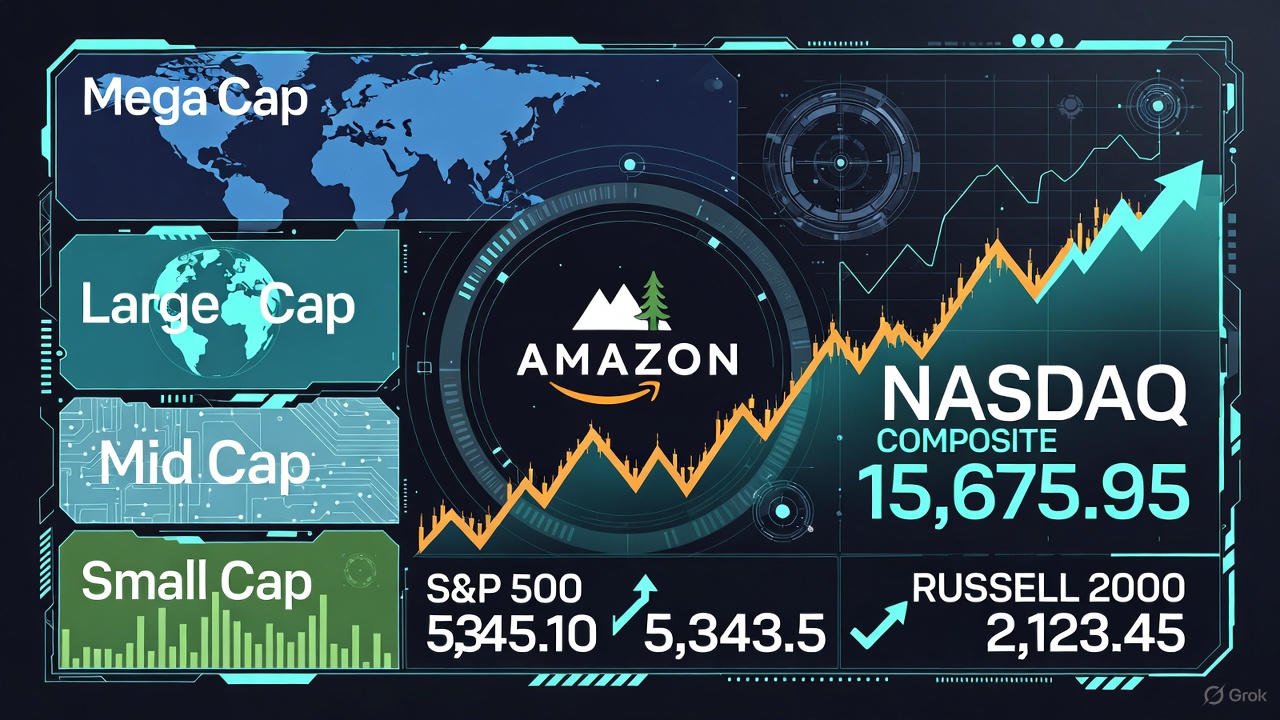
In the ever-shifting landscape of U.S. equities, few companies cast as long a shadow as Amazon.com Inc. As a cornerstone of the Nasdaq Composite, the e-commerce and cloud computing giant doesn’t just participate in the market—it shapes it. The Nasdaq Composite, a broad index tracking over 3,000 stocks listed on the Nasdaq exchange, serves as a vital barometer for technology-driven growth and innovation. With Amazon commanding a market capitalization exceeding $2.3 trillion, its every move sends ripples through this index, influencing everything from mega-cap behemoths to nimble small-cap upstarts. But what happens when institutional investors adjust their stakes in Amazon? These “stake movements”—shifts in ownership by major funds and asset managers—can cascade across the Nasdaq Composite’s diverse market layers, amplifying trends in sectors like retail, cloud services, and artificial intelligence (AI).
Recent regulatory filings, including quarterly 13F reports from the Securities and Exchange Commission (SEC), underscore this dynamic. Institutional ownership in Amazon hovers around 72.2%, a testament to its appeal as a diversified powerhouse spanning e-commerce, advertising, and AWS (Amazon Web Services). In the third quarter of 2025 alone, funds like Capital Square LLC and Watts Gwilliam & Co. LLC boosted their positions, signaling confidence amid volatile markets. Yet, not all movements are upward; Amazon itself trimmed stakes in high-flying names like IonQ and Advanced Micro Devices (AMD), reallocating capital toward core AI and logistics bets. These adjustments aren’t isolated—they reverberate through the Nasdaq Composite’s stratified layers: mega-cap titans, large-cap stalwarts, mid-cap innovators, and small-cap disruptors. Understanding this interplay is key for investors navigating 2025’s choppy waters, where AI hype meets economic headwinds.
The Mega-Cap Anchor: Amazon’s Dominant Grip on the Index
At the apex of the Nasdaq Composite sits the mega-cap layer, where companies with market caps north of $200 billion hold sway. Amazon, with its $2.3 trillion valuation, ranks among the elite, contributing roughly 5-7% to the index’s overall weighting—second only to peers like Nvidia and Microsoft in influence. This isn’t mere size; it’s structural power. The Nasdaq Composite is market-cap weighted, meaning Amazon’s stock fluctuations disproportionately steer the index’s direction. When Amazon’s shares surged nearly 10% following its blowout Q3 earnings in late October 2025—reporting $180.17 billion in revenue, up 13.4% year-over-year—the entire Nasdaq Composite climbed, offsetting broader AI sector jitters.
Stake movements here are seismic. Institutional heavyweights like Vanguard, BlackRock, and State Street—collectively holding over 20% of Amazon’s float—have net increased positions in 2025, with 3,078 additions outpacing 2,209 reductions. This buildup reflects Amazon’s evolution from e-commerce retailer to AI infrastructure kingpin. The $38 billion OpenAI deal, announced in early November, exemplifies this shift, funneling ChatGPT’s workloads onto AWS and propelling Amazon’s stock up 4% in a single session while lifting the Nasdaq by 0.46%. For mega-cap peers, the effects compound: Microsoft’s Azure and Google’s Cloud Platform face stiffer AWS competition, yet collaborative AI ecosystems buoy the layer. Nvidia, supplier of AWS’s Blackwell chips, saw its weighting in the Nasdaq-100 swell to 13.29%, intertwined with Amazon’s capex surge exceeding $120 billion in trailing 12 months.
But risks lurk. Amazon’s forward P/E of 32.82 trades at a premium to the broader retail-wholesale sector’s 21.43, inviting scrutiny if growth falters. Institutional stake trimming, as seen in Q3 when insiders like CEO Andrew Jassy offloaded shares worth millions, can trigger short-term dips, dragging the mega-cap layer—and thus the Nasdaq Composite—downward. Year-to-date, Amazon’s 2.93% gain lags the index’s 13.45% rise, highlighting how stake outflows amplify volatility in this concentrated tier.
Cascading into Large-Cap Stability: Sectoral Spillovers
Descending to the large-cap layer ($10-200 billion market caps), Amazon’s stake movements foster a web of dependencies and competitions. This stratum, home to about 20% of Nasdaq Composite components, includes established players in consumer discretionary and tech services—sectors where Amazon reigns supreme. When institutions pile into Amazon, capital often flows to symbiotic firms, bolstering the layer’s resilience.
Consider the e-commerce ripple: Amazon’s logistics dominance, powered by over 1 million autonomous robots slashing delivery times by 60% in rural areas, pressures large-cap rivals like Etsy or Wayfair. Yet, stake inflows into Amazon correlate with gains in advertising peers; Alphabet’s Google, with a 6.06% Nasdaq-100 weighting, benefits from shared ad-tech ecosystems, as Amazon’s Rufus AI boosts conversion rates by 60%. In Q3 2025, hedge funds upped Amazon exposure by 9.5% via JPMorgan Chase, spilling over to large-cap cloud enablers like Snowflake or Datadog, whose stocks rose 15-20% on AWS partnership announcements.
Conversely, divestments sting. Amazon’s sale of its IonQ stake in quantum computing—part of a $2.5 billion portfolio rebalance—signaled caution in speculative tech, pressuring large-cap quantum and AI hardware firms like Rigetti Computing. This layer, comprising stable growers, absorbs about 40% of the Nasdaq Composite’s volume, so Amazon-driven sentiment swings can widen bid-ask spreads, as seen in October’s AI sell-off when the index shed 5.94% amid stake rotations. Still, positives dominate: Amazon’s $130 billion operating cash flow funds acquisitions, injecting vitality into large-cap supply chain partners like Flexport.
Mid-Cap Momentum: Innovation Under Amazon’s Shadow
The mid-cap layer ($2-10 billion) represents the Nasdaq Composite’s growth engine, with roughly 30% of components fueling emerging trends. Here, Amazon’s stake movements act as a double-edged sword—catalyst for partnerships, caution for direct competitors. Institutions viewing Amazon as a bellwether often mirror moves in mid-caps tied to its ecosystem.
AWS’s expansion into sovereign clouds and Bedrock AI has minted mid-cap winners. Firms like C3.ai or UiPath, leveraging AWS for enterprise AI, saw 25% YTD gains as Amazon’s OpenAI pact validated the stack. Stake increases in Amazon by funds like Alpine Global Management (new $1.285 million position) coincide with mid-cap inflows, as diversified portfolios seek alpha in AWS-adjacent plays. This layer’s beta to Amazon exceeds 1.2, meaning a 1% Amazon uptick can lift mid-caps by 1.5%, per correlation data.
Challenges arise from competition. Amazon’s grocery push, now in 1,000+ cities with same-day delivery, squeezes mid-cap players like Instacart, whose shares dipped 8% post-Amazon earnings amid fears of margin erosion. Institutional outflows from Amazon—net 2,338 reductions in Q2—echo in mid-cap sell-offs, as seen in July’s 6% layer decline tied to capex concerns. Yet, opportunity abounds: Amazon’s $15 billion debt issuance in November, oversubscribed fivefold, signals cheap capital for mid-cap M&A, potentially consolidating the layer.
Small-Cap Echoes: Disruption and Opportunity
At the base, the small-cap layer (<$2 billion) embodies the Nasdaq Composite’s speculative spirit, with over 2,000 components driving 10-15% of the index’s variance. Amazon’s influence here is subtler but profound, as stake movements signal broader risk appetite.
Positive flows amplify: When BlackRock added millions to Amazon in Q1 2025, small-cap AI enablers like SoundHound AI surged 40%, riding AWS’s coattails. Amazon’s ecosystem—via Marketplace seller tools or QuickSight analytics—empowers small-caps, with third-party sales growing 15% YTD. Stake buildups foster this, as retail investors on platforms like Robinhood pile into Amazon-linked small-caps during dips.
Downside risks are acute, though. Amazon’s layoffs of 14,000 in October, tied to AI efficiencies, spooked small-cap labor-tech firms, contributing to a 7% layer drop. Its AMD divestment pressured small-cap chip designers, underscoring how mega-cap reallocations can starve innovation funding. Despite this, the layer’s high-growth potential—averaging 20% revenue CAGR—positions it for rebounds when Amazon’s $94.2 billion cash hoard deploys into ventures.
Institutional Strategies: The Drivers of Movement
Behind these layers lie institutions, whose 13F disclosures paint a bullish picture. Net stake increases reflect Amazon’s “strong buy” consensus, with 40 of 43 analysts rating it positively and a $294.71 median target implying 30% upside. Funds like Maple Capital Management hiked holdings 2.3% to $88.7 million, betting on AWS’s 17-20% growth and 39.5% margins. This cascades: Mega-cap buys lift large/mid-caps via sector rotation, while small-caps gain from venture spillovers.
Bearish notes include insider sales totaling $10.6 million in 90 days, but these are dwarfed by institutional inflows. In a Fed-easing environment, lower yields compress Amazon’s WACC, enhancing layer-wide valuations.
Nasdaq Composite Outlook: Unified Horizons
Amazon’s stake movements unify the Nasdaq Composite’s layers, turning individual bets into index momentum. With the Composite up 33.20% over the past year, Amazon’s Q4 guidance—EPS at $6.31—promises continuity. Looking to 2026, AI capex and logistics AI like Transform (saving 700,000 labor hours annually) position Amazon to lead a 15-20% index rally. Investors should watch 13F deadlines for fresh signals, balancing mega-cap stability with mid/small-cap upside. In this layered ecosystem, Amazon isn’t just a stock—it’s the Nasdaq Composite’s beating heart.