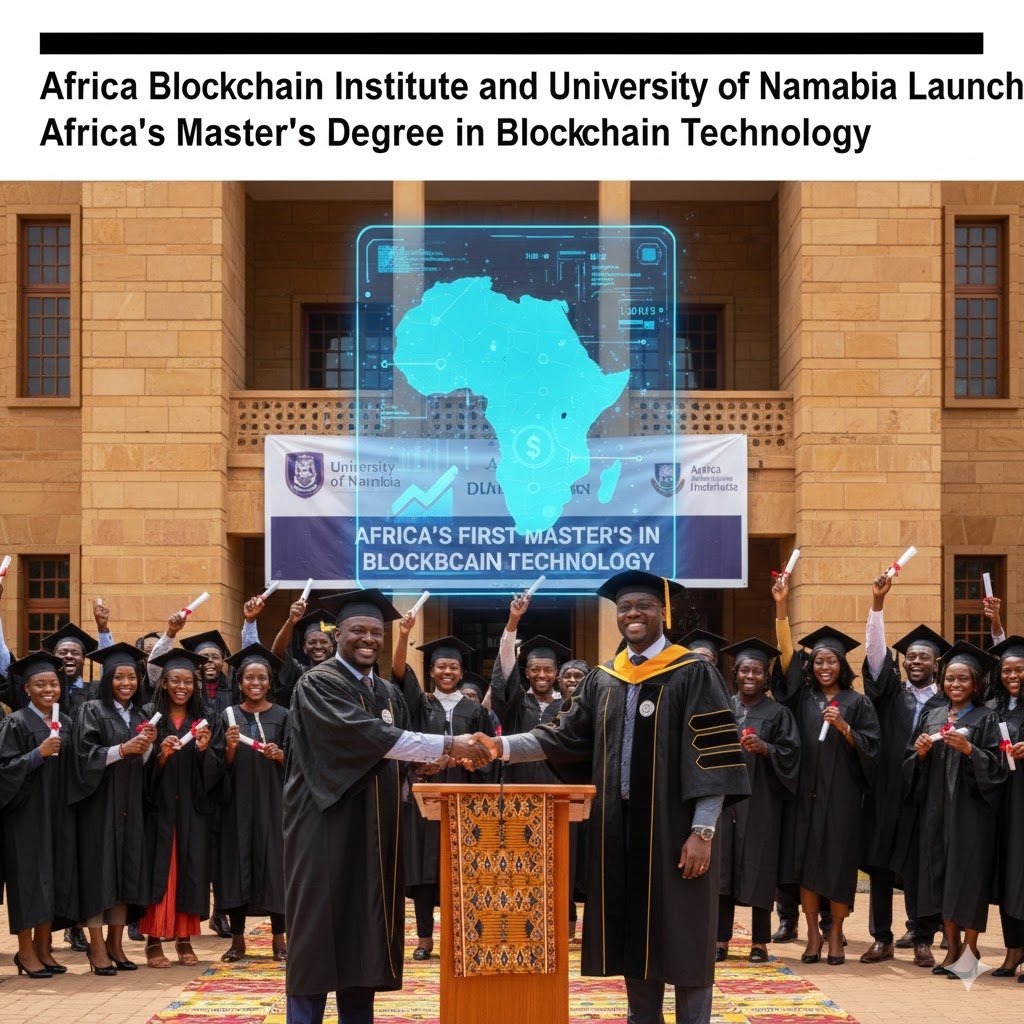
In a historic move for African higher education and technological advancement, the Africa Blockchain Institute (ABI) based in Rwanda and the University of Namibia (UNAM) have officially launched the continent’s first full Master’s degree program dedicated entirely to Blockchain Technology. Announced in Windhoek in late 2025, the MSc in Blockchain Technology is designed to produce home-grown experts who will drive digital innovation, financial inclusion, and transparent governance across Africa for decades to come.
For years, African professionals interested in mastering blockchain have had to travel to Europe, North America, or Asia, or settle for short certificate courses that barely scratch the surface. This new two-year postgraduate program changes everything. It is the first time an accredited African university is offering a comprehensive, research-intensive master’s degree focused exclusively on blockchain and distributed ledger technologies.
Why this program matters now
Africa is already one of the fastest-adopting regions for blockchain solutions in the world. From mobile-money interoperability in East Africa to land-registry pilots in Ghana and Rwanda, from remittance corridors that bypass expensive traditional banks to tokenization of agricultural commodities in Nigeria and Kenya, the technology is quietly reshaping how Africans save, trade, and trust one another.
Yet the continent has suffered from a severe shortage of senior-level talent who truly understand both the technical depth and the socio-economic context of blockchain. Most projects today are still designed and led by foreign consultants. The new MSc program is a deliberate answer to that gap.
Speaking at the launch event, Dr. Innocent Shumba, Provost of the Africa Blockchain Institute, explained: “We have trained over 8,000 young Africans through our short courses and bootcamps since 2018, but we realized that Africa needs PhD-level thinkers and architects, not just users. Partnering with the University of Namibia allows us to institutionalize deep expertise on the continent for the first time.”
Professor Kenneth Matengu, Vice Chancellor of the University of Namibia, added: “This is not just another IT degree. This is about preparing leaders who will build systems that reduce corruption, increase trust in public records, lower the cost of cross-border payments, and create new wealth for ordinary citizens.”
What the curriculum actually covers
The 24-month program is built around four pillars: Theory, Engineering, Application, and African Context.
Year one focuses on foundational and advanced theory:
- Cryptography and consensus mechanisms
- Smart-contract development (Solidity, Rust, Move)
- Layer-1 and Layer-2 scaling solutions
- Token economics and decentralized finance (DeFi)
- Privacy-enhancing technologies and zero-knowledge proofs
- Blockchain interoperability protocols
Students spend significant time in state-of-the-art labs writing and auditing smart contracts, building their own proof-of-stake sidechains, and stress-testing consensus algorithms.
Year two shifts toward real-world African challenges:
- Designing blockchain-based land titling systems that work in customary law environments
- Building low-bandwidth, mobile-first decentralized applications for rural farmers
- Creating central bank digital currency (CBDC) frameworks suitable for small open economies
- Using blockchain for transparent humanitarian aid distribution and election monitoring
- Regulatory sandboxes and policy drafting for African jurisdictions
Every student must complete a research thesis that solves a documented problem in their home country. Past pilot projects already include a cocoa-farmer traceability platform in Côte d’Ivoire and a cross-border payment corridor between Zambia and Namibia using stablecoins.
Who can apply and how the program is funded
The program welcomed its inaugural cohort of 25 students in early 2026, selected from over 400 applications across 22 African countries. Entry requirements include a relevant bachelor’s degree (computer science, engineering, mathematics, economics, or law) with at least a 65% average, plus demonstrated interest in distributed systems.
Tuition is heavily subsidized. The Africa Blockchain Institute covers 70% of the cost for African nationals through grants from pan-African development funds and private-sector partners in the blockchain industry. Namibian citizens pay even less under a government scholarship scheme aimed at building national capacity in emerging technologies.
A few full scholarships are reserved specifically for women and candidates from least-developed countries to ensure diversity and inclusion.
More than just a degree – building an ecosystem
The partnership goes beyond the classroom. ABI and UNAM have jointly established the Southern Africa Blockchain Research Centre on the main campus in Windhoek. The centre already hosts weekly hackathons, industry meetups, and an incubator that has spun out three startups in its first six months.
Major blockchain networks have taken notice. Faculty members now serve as country ambassadors for Cardano, and the university has become an official Plutus Pioneer training partner. Similar relationships are being forged with Stellar, Algorand, and the Celo ecosystem, all of which have strong footprints in African payments and identity.
Perhaps most exciting is the “return-home clause” gently encouraged for graduates: students are asked to commit to spending at least three years working in Africa after graduation, either in the public sector, local startups, or established companies. Early signs show that nearly 90% intend to honor that commitment.
Early success stories
Even before the first cohort graduates, the impact is visible. Maria Nakale, a 28-year-old software developer from northern Namibia and one of the pioneer students, has already built a working prototype that allows communal farmers to register livestock ear-tags on a Hyperledger Fabric network, reducing cattle rustling disputes by providing immutable proof of ownership. Her work is now being piloted in the Kunene region.
Another student from Zimbabwe is collaborating with the Reserve Bank on a regulatory reporting framework using permissioned blockchain, work that could save the central bank millions in reconciliation costs.
The bigger picture for Africa
This master’s program arrives at a pivotal moment. The African Continental Free Trade Area (AfCFTA) is gathering momentum, and seamless, low-cost cross-border payments are essential for its success. At the same time, citizens across the continent are demanding greater transparency in government spending and natural-resource management.
Blockchain, when designed thoughtfully and inclusively, offers tools to meet both challenges. But tools are only as good as the minds wielding them. By producing dozens and eventually hundreds of African blockchain architects, researchers, and policymakers every year, the University of Namibia and Africa Blockchain Institute are planting seeds for a truly indigenous digital economy.
As Dr. Shumba put it in his closing remarks at the launch: “Ten years from now, when people ask who built the payment rails for the African single market, who secured the land rights of millions of smallholder farmers, who made humanitarian aid verifiable in real time, we want the answer to be clear: it was African graduates, trained on African soil, solving African problems with world-class expertise.”
For the first time, that future feels not just possible, but already in motion.