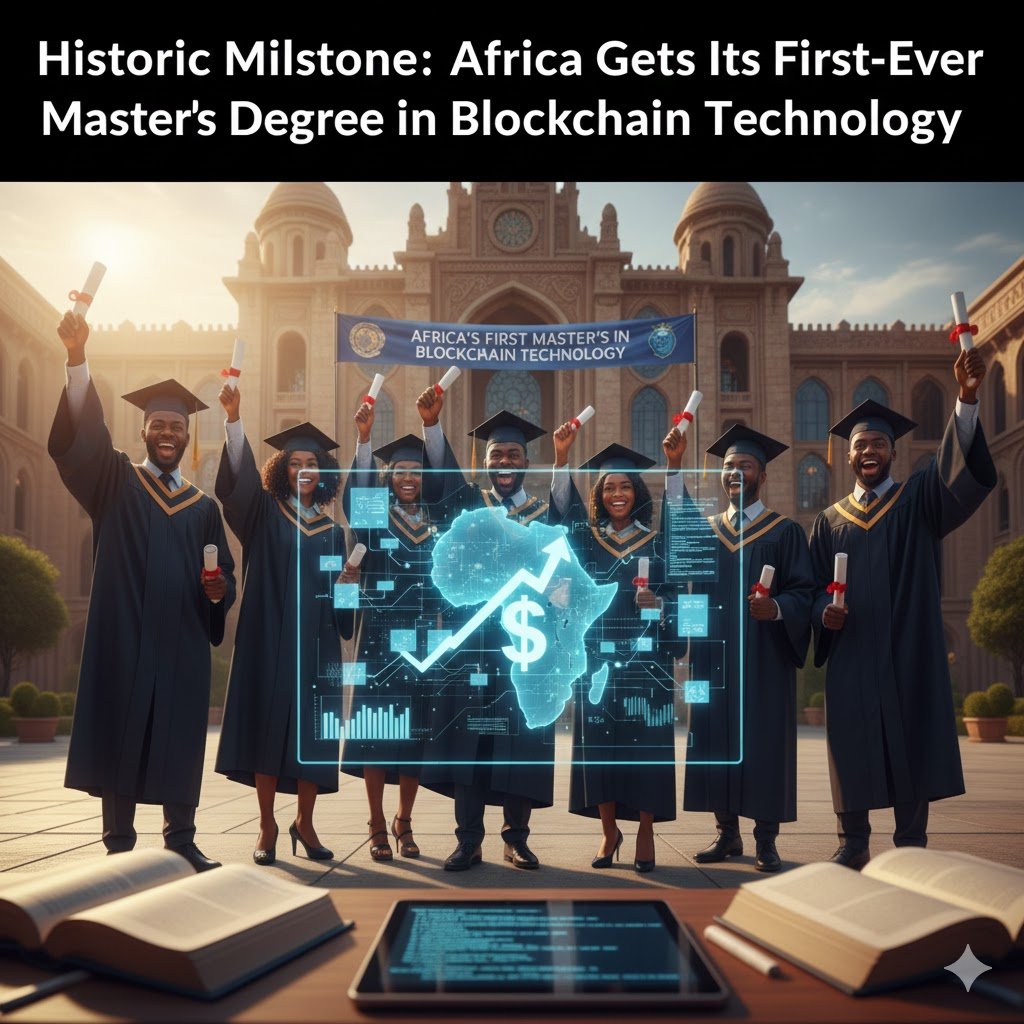
History was quietly made this month when the Africa Blockchain Institute (ABI) based in Kigali, Rwanda, and the University of Namibia (UNAM) officially launched the continent’s very first Master of Science in Blockchain Technology. While many African countries have been experimenting with blockchain pilots in land registries, remittances, and digital identity, this postgraduate program marks the first time an accredited African university is offering a full master’s degree dedicated entirely to blockchain and distributed ledger technologies.
The two-year, research-driven program welcomed its inaugural cohort of 25 students in October 2025, with another intake planned for February 2026. The degree is hosted under UNAM’s Faculty of Engineering and Information Technology and carries full accreditation from both the Namibia Qualifications Authority and the Higher Education Council of Rwanda (through ABI’s academic partnerships).
Why this matters for Africa
For years, African innovators have been using blockchain to solve real problems — from cross-border mobile money in East Africa to transparent diamond tracking in Botswana and Zimbabwe. Yet most of the continent’s blockchain talent has had to rely on short courses, online MOOCs, or expensive overseas degrees. The new MSc closes that gap.
Dr. Kayode Babarinde, Founder and CEO of the Africa Blockchain Institute, explained the urgency: “Africa is already one of the fastest-adopting regions for blockchain applications in finance, agriculture, health, and governance. But adoption without deep local expertise creates dependency. This master’s program is designed to produce African architects, not just users, of tomorrow’s blockchain infrastructure.”
Professor Anicia Peters, Vice Chancellor of the University of Namibia, echoed the sentiment during the launch ceremony in Windhoek: “Namibia has declared itself a knowledge-based economy. You cannot build a digital economy on rented brains. This partnership with ABI ensures that Namibians — and students from across SADC and the continent — will lead the next wave of blockchain innovation coming out of Africa.”
What the program actually teaches
The curriculum is deliberately practical and Africa-centric. Students will not just study Bitcoin and Ethereum whitepapers in a vacuum; they will build solutions that matter on the continent.
Core modules include:
- Foundations of Cryptography and Distributed Systems
- Smart Contract Development (Solidity, Rust, and Move)
- Layer-1 and Layer-2 Scaling Solutions
- Token Economics and Decentralised Finance (DeFi) for Emerging Markets
- Blockchain for Supply Chain and Agricultural Traceability
- Central Bank Digital Currencies (CBDCs) and Financial Inclusion
- Digital Identity and Humanitarian Applications
- Regulatory Frameworks and Policy Design for African Jurisdictions
- Blockchain Interoperability and Cross-Chain Technologies
- Enterprise Blockchain (Hyperledger Fabric, Corda, and Quorum)
Perhaps the most exciting part is the mandatory six-month industry placement and a research thesis that must address a real African challenge. Past and current industry partners already committed include Stellar Development Foundation, Cardano Foundation (through its African partnerships), Binance Charity, the Rwanda ICT Chamber, and the Namibian fintech hub.
Who is studying
The first cohort is remarkably diverse — 40% women, students from 11 African countries (Namibia, Rwanda, Nigeria, Kenya, Ghana, South Africa, Zimbabwe, Botswana, Uganda, Tanzania, and Cameroon), and even two students from the Democratic Republic of Congo who received full scholarships through the Mastercard Foundation.
Aisha Musa, a 26-year-old software developer from Kano, Nigeria, and one of the first graduates-to-be, told journalists: “I almost went to the UK for a similar master’s, but the cost was crazy and I would have been far from the problems I actually want to solve. Here, I’m learning how to build remittance corridors that work for truck drivers crossing West Africa, not just theoretical DeFi for London traders.”
Funding and accessibility
Understanding the economic realities of the continent, the program has worked hard to keep fees reasonable. Annual tuition is set at approximately NAD 68,000 (around USD 3,700), with a range of scholarships:
- 10 full scholarships funded by the African Development Bank
- 15 partial scholarships from the Namibia Students Financial Assistance Fund (NSFAF)
- 8 corporate scholarships from Old Mutual Namibia, Mobile Telecommunications Limited (MTC), and Bank Windhoek
- 5 special seats reserved for public-sector employees from SADC member states
The program is also hybrid-ready. While core hands-on labs take place on the UNAM main campus in Windhoek, lectures are streamed live and recorded, making it possible for students in Kigali, Lagos, or Nairobi to participate without relocating for the entire duration.
Bigger than one degree
This launch is about more than just another master’s program. It is a signal.
When the African Union adopted its Digital Transformation Strategy (2020–2030), blockchain was explicitly mentioned as a priority technology. Yet very few African universities have responded with formal education at this level. The UNAM-ABI partnership has instantly become the template others are already studying.
Dr. Kenneth Odero, blockchain lead at the African Union’s Digital Transformation team, congratulated both institutions: “Namibia and Rwanda have just raised the bar. We hope to see similar accredited programs emerge in Francophone Africa, North Africa, and Lusophone countries within the next 24 months.”
The road ahead
By 2027, the program aims to produce at least 120 African blockchain specialists with master’s-level training. Many will go on to lead national blockchain task forces, build home-grown layer-1 protocols, audit smart contracts for African DeFi platforms, or launch startups that finally crack the hardest problems in agricultural finance and land tenure.
As the sun set over the University of Namibia campus on launch day, one of the new students summed it up neatly on social media: “They told us Africa would adopt blockchain. Today we start building the generation that will write it.”
For a continent that has often been written about in the future tense, the MSc in Blockchain Technology is a very present-tense statement: Africa is not waiting for the future. Africa is coding it.