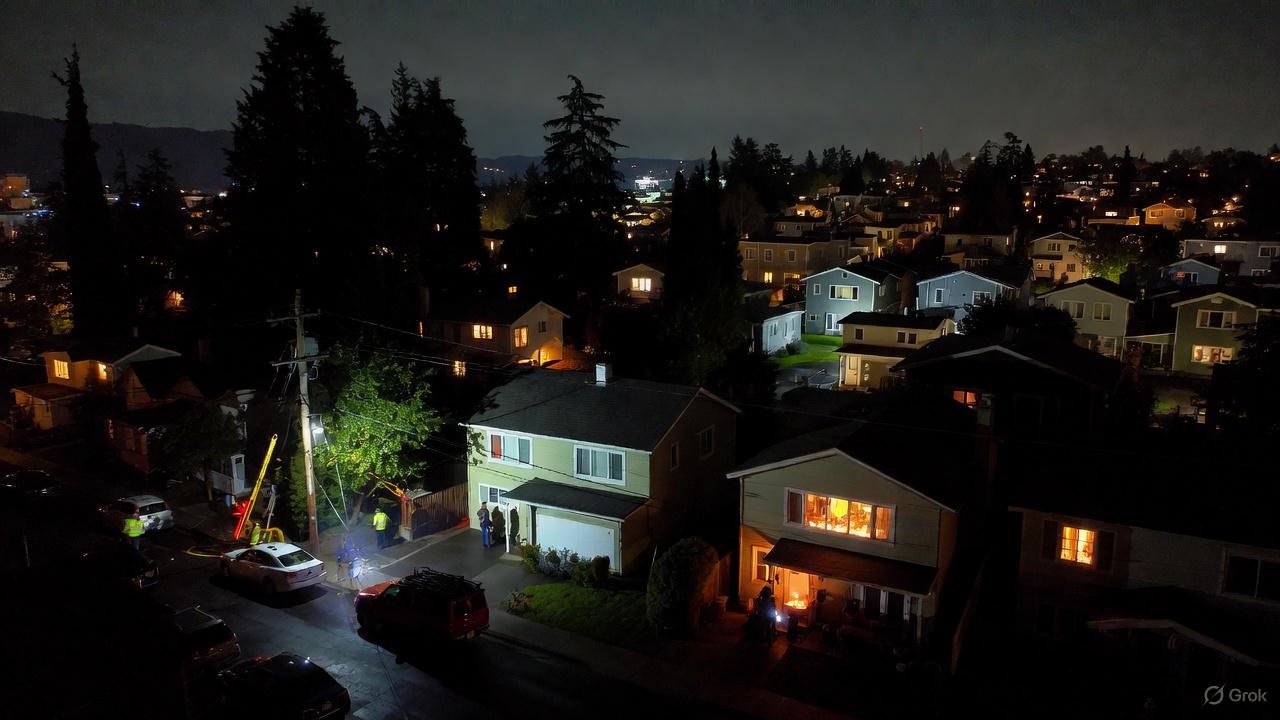
It was supposed to be a crisp autumn Sunday in Southwest Seattle, the kind where families gather for brunch, kids play in leaf-strewn parks, and die-hard Seahawks fans settle in for an afternoon of gridiron glory. But at precisely 11:48 a.m. on November 23, 2025, the hum of everyday life ground to a sudden, eerie halt. Lights flickered once, twice, then plunged entire neighborhoods into darkness. What started as a minor glitch for some ballooned into a sprawling power outage affecting nearly 3,000 Seattle City Light customers, stretching from the quiet residential pockets of Arbor Heights to the bustling commercial strips of Sunrise Heights. For many, relief came swiftly—an hour and a half of inconvenience. For others, it was a grueling wait of six and a half hours, testing patience, ingenuity, and the bonds of a tight-knit community.
The outage hit like a thief in the night, unannounced and unforgiving. Reports trickled in almost immediately from spots like 29th Avenue SW and SW Holden Street, where residents described two quick “off and on” cycles before the lights stayed stubbornly dim. By noon, the scope became clear: a patchwork of blacked-out homes and businesses blanketing south West Seattle. Neighborhoods such as Westwood, Highland Park, and areas near the Barton P-Patch found themselves in the dark, while adjacent zones like the QFC side of Westwood Village chugged along with full illumination. Target, ever the resilient retail giant, operated on half-power, its registers beeping faintly under emergency lights, a surreal half-life amid the outage’s shadow.
Seattle City Light, the municipal utility serving the Emerald City, sprang into action with a public alert on X (formerly Twitter) around 12:13 p.m. Pacific Time. “Crews are responding to an outage in the southwest Seattle area affecting approx. 2,950 customers,” the post read, urging folks to track progress on their outage map. The cause? Still a mystery at that point, with an estimated restoration time “yet to be determined.” As the afternoon wore on, the utility’s teams fanned out, diagnosing issues amid a backdrop of frustrated but cooperative locals.
What could have sparked this midday mayhem? Eyewitness accounts painted a vivid picture of electrical drama. One resident near Seola Pond on 28th Avenue SW recounted a “big blue flash” followed by plumes of smoke rising into the clear sky—no rain, no storm, just the capricious whims of aging infrastructure. Others heard what sounded like a transformer exploding, a sharp crack echoing through quiet streets, accompanied by the acrid scent of arcing wires. Sirens wailed as Seattle Fire Department crews rushed to the 10200 block of 31st Avenue SW, initially dispatched to a nearby dead-end on 30th SW, to probe what locals dubbed a “sparkling spectacle.” No injuries were reported, a small mercy in an otherwise disruptive event, but the incident underscored a nagging vulnerability: Seattle’s power grid, strained by urban growth and occasional equipment failures, isn’t immune to these sudden betrayals.
As crews labored under the hood—literally, in some cases, peering into utility vaults and splicing lines—the human toll unfolded in real time. For Seahawks enthusiasts, the timing was cruel poetry. “Power outage during the Seahawks game, Noooooo!!! Out at 24th and Holden,” lamented one fan, her string of crying emojis capturing the collective groan rippling through living rooms turned impromptu fortresses of flashlight beams. Another, mid-church service at 103rd and 28th SW, joked, “Right at the end of our church service!! Thought Jesus was coming back!!” Humor, it seems, is Southwest Seattle’s secret weapon against adversity.
Businesses felt the pinch too. Roxbury Safeway, a neighborhood lifeline for groceries and last-minute game-day snacks, limped along on generator power with “limited lighting,” its shelves bathed in a dim glow that made picking out produce feel like foraging in a cave. Staff promised full restoration by 5 p.m., but shoppers navigated aisles warily, their carts half-full of impulse buys born of boredom. Over at Westwood Village, the outage carved a quirky divide: half the complex plunged into shadow, while the other buzzed obliviously. “I was in Target when the power went out,” shared one shopper. “Target still is apparently up and running with half the lights on and the registers are open. Only half of Westwood appears to be out.” In a city where coffee runs are sacred, such partial blackouts bred a strange normalcy—annoying, yet not apocalyptic.
Restoration came in waves, a testament to the grit of utility workers who toiled through the afternoon chill. By 1:18 p.m., many homes flickered back to life, their refrigerators humming anew after the 90-minute ordeal. Cheers erupted in pockets of Arbor Heights and North Arbor Heights, where families exhaled and returned to their Seahawks stream, albeit with a newfound appreciation for the glow of a screen. But for hundreds more, the wait stretched into evening. Seattle City Light’s outage map, a digital beacon for the anxious, pegged a broad estimated time of 5:55 p.m.—a figure one resident dismissed as “guessing and likely to take longer.” True to form, full power didn’t return until around 6:18 p.m. for the last holdouts, leaving behind tales of MacGyver-esque adaptations: inverters powering recliners, fully charged phones piping in radio play-by-plays, and generators tested in backyards like relics from a bygone prepper era.
One stuck-in-the-dark local, trapped momentarily in his recliner after a surge zapped his power strip, summed up the absurdity: “I happened to hear a surge hit my power strip next to my recliner. I held my breath, and waited for something to happen. 5 seconds later I heard the arc over on 30th. Of course I got stuck in my recliner LOL. I broke out my inverter for some power, so I’m not tripping over the chair all day in the dark.” Stories like his wove a tapestry of resilience, reminding us that outages aren’t just about lost electricity—they’re about the sparks of community that ignite in the void.
This wasn’t Southwest Seattle’s first dance with darkness, nor will it be the last. Just days earlier, on November 20, a separate power glitch shuttered the SR 99 tunnel in both directions, snarling commutes from downtown to West Seattle with delays that felt eternal. Downed wires at 4th Avenue South and South Hanford Street were the culprits there, forcing a frantic switch to backup systems that, frustratingly, failed to engage. And let’s not forget the underground vault fire in South Seattle on November 7, which left over 650 customers in the lurch, a smoldering reminder of the hidden hazards beneath our feet. Across Washington state, outages remain a stubborn specter; as of November 24, 876 customers statewide were still offline, with Snohomish County bearing the brunt at 0.14% affected.
Experts point to a cocktail of factors fueling these frequent flickers: an aging grid ill-equipped for Seattle’s booming population, extreme weather patterns amplified by climate change, and the occasional human error, like vehicles clipping poles—as seen in a car crash-induced blackout earlier that week. Seattle City Light has poured millions into upgrades, from smart grid tech to buried lines, but the pace lags behind the risks. “We’re playing catch-up in a city that’s growing faster than our wires can handle,” noted utility spokesperson Maria Gonzalez in a recent interview. Add in the Pacific Northwest’s penchant for wind-whipped storms—recall the October 25 gale that felled trees and darkened 34,000 homes—and it’s clear: reliability is a goal, not a guarantee.
Yet, in the outage’s aftermath, Southwest Seattle’s spirit shone brighter than any bulb. Residents turned to hyper-local blogs like West Seattle Blog, a digital town square where updates flowed faster than official channels. “I was searching for about three minutes before I heard or saw anything covering the outage,” one grateful poster wrote. “There’s no storm happening at this moment. It’s not even raining. Can’t wait for an update. Super thankful for this webpage.” Neighbors swapped tips on X and Nextdoor: Charge your devices now! Stock canned goods! And for quake prep—a perennial Seattle sermon—one voice boomed, “This is also a reminder to be ready for the next big earthquake! If the electricity is out ATM’s and cash register machines will not work… Keep cash in small bills and a roll of quarters on hand.”
These moments of enforced unplugging, while inconvenient, foster a deeper connection to place. In Westwood, families dusted off board games, turning outage hours into unexpected quality time. In Highland Park, a power surge that mercifully spared most homes sparked conversations about home safety—surge protectors, anyone? And across the board, gratitude for the frontline workers who braved ladders and live wires tempered any gripes. “Time to test the generator! Good thing my phone has a full charge to listen to the game!! GO HAWKS!” one optimist declared, blending preparedness with fandom.
As the sun dipped below the Olympics on that disrupted Sunday, and lights winked back on one by one, Southwest Seattle exhaled. The Seahawks game concluded (a narrow win, for the record), Safeway’s fluorescents buzzed to full strength, and the arc of normalcy arched once more. But the outage lingers as a quiet cautionary tale: In a tech-saturated world, we’re one flipped switch from humility. Seattle City Light vows a full investigation, promising tweaks to prevent a sequel. Residents, meanwhile, stock their mental shelves with lessons learned—because in this rainy corner of the world, the power may flicker, but the community’s current runs steady and strong.
What does the future hold? Calls for accelerated infrastructure investments grow louder, with advocates pushing for federal grants to bury more lines and integrate renewables that buffer against failures. For now, though, Southwest Seattle rebuilds not just its circuits, but its collective resolve. In the words of a local poet-turned-blogger: “Power out, but never powerless.” As winter looms with its winds and whims, that’s a mantra worth remembering.