In the quiet, sun-drenched enclave of Vero Beach, Florida, where palm trees sway gently against the Atlantic breeze, a morning that began with paperwork and procedure spiraled into unimaginable horror. What was meant to be a straightforward eviction notice—serving as a bridge between family tension and legal resolution—unraveled into a hail of bullets, claiming the life of a dedicated law enforcement veteran and wounding those who simply showed up to do their jobs. On Friday, November 21, 2025, the sleepy rhythm of the Bermuda Club gated community was shattered by gunfire, echoing the raw vulnerabilities hidden behind closed doors.
The shooter, 37-year-old Michael Halberstam, who had been living in his mother’s home, opened fire on two deputies and a locksmith standing in the entryway of the residence on Governors Way. Among the fallen was Deputy Terri Sweeting-Mashkow, a 47-year-old pillar of the Indian River County Sheriff’s Office, whose 25 years of service ended in an instant. Her death marked only the second line-of-duty loss in the agency’s century-long history, a stark reminder of the perils lurking in even the most mundane tasks. Halberstam himself, struck by return fire, clung to life for less than a day before succumbing to his injuries on Saturday afternoon, closing a chapter of violence that has left an entire community grappling with grief, questions, and a renewed urgency for safeguards in everyday policing.
The events of that fateful morning unfolded with the deceptive normalcy of routine civil work. At around 8:42 a.m., deputies responded to a call from a woman seeking assistance in evicting her adult son from the family home. The Bermuda Club, a serene pocket of Orchid Island known for its manicured lawns and waterfront views, hardly seemed the stage for such chaos. Halberstam’s mother, whose pleas for help had prompted seven prior dispatches to the address that month alone, stood outside as the team arrived. She had filed the eviction paperwork on November 5, a decision born from mounting frustrations over her son’s behavior and instability.
Accompanying the deputies was a locksmith, there to change the locks and facilitate the process without drama. Deputy Sweeting-Mashkow, fresh in her role with the Legal Process Civil Unit after years as a dispatcher, led the group into the entryway. It was there, in that narrow threshold between public duty and private turmoil, that Halberstam allegedly retrieved a firearm and unleashed a barrage of shots. “Indiscriminately firing,” as Sheriff Eric Flowers later described it during a somber press conference, the gunfire struck without warning or mercy.
Sweeting-Mashkow was hit fatally, her body crumpling in the line of fire she had sworn to face. Nearby, Deputy Florentino “Tino” Arizpe, another 25-year veteran of the force, took a bullet to the shoulder. The locksmith, caught in the crossfire while performing a neutral task, suffered critical wounds that required immediate surgical intervention. In the chaos, the deputies returned fire, striking Halberstam multiple times. Armored vehicles and reinforcements swarmed the scene, transforming the upscale neighborhood into a fortress of flashing lights and tactical precision. For hours, the air hung heavy with uncertainty, as neighbors peered from behind curtains, their holiday preparations halted by the crackle of radios and the wail of sirens.
As the sun climbed higher, the full weight of the tragedy settled in. Sweeting-Mashkow was pronounced dead at the scene, her loss rippling through the ranks of the sheriff’s office like a stone skipped across still water. Arizpe, resilient and battle-tested, underwent treatment and was soon on the mend, his release from care announced by the agency as a small beacon amid the darkness. The locksmith’s condition remained precarious, a testament to the indiscriminate nature of violence that spares no one in its path. Halberstam, transported for emergency care, fought through the night but breathed his last by Saturday, his actions sealing a fate that spared no one further courtroom agony but amplified the pain of those left behind.
To understand the depth of this loss, one must look to the woman at its heart: Terri Sweeting-Mashkow. Born with a spirit as unyielding as the Florida coastline she patrolled, Terri joined the Indian River County Sheriff’s Office over two decades ago, starting in the dispatch trenches where every call carried the weight of someone’s crisis. Her voice, calm and commanding, had guided countless officers through storms both literal and figurative—hurricanes barreling ashore, domestic disputes flaring hot, and the quiet emergencies of daily life. In 2023, she transitioned to the civil unit, a role that demanded not just enforcement but empathy, navigating the delicate dance between law and human frailty.
Colleagues remember her as the steady hand in the squad room, the one who baked treats for birthdays and shared laughs over lukewarm coffee during long shifts. “She was family,” Sheriff Flowers choked out, his eyes glistening under the conference room lights. “I’ve worked my entire career with Terri, and pretty much everybody else at the agency feels the same.” Posthumously promoted to sergeant—a nod to her unwavering commitment—Sweeting-Mashkow leaves behind a husband, children, and a legacy etched in the annals of service. Tributes poured in from across the state: Florida Governor Ron DeSantis extended condolences, while Attorney General James Uthmeier called for a moment of silence at a public event, his words underscoring the shared mourning of a force that binds communities together.
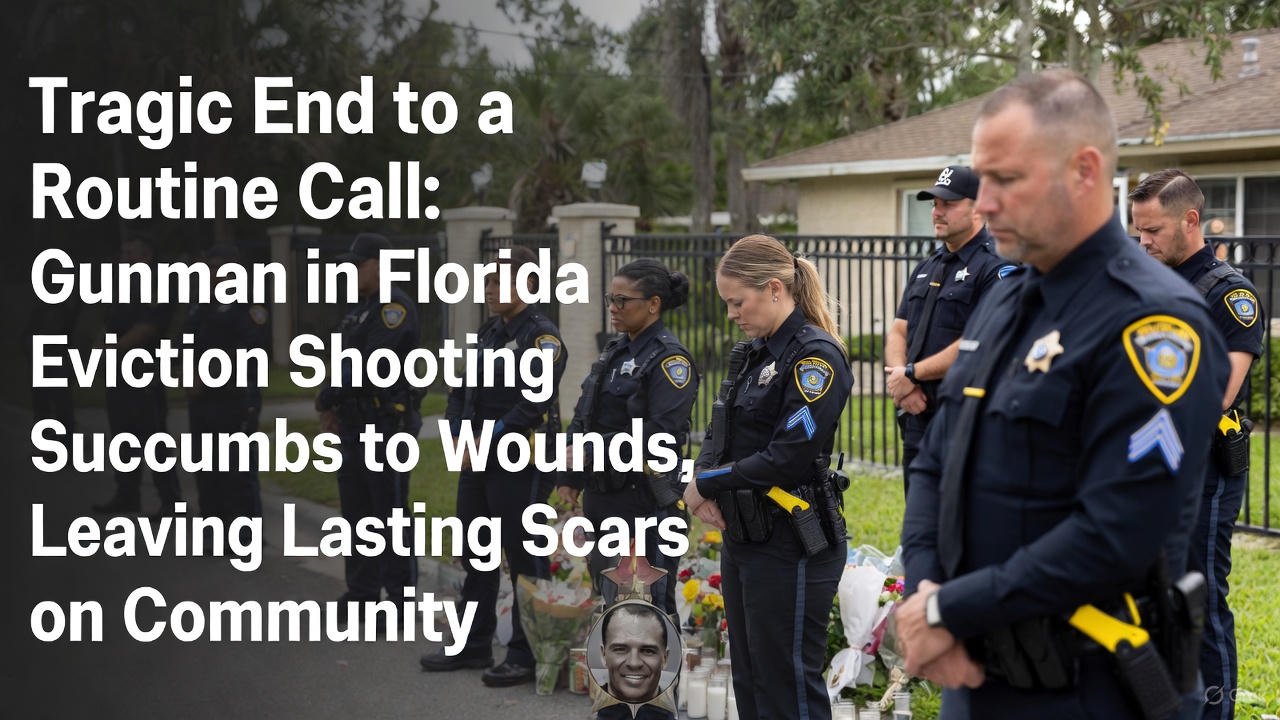
Outside the sheriff’s headquarters, a makeshift memorial grew like a living thing—flowers in vibrant blues and whites, handwritten notes fluttering in the breeze, badges polished and placed with reverence. “A great person with a great personality,” one Vero Beach resident recalled of a brief encounter, her voice thick with regret. “Always polite, always professional.” Law enforcement from neighboring counties lined the streets in silent procession, their vehicles a river of blue cutting through the grief-stricken town. For a community on the cusp of Thanksgiving, the timing felt like a cruel twist, turning tables laden with turkey and pie into spaces heavy with absence.
Yet amid the sorrow, questions loomed large about the man whose rage ignited the spark. Michael Halberstam, at 37, embodied a portrait of quiet unraveling. Court records paint a picture of a life marked by brushes with the law: a 2006 narcotics conviction in Virginia, followed by a 2015 misdemeanor assault charge right there in Vero Beach. Neither barred him from possessing a firearm, a detail that Sheriff Flowers emphasized with a heavy sigh—no red flags waving like warning flares. Halberstam’s social media trail, scoured by investigators, revealed a man simmering with discontent. Posts railing against his former employer, UPS—where a spokesperson confirmed no record of him since 2022—hinted at job loss as a fresh wound. Darker still were his barbs aimed at the very sheriff’s office now piecing together his story, comments that spoke of isolation and brewing resentment.
The eviction itself was no snap decision. Halberstam’s mother had endured a month of turmoil, dialing authorities repeatedly for help with her son’s erratic actions—disputes that escalated from words to something more ominous. “Almost all of them from the mother calling about him and her decision to evict him ultimately,” Flowers noted, his tone laced with hindsight’s bitter clarity. Experts in family dynamics might point to the toxic brew of adult children lingering in parental nests, compounded by economic pressures and untreated personal demons. In Florida, where housing costs climb like vines in the humid air, evictions have surged post-pandemic, straining not just wallets but the fragile threads of familial bonds. This wasn’t a stranger’s quarrel; it was a mother’s desperate bid for peace, enlisting the law as her reluctant ally.
As the Florida Department of Law Enforcement takes the reins of the investigation, probing every angle from ballistics to motive, the sheriff’s office braces for an internal reckoning. “This was a standard call for service,” Flowers insisted, underscoring how peril can ambush the predictable. Yet in the echo chamber of hindsight, calls for enhanced protocols grow louder. Should civil evictions mandate threat assessments? Body cameras, already standard, captured the frenzy, but could mental health screenings or de-escalation teams have tipped the scales? Across the nation, similar incidents—ambushes during welfare checks, flare-ups in domestic calls—highlight the thin blue line’s exposure to unchecked firearms. With over 400 million guns in circulation nationwide, the calculus of risk tilts ever toward the tragic.
Vero Beach, a gem of the Treasure Coast with its art museums and citrus groves, now carries this scar like a fresh tattoo. Neighbors, who once waved over hedges, now whisper about vigilance, their gates feeling less like luxuries and more like lifelines. Online, the story sparked a torrent of reactions: prayers for the fallen deputy threading through threads of outrage at gun access, calls for justice mingling with empathy for a family torn asunder. One X user, local to the area, posted a heartfelt plea: “Please pray for Sheriff Deputy Terri Mashkow… very close to our home. She was a 25 yr veteran, much loved.” Others decried the suspect’s end as a hollow closure, sparing trials but denying deeper truths.
In the days ahead, as autopsy reports and witness statements fill folders, the focus shifts to healing. The sheriff’s office, coordinating donations through a dedicated liaison, urges support for Sweeting-Mashkow’s family—practical aid for funerals, funds for futures interrupted. Vigils dot the calendar, with law enforcement honors planned to celebrate a life of quiet heroism. And for Halberstam’s mother, whose world imploded in her own driveway, counseling and community arms extend, acknowledging that survival in the aftermath can be its own battlefield.
This eviction gone awry isn’t just a local headline; it’s a microcosm of America’s fraying edges—where economic squeezes collide with mental health gaps, and those sworn to serve become targets in the crosshairs. Terri Sweeting-Mashkow’s light, extinguished too soon, casts long shadows that demand we do better: for the officers who knock on doors, for families fracturing under pressure, for locksmiths caught in the gears of circumstance. As Thanksgiving dawns, Vero Beach gives thanks not for the feast, but for the guardians like Terri who made their tables possible. Her story, raw and unresolved, urges a collective pause: In the rush of routine, what safeguards do we owe the sentinels at our thresholds?