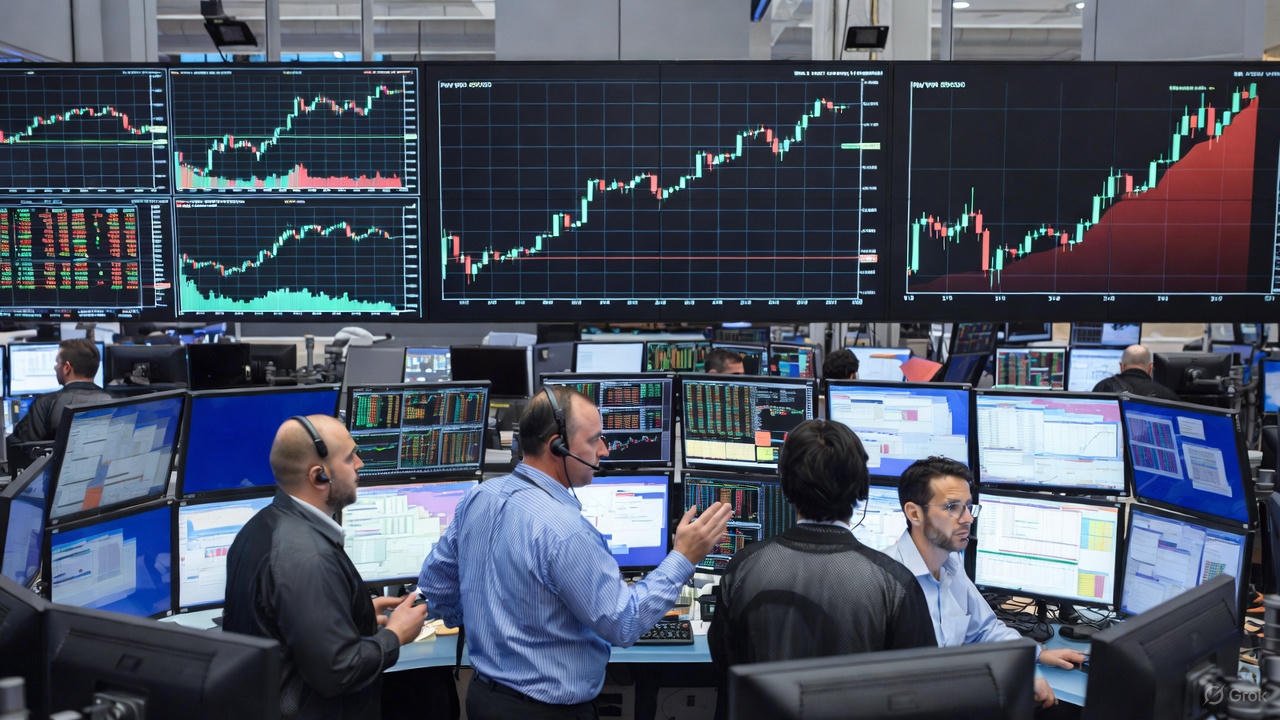
November 24, 2025 – In the quiet hours before the opening bell, the stock market is whispering promises of recovery. Futures contracts for the Dow Jones Industrial Average, S&P 500, and Nasdaq Composite are climbing steadily, a stark contrast to the red ink that dominated trading screens just days ago. The Dow futures have jumped more than 550 points, while the S&P 500 and Nasdaq are each up around 0.5% in pre-market action. This surge is igniting cautious hope among investors who have weathered a volatile November, marked by sharp pullbacks in tech-heavy sectors and lingering fears of an AI-driven bubble. As the shortened Thanksgiving week kicks off, could this be the turning point to claw back some of the month’s early losses?
The timing couldn’t be more poignant. With Black Friday looming and holiday shopping mania on the horizon, Wall Street is desperate for positive momentum. Last week alone, the S&P 500 shed nearly 2%, the Nasdaq tumbled about 2.7%, and the Dow dipped 1.9%. These weren’t just blips; they represented the culmination of mounting pressures, from overinflated valuations in artificial intelligence stocks to uncertainty over the Federal Reserve’s next moves. Yet, as dawn breaks on this crisp Monday, the futures leap suggests that the selling frenzy might finally be easing its grip.
Let’s break it down. At around 4 a.m. ET, Dow futures were trading at 46,377, up a robust 552 points from Friday’s close. That’s a gain of over 1.2%, signaling potential for the blue-chip index to open sharply higher and build on its modest 1.08% Friday advance. The S&P 500 futures, often seen as the market’s bellwether, stood at 6,631.50, reflecting a 74-point increase, or about 1.1%. Meanwhile, Nasdaq futures hit 24,349, buoyed by a 217.50-point rise—good for roughly 0.9%. These moves aren’t isolated; they’re echoing across global markets, with Asia-Pacific indices rebounding on similar rate-cut optimism.
What sparked this pre-dawn rally? The finger points squarely at the Federal Reserve. On Friday, New York Fed President John Williams delivered remarks that sent ripples through trading floors and futures pits alike. Speaking at a conference, Williams indicated there’s “room for a further adjustment in the near term” to the federal funds rate, keeping the door ajar for a December cut. Traders, who had dialed back expectations to just 39% odds of easing at the Fed’s December 9-10 meeting, quickly revised their bets. By late Friday, the probability had surged to 70%, according to CME Group’s FedWatch tool. This isn’t just number-crunching; it’s a lifeline for stocks futures, as lower rates typically juice borrowing costs, boost corporate profits, and lure investors back into equities.
Williams’ comments couldn’t have come at a better time. November has been a month of reckoning for the markets, where the heady gains of earlier in 2025—fueled by AI hype and resilient economic data—began to unwind. The S&P 500, which had flirted with all-time highs in October, entered the month riding a wave of optimism. But by mid-November, cracks appeared. Tech stocks, long the darlings of the bull run, faced scrutiny over sky-high valuations. Nvidia, the poster child of the AI boom, saw its shares swing wildly after blockbuster earnings on Wednesday, November 19. An initial surge gave way to profit-taking, dragging the Nasdaq into a 2.2% plunge on Thursday, its worst day in months.
Zooming out, November’s losses paint a picture of a market catching its breath. Through Friday’s close, the S&P 500 was down 1.95% for the month, the Nasdaq off 2.74%, and the Dow trailing by 1.91%. Small-cap stocks, tracked by the Russell 2000, fared even worse, logging a fourth straight weekly decline—the longest skid since March. This wasn’t uniform pain; it was concentrated in growth-oriented sectors. The Nasdaq’s three-week losing streak, its longest in eight months, highlighted the fragility of tech’s dominance. Investors, spooked by whispers of an “AI bubble,” rotated out of megacaps like Nvidia, Apple, and Microsoft, seeking refuge in more defensive plays like utilities and consumer staples.
Thursday, November 20, epitomized the chaos. The Dow rocketed as much as 718 points intraday on Nvidia’s earnings glow, only to erase those gains and close down nearly 400 points, a 0.8% drop. The S&P 500 mirrored the drama, swinging from a 1% gain to a 1.6% loss, while the Nasdaq cratered 2.2%. Broader concerns amplified the sell-off: geopolitical tensions in the Middle East pushed oil prices higher, inflation fears lingered despite cooling job data, and corporate bond yields ticked up, squeezing high-debt firms. Even cryptocurrencies, often a leading indicator for risk appetite, touched multi-month lows before paring losses.
Friday’s rebound offered a glimmer of relief, but it was the Fed’s dovish tilt that truly lit the fuse for today’s stocks futures surge. All 11 S&P 500 sectors closed green on November 21, led by materials and industrials. Homebuilders like D.R. Horton and Lennar jumped 6-7% on rate-cut hopes, as cheaper mortgages could reignite housing demand. Retailers perked up too, with Gap soaring 8% after upbeat guidance, a nod to resilient consumer spending heading into the holidays. Walmart, fresh off strong quarterly results, added to the positive vibe, its shares climbing on forecasts of steady sales despite inflationary headwinds.
Overseas, the sentiment is syncing up. Asia-Pacific markets kicked off the week on a high note, with Australia’s S&P/ASX 200 up 0.94% and Hong Kong’s Hang Seng gaining 1.06%. Japan’s Nikkei was closed for a holiday, but the broader MSCI Asia-Pacific ex-Japan index rose 0.16%, shrugging off a 2.67% weekly dip. European futures are pointing higher too, though the STOXX 600 logged its biggest weekly drop since July last week, down 0.3% amid tech valuation jitters. The common thread? Renewed faith in central bank easing. Goldman Sachs economists echoed Williams, projecting a December cut followed by two more in 2026, taking the funds rate to 3-3.25%.
As stocks futures climb, analysts are parsing the implications for the week ahead. This is Thanksgiving week, after all—trading days are slim, with markets closing early on Wednesday and dark on Thursday. Volume could be thin, amplifying swings from any surprise news. Key events include flash PMI data on Monday, durable goods orders on Tuesday, and the Fed’s Beige Book on Wednesday. But the real wildcard is consumer sentiment. November’s University of Michigan survey hit one of its lowest levels on record, hammered by high shop prices and stock market volatility. If Black Friday data shows robust spending, it could supercharge the rebound narrative.
Diving deeper into sectors, technology remains the focal point. The Nasdaq’s heavy reliance on the “Magnificent Seven”—Nvidia, Tesla, Amazon, Meta, Alphabet, Apple, and Microsoft—has been both its superpower and Achilles’ heel. These giants drove over 60% of the S&P 500’s year-to-date gains through October, but November’s 7% pullback from October highs exposed vulnerabilities. Nvidia alone shed billions in market cap last week, its post-earnings fade underscoring fears that AI investments might outpace real-world returns. Yet, today’s Nasdaq futures leap suggests bargain hunters are circling. If Williams’ words hold sway, lower rates could make growth stocks more palatable again, potentially extending the rally into December.
Financials and industrials, meanwhile, are poised to benefit most from a Fed pivot. Banks like JPMorgan and Goldman Sachs could see loan demand spike with cheaper capital, while manufacturers eye relief from elevated borrowing costs. Energy, battered by Middle East flares, might stabilize if oil’s recent uptick—Brent crude hovering near $85—proves temporary. And don’t overlook small caps: The Russell 2000’s four-week slide has left it undervalued relative to large caps, drawing value investors in a rate-cut environment.
Of course, optimism comes with caveats. The market’s jittery week wasn’t born in a vacuum. Broader economic signals are mixed: Unemployment ticked up to 4.2% last month, but job growth held steady at 150,000. Inflation has cooled to 2.4% core PCE, within shouting distance of the Fed’s 2% target, yet sticky services prices keep policymakers cautious. Geopolitics adds another layer—progress in Ukraine peace talks lifted defense stocks briefly, but sliding yen values (down 2.4% last week) raise intervention risks from Tokyo.
Moreover, the AI narrative isn’t fading quietly. While Nvidia’s earnings beat expectations with 94% revenue growth, forward guidance highlighted intensifying competition from AMD and custom chips by hyperscalers like Amazon. This has some strategists warning of a “reality check” for Big Tech, potentially capping upside even as stocks futures soar. Bloomberg Intelligence notes that while volatility may persist into 2026, the S&P 500 could still hit 7,500 by year-end, implying a 13% gain from current levels—a bullish call tempered by bubble risks.
For individual investors, this moment feels like a crossroads. Retail traders, who piled into AI themes via apps like Robinhood, watched paper gains evaporate last week. Now, with futures pointing up, the temptation to buy the dip is strong. But experts urge diversification: Balance tech exposure with cyclicals like industrials or even emerging markets, which fell 2.64% last week but offer value at lower multiples.
Looking globally, the U.S. rebound is rippling outward. China’s CSI 300 eked out a 0.16% gain Monday, buoyed by stimulus whispers, while Europe’s FTSE Eurofirst 300 dipped 0.32% Friday but futures suggest a snapback. Commodities are mixed: Gold, a safe-haven staple, eased slightly to $2,650 an ounce, while Bitcoin clawed back to $92,000 after brushing $88,000 lows—its worst monthly start since 2022.
As the opening bell nears, the question lingers: Will this stocks futures momentum translate into a sustained rally, or is it just another head fake in a month of whiplash? History offers clues—November has been kind to the S&P 500, averaging 1.5% gains since 1950, often as a Santa Claus rally precursor. But 2025’s unique blend of AI exuberance and Fed fine-tuning demands vigilance.
In the end, today’s leap isn’t a guarantee, but it’s a spark. It reminds us that markets, like turkeys at Thanksgiving, can surprise with unexpected turns. Investors would do well to savor the optimism while keeping an eye on the oven timer—overcooking this rebound could lead to indigestion. With rate cuts in sight and holiday cheer on deck, November’s losses might soon feel like yesterday’s news. For now, Wall Street is betting on a feast, not a famine.