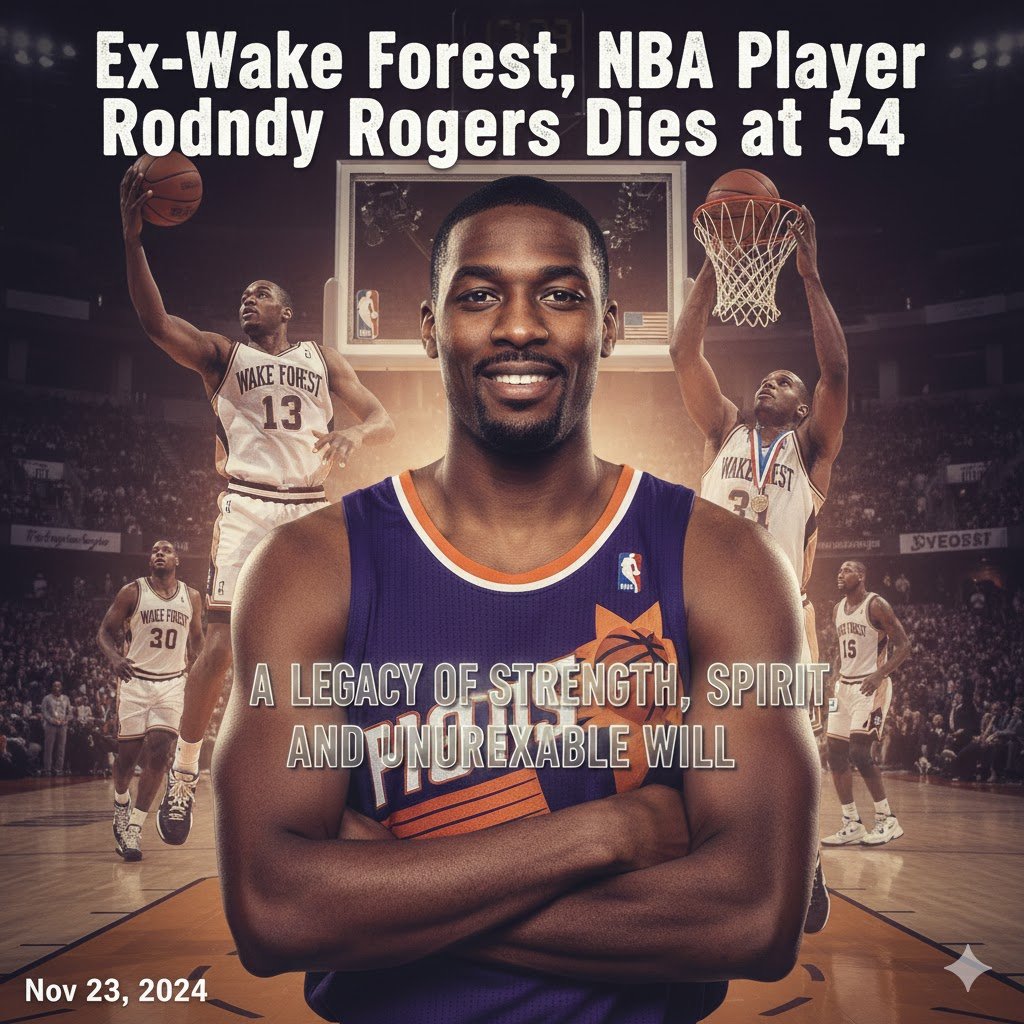
The basketball world is mourning the loss of Rodney Rogers, the former Wake Forest legend and NBA standout who passed away at the age of 54. His death has sent waves of grief across the sports community, not only because he was a remarkably talented player, but because he represented something much greater—resilience, courage, and humanity.
Rogers’ journey was far more than a sports story. It was a story about rising from humble beginnings, reaching national stardom, and then facing life’s most devastating challenges with extraordinary grace. His life reminds us that greatness is not just measured in points scored or games won, but in the battles we fight when the lights fade and the world grows quiet.
In this article, we remember Rodney Rogers, not only as an icon on the court but as a symbol of unshakable strength off of it.
A Humble Beginning: The Early Life of Rodney Rogers
Rodney Rogers was born on June 20, 1971, in Durham, North Carolina—a city known for tough playgrounds, competitive basketball culture, and kids who learned early that talent alone wasn’t enough. Rogers grew up in a neighborhood where nothing was handed out freely. He had to fight for space, attention, and his dreams.
From a young age, he displayed the kind of natural basketball talent that didn’t need much explanation. His frame was strong, his instincts sharp, and his competitive fire unmatched. Teachers often described him as quiet but observant—someone who didn’t speak often but made every action count.
His mother, a strong force in his life, worked tirelessly to support him. She encouraged him to chase every opportunity, reminding him that basketball could be the bridge to something bigger.
By the time he reached high school at Hillside, Rodney Rogers had already become a local legend. His physical dominance and aggressive playing style earned him the nickname “The Durham Bull.” He wasn’t just a scorer; he was a force of nature. His high-school performances became the stuff of local folklore, drawing scouts, fans, and college coaches from all over the region.
Rise at Wake Forest: The Birth of a Star
When Rodney Rogers committed to Wake Forest University in 1990, it felt like the beginning of a new era for the program. Wake Forest was searching for a player who could elevate the team to national prominence—and they found that player in Rogers.
Freshman Year: A Statement of Intent
His impact was immediate. Rogers played with a level of confidence and physicality rarely seen in freshmen. He averaged double-digit scoring, dominated the boards, and quickly became a crowd favorite. His efforts earned him the ACC Freshman of the Year award—an early sign of the greatness to come.
Growth, Leadership, and Stardom
Over the next two seasons, Rogers’ game reached new heights. By his junior year, he had become one of the most unstoppable players in the country. His combination of strength, shooting touch, and versatility made him a matchup nightmare.
In 1993, he captured the ACC Player of the Year title, cementing his status as one of the best players in Wake Forest history. That same season, he helped lead the team to the NCAA Sweet 16, bringing national attention to the program and inspiring the next generation of Demon Deacons.
Wake Forest honored him in 1996 by retiring his jersey, No. 54—a rare and prestigious recognition reserved for only the greatest athletes to come through the university.
From Durham to the NBA: A 12-Year Professional Journey
In the 1993 NBA Draft, Rodney Rogers was selected ninth overall by the Denver Nuggets. His transition to the NBA was seamless. He wasn’t flashy; he wasn’t a highlight machine. Instead, he was consistent, reliable, and incredibly tough.
Denver Nuggets: The Foundation
In Denver, Rogers built a reputation as a physical forward who could score from anywhere on the floor. His ability to stretch the floor, combined with his rebounding strength, made him an important piece of the Nuggets’ rotation.
Los Angeles Clippers: The Breakout
His move to the Clippers gave him more opportunities to shine. Here, his scoring output increased, and he developed a confident offensive identity. His performances caught the league’s attention and opened the door for his next big chapter.
Phoenix Suns: Sixth Man of the Year
The 1999–2000 season with the Phoenix Suns was the pinnacle of his NBA career. Coming off the bench, Rogers played all 82 games and averaged nearly 14 points per game. His ability to change the momentum of a match made him invaluable, earning him the NBA Sixth Man of the Year Award.
He continued his career with the Boston Celtics, New Jersey Nets, New Orleans Hornets, and Philadelphia 76ers, consistently playing the role of a tough, reliable veteran.
By the time he retired from the NBA in 2005, Rodney Rogers had scored close to 9,500 points—an impressive achievement for a player who often came off the bench.
A Tragic Turn: The Accident That Changed Everything
Life can be unpredictable, and sometimes the most devastating chapters remain unwritten until they suddenly unfold. For Rodney Rogers, that moment came on November 28, 2008.
While riding a dirt bike—one of his favorite pastimes—Rogers suffered a severe accident that left him paralyzed from the shoulders down. In an instant, the athletic, unstoppable force who once controlled the paint could no longer control his own body.
Doctors informed him that he would never walk again.
For many, such news would mark the end of hope. But for Rodney Rogers, it became the beginning of a different kind of fight—one that required a deeper kind of strength than basketball ever did.
A New Purpose: Life After Injury
Following the accident, Rogers faced an unimaginable physical and emotional challenge. Yet despite the limitations of his body, his spirit remained unbroken.
He founded the Rodney Rogers Foundation, a nonprofit organization dedicated to supporting individuals with spinal cord injuries. Through this foundation, he offered hope, resources, and emotional support to people navigating the same dark road he had traveled.
Rogers often said that life was no longer about physical movement—it was about using the power he still had: his voice, his influence, and his story.
He became an inspirational figure for thousands, proving that purpose does not disappear in the face of tragedy. Instead, it transforms.
The Final Chapter: Passing at Age 54
In November 2025, the heartbreaking news spread across the basketball community: Rodney Rogers had passed away at the age of 54. According to his family, he died from complications related to his long-term spinal cord injury.
Tributes poured in from former teammates, coaches, fans, and players who grew up watching him. Wake Forest University released emotional statements honoring his legacy. NBA teams he once played for shared memories of his toughness, kindness, and impact.
His former coach described him as “every bit as remarkable as a human being as he was as a player.”
And that may be the most accurate summary of his life.
Rodney Rogers’ Legacy: More Than Basketball
Rodney Rogers will forever be remembered for:
1. His Power and Presence on the Court
He dominated games with a combination of strength and finesse that made him one of the most unique players of his era.
2. His Perseverance After Injury
Despite losing mobility, he never lost his will to help others or inspire those around him.
3. His Humility and Character
Rogers lived as a gentle giant—strong yet soft-spoken, confident yet grounded.
4. His Service Through His Foundation
He turned a life-altering tragedy into an opportunity to uplift others.
5. His Influence on Future Generations
Young players still study his game. Fans still remember his tenacity. Communities still feel his impact.
Conclusion: Remembering a True Warrior
The story of Rodney Rogers is not just a sports biography—it is a life lesson. His success on the basketball court demonstrated talent, work ethic, and determination. But his life after basketball showed something far deeper: unmatched courage, humility, and resilience.
He leaves behind a family who adored him, a fanbase that admired him, and a legacy that will never fade.
Rodney Rogers may no longer be with us, but the strength he displayed—both in motion and in stillness—will continue to inspire generations.
Rest in peace, Rodney Rogers. Your strength was legendary, your spirit unforgettable.