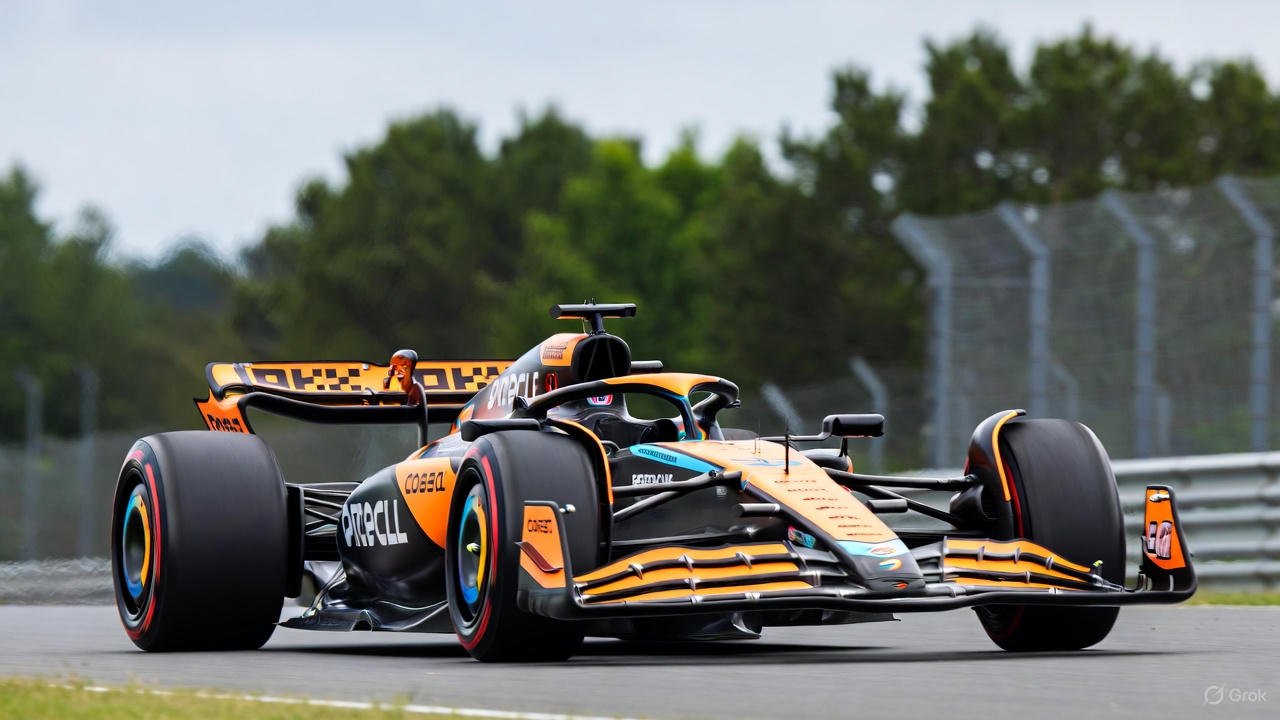
The neon lights of Las Vegas had barely dimmed when the Formula 1 world was hit with a bombshell that turned the glittering Strip into a stage for high-stakes drama. On a crisp November night in 2025, McLaren’s dream run at the Las Vegas Grand Prix unraveled in the most heartbreaking fashion. Lando Norris and Oscar Piastri, the British team’s dynamic duo leading the drivers’ standings, crossed the finish line with grins and podium aspirations—Norris in second, Piastri in fourth. But hours later, under the unforgiving glare of FIA scrutineers, both cars were stripped of their results. “Mclaren disqualified” became the phrase echoing through pit lanes and social media feeds, a double whammy that yanked 30 precious points from the team’s grasp and flung the championship wide open. Max Verstappen, the ever-resilient Red Bull ace, suddenly found himself not just a race winner, but a title contender with real momentum heading into the final showdowns.
It was the kind of twist that F1 thrives on—equal parts technical intrigue, human emotion, and razor-thin margins. McLaren, who had dominated much of the 2025 season with their MCL39’s blistering pace, watched as a 1mm oversight on their skid blocks transformed a potential championship-clinching haul into a gut-punch setback. For fans glued to their screens, it was a reminder that in this sport, victory isn’t sealed until the scales have spoken. And now, with just a handful of races left, the “mclaren disqualified” saga has injected fresh fire into what was starting to feel like a procession toward Woking’s first drivers’ crown in over two decades.
A Night of Highs and Hidden Lows on the Strip
The Las Vegas Grand Prix has always been F1’s glitzy outlier—a spectacle where Hollywood stars mingle with horsepower under the shadow of casino towers. Saturday’s race, the 21st round of the 2025 calendar, delivered on that promise. Starting under the floodlights, Norris lined up on pole, his orange McLaren a beacon of confidence after a flawless qualifying. Piastri, his Australian teammate, slotted in fourth, ready to pounce on any chaos.
The lights went out, and the 17-lap sprint to Turn 1 was a frenzy. Verstappen, starting third, muscled his way to the front with a signature bold move, slipping past Norris on the outside into the sweeping right-hander. “I’ve got him!” crackled over the Red Bull radio as Max seized the lead, a position he’d hold unchallenged for all 50 laps. Norris, undeterred, shadowed the Dutchman closely, eking out a solid second place with tire management that bordered on poetry. Piastri, meanwhile, clawed his way through the midfield, overtaking Mercedes’ George Russell and Ferrari’s Charles Leclerc to snag fourth—a gritty drive on a track notorious for its abrasive surface.
Post-race celebrations were in full swing. Verstappen sprayed the champagne, crediting his team’s strategy for the win, while Norris and Piastri exchanged fist bumps in parc fermé. McLaren’s garage buzzed with optimism; team principal Andrea Stella had even hinted in pre-race briefings that this could be the weekend they mathematically wrapped up the constructors’ title. The points looked juicy: 25 for Verstappen, 18 for Norris, 12 for Piastri. Heading into the night, the standings painted a McLaren masterclass—Norris on 408 points, Piastri on 378, and Verstappen trailing at 366. A 42-point lead for Norris over Max seemed insurmountable, with only Qatar and Abu Dhabi left to negotiate.
But as the crews wheeled the cars into the impound area, the mood shifted. FIA technical delegate Jo Bauer, armed with a Mitutoyo micrometer calibrated to 0.001mm precision, began the ritualistic post-race checks. The focus: the rear skid block, that unassuming plank bolted to the car’s underbelly, designed to keep the floor from scraping too close to the tarmac. Regulations are crystal clear—Article 3.5.9 of the 2025 Technical Regulations mandates a minimum thickness of 9mm. Anything less, and it’s game over.
For Norris’s car (chassis 4), the readings were damning: right-hand side front at 8.88mm, rear at 8.93mm. Piastri’s (chassis 81) fared no better, with similar infractions across both sides. The breach was blatant, a violation born not of malice but of the relentless grind of a high-downforce car devouring its limits on Vegas’s unforgiving asphalt. By midnight, stewards had convened, summoning McLaren for explanations. The verdict dropped like a Vegas slot machine hitting triple sevens—in reverse.
Unpacking the Plank: A Technical Tumble in Sin City
At its core, the “mclaren disqualified” controversy boils down to physics meeting bureaucracy. The skid block—once a simple wooden slat, now a high-tech composite—serves as F1’s guardrail against teams gaming the ride height. Too low, and aerodynamics get an unfair boost; too worn, and safety margins erode. The 9mm rule, tightened after 2021’s porpoising scandals, ensures parity and prevents floors from “porpoising” uncontrollably, that bouncy nightmare that plagued Red Bull in Bahrain earlier this year.
McLaren’s MCL39, a car that’s feasted on straight-line speed and cornering grip all season, apparently pushed the envelope too far. The Vegas track, with its temporary surface laid over casino parking lots, is a plank’s worst enemy—bumpy, dusty, and brutally abrasive. Data from the race showed both cars running aggressive setups to maximize downforce, leading to excessive wear. “It was like the track was eating the car alive,” one anonymous McLaren engineer later whispered to reporters, off the record.
The team didn’t go down without a fight. In their defense to the stewards, McLaren cited “mitigating circumstances”: unexpected porpoising exacerbated by Saturday’s rain-shortened practice sessions, leaving scant time for setup tweaks. They argued the breach was unintentional, a byproduct of pushing for performance in a championship scrap. “We had limited opportunity to test due to the weather,” read their submission, pleading for a points deduction over outright disqualification. It was a Hail Mary, invoking precedents like the 2024 Qatar GP where Alpine escaped with fines for similar issues.
But the FIA held firm. “There is no provision in the regulations or precedent for any penalty other than disqualification,” the stewards’ report stated coolly. They acknowledged McLaren’s clean intent—no deliberate circumvention here—but rules are rules. Both cars were tossed from the results, promoting Russell to second (18 points for Mercedes) and rookie sensation Kimi Antonelli to third (15 points, a breakout moment for the young Italian). Leclerc inherited fourth, salvaging 12 for Ferrari. The ripple effect? A constructors’ shake-up too, with McLaren’s lead over Mercedes trimmed from a comfy margin to a knife-edge.
In the hours after, McLaren’s silence spoke volumes. Stella cancelled his mandatory media duties, a rare no-show that underscored the sting. Norris and Piastri, sequestered in team briefings, emerged stone-faced, their post-race highs evaporated. “It’s tough to swallow,” Norris later admitted in a team statement, his voice laced with frustration. “We gave everything out there, and to lose it like this… it’s not how you want to fight for a title.”
A Championship Reset: From procession to Pandemonium
Nothing crystallizes F1’s brutality like a disqualification double. Pre-Vegas, McLaren’s dominance was the story of 2025—a team reborn under Stella’s steady hand, blending Norris’s flair with Piastri’s precision. The Brit led with 390 points, Piastri 24 back at 366, and Verstappen a distant 341, his Red Bull RB21 hampered by early-season reliability woes. Constructors? McLaren on 786, Mercedes lurking at 423, Red Bull at 391. It smelled like coronation.
Post-DQ, the math tells a thriller’s tale:
| Position | Driver (Team) | Pre-Vegas Points | Vegas Gain/Loss | Post-Vegas Points | Gap to Leader |
|---|---|---|---|---|---|
| 1 | Lando Norris (McLaren) | 390 | -18 (DQ) | 390 | – |
| 2 | Oscar Piastri (McLaren) | 366 | -12 (DQ) | 366 | -24 |
| 3 | Max Verstappen (Red Bull) | 341 | +25 (Win) | 366 | -24 |
| 4 | George Russell (Mercedes) | 276 | +18 (P2) | 294 | -96 |
| 5 | Charles Leclerc (Ferrari) | 214 | +12 (P4) | 226 | -164 |
The table doesn’t lie: Verstappen vaults to level with Piastri, just 24 shy of Norris—a chasm that one strong weekend could bridge. McLaren’s intra-team battle intensifies too; Norris’s edge over his teammate shrinks from 30 (post-race, pre-DQ) to 24, setting up potential fireworks in Qatar’s high-speed desert layout. Constructors-wise, McLaren clings to 744, but Mercedes closes to 441, with Red Bull at 416. Every point now feels like gold dust.
For Verstappen, it’s manna from heaven. The three-time champ, who started the season with four wins in five but hit a mid-year slump, has roared back with victories in Mexico and Brazil. “This is a big motivational boost,” he said post-race, his grin masking the relief. “We’ve been fighting hard, and now it’s game on. Amazing end to the year.” Red Bull boss Christian Horner was blunter: “Fortune favors the bold, but today it favored the compliant.” A subtle dig at McLaren’s setup gamble? You bet.
Echoes from the Past: When DQs Rewrite History
This isn’t McLaren’s first rodeo with the stewards’ wrath, nor F1’s. Flash back to 2023’s United States GP, where Lewis Hamilton and Charles Leclerc were DQ’d for identical plank issues—McLaren’s Zak Brown called it “a witch hunt” then, only for his team to taste the same bitter pill last year in Qatar. The irony? That 2024 US DQ handed Norris his maiden win, a karmic loop now snapped shut.
Deeper history offers lessons. The 1982 San Marino GP saw six cars DQ’d for turbo fuel irregularities, flipping the entire race order. Or 2007’s SpyGate, where McLaren was fined $100 million and erased from constructors’ points for industrial espionage. These scars run deep in Woking, where Ron Dennis’s era prized precision above all. Today’s “mclaren disqualified” feels like a modern echo—technical, not nefarious, but no less devastating.
Experts point to evolving regs as the culprit. Post-2022 ground-effect cars demand surgical setup; a millimeter here means seconds per lap there. “Teams are walking a tightrope,” says former FIA tech chief Nikolas Tombazis. “Vegas’s surface amplified it—bumpier than Monza, rougher than Silverstone.” McLaren’s aggressive ride height? A calculated risk that backfired spectacularly.
Voices from the Paddock: Shock, Support, and Side-Eyes
Reactions poured in like monsoon rain. Piastri, ever the stoic, posted on X: “Gutted, but we’ll bounce back. Team’s behind us 100%.” His 366 points keep him mathematically alive, but the mental toll? “It’s like losing a family member,” he told Sky Sports later. Norris, more fiery, vented in a hushed team huddle: “We were the quickest car; this shouldn’t define us.” Off-camera, sources say he punched a wall—classic Lando, channeling rage into resolve.
Rivals treaded carefully. Russell, elevated to P2, called it “bittersweet—congrats to the McLaren boys on the pace, tough break.” Leclerc, philosophical as always, mused: “F1 punishes the bold. We’ve all been there.” But whispers from Ferrari’s Maranello camp hint at schadenfreude; their dismal Vegas (Leclerc fifth, Sainz out early) suddenly looks rosier.
Verstappen’s camp was jubilant yet measured. “Max deserves this shot,” Horner told Dutch media. “He’s been flawless when it counts.” The Dutchman himself, in a rare vulnerable moment, added: “I feel for Lando and Oscar—they’re great drivers. But championships are won in the details.” No gloating, just quiet confidence. On X, the semantic storm raged: #MclarenDisqualified trended with 2.5 million posts, a mix of memes (Norris as a Vegas gambler bust), outrage (“FIA ruining the show!”), and analysis threads dissecting skid wear like a crime scene.
McLaren’s internal reckoning? Stella, in a terse release, vowed: “We’ll learn, adapt, and come back stronger. This is a bump, not the end.” Privately, engineers are poring over telemetry, tweaking simulations for Lusail’s smoother track. The Woking faithful, scarred by decades of near-misses, rally with #TeamMcLaren hashtags—resilience is their creed.
Road to Redemption: Qatar, Abu Dhabi, and Beyond
With two rounds left, the calendar closes in the Gulf’s furnace. Qatar’s Losail circuit, a night race of sweeping straights and tight esses, favors the bold setups McLaren craves—but after Vegas, caution will reign. Verstappen’s RB21 shines in high-speed corners; a win there, and Norris’s lead evaporates. Piastri, overlooked as the “support act,” now eyes a late charge—his cool head could split the McLaren points and keep Red Bull at bay.
Constructors’ drama looms larger. McLaren’s 345-point buffer? Sliced to 303 over Mercedes, who smell blood with Russell and Antonelli’s youth surge. Red Bull, 28 back, needs perfection. Ferrari, perennial bridesmaids, lurk 60 adrift—Leclerc’s consistency their wildcard.
Off-track, the “mclaren disqualified” fallout ripples. Sponsors like Google and OKX, betting on orange dominance, now hedge. FIA faces scrutiny too— is the plank rule too punitive in an era of 300km/h precision? Calls for appeals or regulatory tweaks bubble up, though McLaren’s window slammed shut at 2200 local time.
Yet amid the chaos, F1’s magic endures. This double DQ isn’t a death knell; it’s rocket fuel. It humanizes the titans, reminding us that even gods bleed millimeters. As Norris quipped in a late-night Instagram story: “From heartbreak to hungry. See you in Qatar.” The championship, once a McLaren monologue, now hums with polyphony—Verstappen’s growl, Piastri’s whisper, Russell’s roar. Game on, indeed.
In the end, 2025’s tale might not crown a hero in Woking, but it’ll etch legends in controversy. That’s F1: where disqualifications don’t end stories; they ignite them. And with the checkered flag three races away, every lap feels like legacy.