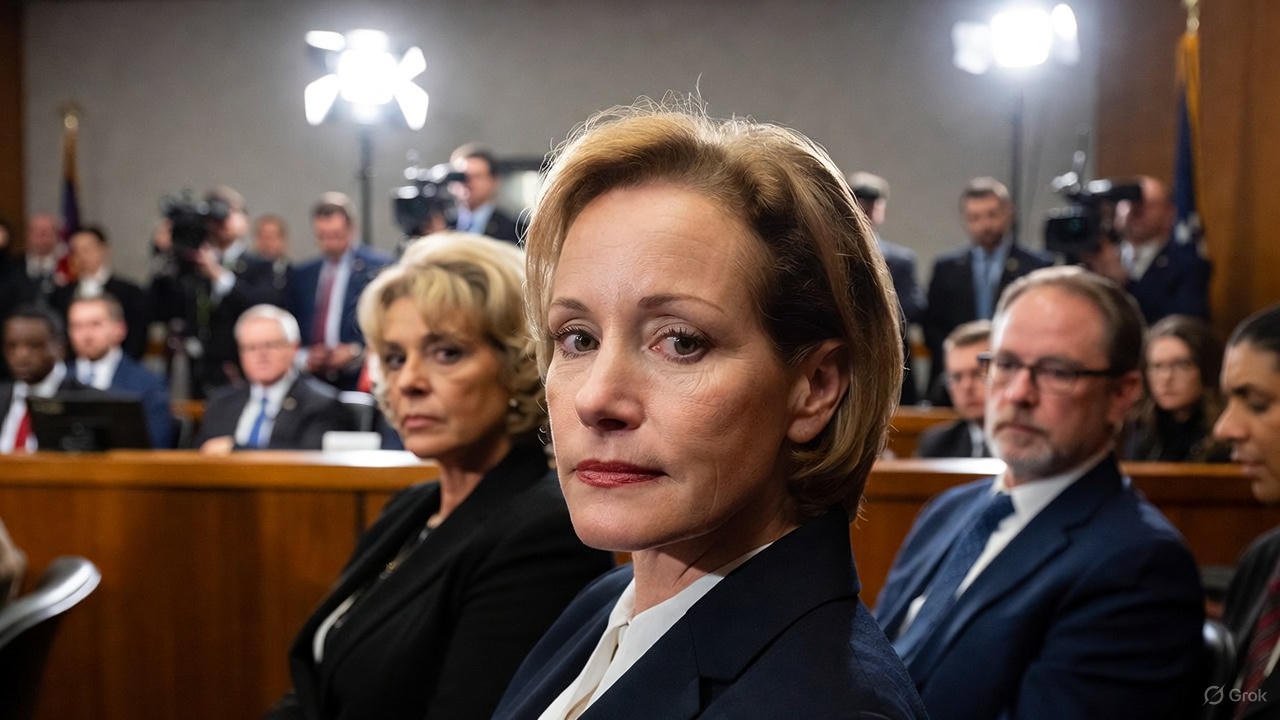
In the sweltering heat of a Fort Worth courtroom on November 21, 2025, the gavel fell like a thunderclap, sealing the fate of a woman once celebrated for her poised delivery on local television screens. Stephanie Hockridge, the charismatic ex-anchor from Phoenix’s ABC15 station, stood before U.S. District Judge Mark T. Pittman, her face a mask of quiet resignation. At 42 years old, Hockridge — also known by her married name, Stephanie Reis — was handed a 10-year prison sentence for her central role in a sprawling $63 million fraud scheme that exploited the chaos of the COVID-19 pandemic. But the story doesn’t end with the bars slamming shut behind her. Hockridge has been ordered to report to the Federal Prison Camp in Bryan, Texas, by December 30 — a minimum-security facility that’s become an unlikely celebrity enclave, home to none other than Ghislaine Maxwell, the convicted sex trafficker, as well as disgraced tech mogul Elizabeth Holmes and reality TV star Jen Shah. In this ironic twist, the former broadcaster will trade her spotlight for a shared cellblock with some of the most notorious women in modern infamy.
Hockridge’s journey from the bright lights of the newsroom to the dim corridors of federal justice reads like a cautionary tale scripted for prime time. Born and raised in Arizona, she carved out a solid career in journalism during the early 2010s. Viewers in the Phoenix metro area knew her as the fresh-faced reporter who could pivot seamlessly from covering school board meetings to delivering urgent weather updates during monsoon season. By 2015, she’d ascended to the anchor desk at KNXV-TV, ABC15’s local affiliate, where her warm on-camera presence and sharp interviewing skills made her a household name. Colleagues remember her as ambitious and affable, the kind of person who’d linger after shifts to mentor interns or organize charity drives for local food banks. “She had that rare gift,” one former producer told local media outlets after the verdict. “You believed every word she said because she made you want to.”
But beneath the polished exterior, Hockridge harbored entrepreneurial dreams that would soon collide disastrously with the unprecedented economic turmoil of 2020. As the coronavirus swept across the globe, shuttering businesses and sending unemployment lines snaking around city blocks, the U.S. government rolled out the CARES Act — a $2.2 trillion lifeline including the Paycheck Protection Program (PPP). Designed to keep small enterprises afloat with forgivable loans, the PPP became a bureaucratic behemoth, processing over 11 million applications in its first weeks. Into this frenzy stepped Hockridge and her husband, Nathan Reis, a tech-savvy entrepreneur with a background in software development.
In April 2020, the couple co-founded Blueacorn, a Scottsdale-based fintech startup billed as a one-stop shop for navigating the PPP maze. Hockridge, leveraging her public profile, became the face of the venture, appearing in promotional videos and social media posts that promised seamless access to federal aid. “We’re here to help real people through real hardship,” she said in one early clip, her voice steady and reassuring, echoing the empathy she’d honed in the newsroom. Blueacorn quickly scaled, partnering with major lenders and boasting that it had facilitated over $1 billion in loans — a figure that dwarfed even the outputs of banking giants like J.P. Morgan Chase and Bank of America combined in 2021. At its peak, the company employed dozens and processed thousands of applications daily, turning a profit through SBA-mandated lender fees and borrower kickbacks.
What prosecutors later unveiled, however, was a far darker operation: a sophisticated conspiracy to siphon millions from the program by coaching applicants on how to inflate their eligibility. Hockridge and Reis allegedly orchestrated the creation of bogus documents — fabricated payroll records, phony tax returns, and counterfeit bank statements — to qualify clients for outsized loans. They even secured a PPP payout for a sham company with zero employees, pocketing fees along the way. The scheme’s crown jewel was the “VIPPP” service, a premium tier where Hockridge’s team hand-held high-rollers through the fraud, charging percentages of the disbursed funds as hush-hush commissions. Co-conspirators, recruited as referral agents, were schooled in the art of deception, from scripting false narratives about employee headcounts to timing submissions to evade audits.
The total haul? Over $63 million in fraudulent loans, funneled through Blueacorn’s platform and disbursed to complicit borrowers who, in turn, kicked back portions to the founders. Hockridge herself benefited directly, prosecutors argued, using the ill-gotten gains to fund a lavish lifestyle that included a move to the sun-drenched shores of Rio Grande, Puerto Rico, just as the first waves of PPP forgiveness hit. There, the couple allegedly reveled in beachfront properties and luxury vehicles, a stark contrast to the struggling families the program was meant to save. “This wasn’t opportunism; it was predation,” declared Acting Assistant Attorney General Matthew R. Galeotti during the sentencing hearing. “They turned a lifeline into a noose for the American taxpayer.”
The unraveling began in late 2023, when whistleblowers from within Blueacorn — disgruntled employees who’d grown uneasy with the ethical tightrope — tipped off federal investigators. The IRS Criminal Investigation division, alongside the FBI, the Special Inspector General for Pandemic Recovery, and the SBA’s Office of Inspector General, launched a multi-agency probe that peeled back layers of digital forensics and financial trails. Raids on the couple’s properties yielded troves of incriminating emails and spreadsheets, painting a picture of deliberate deceit. Hockridge, in particular, stood accused of micromanaging the fabrications, personally vetting falsified docs to ensure they passed lender scrutiny.
Indictments dropped in November 2024, charging Hockridge and Reis with conspiracy to commit wire fraud and multiple counts of wire fraud — crimes carrying up to 20 years each. Reis, facing mounting evidence, cut a plea deal in early 2025, agreeing to testify against his wife in exchange for a reduced sentence still pending in December. Hockridge, ever the fighter, went to trial in June, her defense painting her as a naive partner overshadowed by her husband’s schemes. “Stephanie was the heart of Blueacorn, not the architect of its sins,” her attorney argued, emphasizing her acquittal on four wire fraud counts as proof of selective culpability. But the jury saw through the spin, convicting her on the conspiracy charge after just two days of deliberation.
The trial itself was a media circus, with Hockridge’s former colleagues watching from the gallery in stunned silence. Testimonies from co-conspirators detailed her hands-on role: late-night calls coaching a restaurant owner on inflating staff numbers, emails approving a $2 million loan for a ghost payroll. Hockridge took the stand in her own defense, her voice cracking as she recounted the pandemic’s toll on her mental health. “We were desperate to help,” she insisted, tears streaking her makeup-free face. “The system was broken; we tried to fix it.” Yet cross-examination exposed contradictions — luxury purchases timestamped against her claims of altruism — eroding her credibility in the eyes of the panel.
When Judge Pittman delivered the sentence, his words cut deep. “Ms. Hockridge, you wielded your charisma not for truth, but for theft,” he intoned, rejecting her bid for probation. The 120-month term, coupled with nearly $64 million in joint restitution and two years of supervised release, ensures her downfall will echo for years. Hockridge nodded solemnly, whispering farewells to her legal team before being led away, her surrender date looming like a holiday guillotine.
Now, as the holidays approach, Hockridge faces an abrupt relocation to FPC Bryan, a sprawling 37-acre compound in east Texas that’s more country club than correctional nightmare. Dubbed “Club Fed” by inmates, the camp dispenses with razor wire and armed patrols, opting instead for self-policing dorms, communal kitchens, and recreational fields where residents play softball or tend community gardens. It’s a far cry from the supermax hellholes of popular lore, designed for nonviolent white-collar offenders serving lighter stretches. Yet even here, Hockridge’s arrival stirs ripples. The facility already buzzes with high-profile residents: Ghislaine Maxwell, the 63-year-old British socialite serving 20 years for her role in Jeffrey Epstein’s underage sex trafficking ring, has reportedly adapted to the routine with her trademark poise, trading society galas for yoga classes and prison book clubs.
Maxwell’s transfer to Bryan in August 2025 from the more restrictive FCI Tallahassee sparked its own drama — increased lockdowns, extra guards, and whispers of VIP treatment that irked longtime inmates. Joining her is Elizabeth Holmes, the Theranos founder whose blood-testing empire crumbled in a web of lies, now marking time on an 11-year bid amid rumors of prison-side startups. And then there’s Jen Shah, the “Real Housewives of Salt Lake City” firebrand convicted of telemarketing fraud, whose brash antics have allegedly lightened the mood with impromptu talent shows. For Hockridge, stepping into this sisterhood could be a double-edged sword: camaraderie from shared notoriety, or isolation amid judgments from women whose scandals eclipse her own.
What does this mean for the disgraced anchor? Insiders speculate she’ll lean on her communication skills, perhaps volunteering for the camp’s public affairs committee or tutoring fellow inmates in media literacy. But the psychological toll is undeniable. Hockridge leaves behind two young children in Puerto Rico, cared for by extended family as Reis awaits his own reckoning. Letters from supporters flood the couple’s inbox, a mix of betrayal and pleas for mercy. “How does a woman who championed the underdog become the villain?” pondered one anonymous fan in a viral X post.
Her case underscores a broader reckoning with the PPP’s dark underbelly. Of the $800 billion disbursed, auditors estimate up to $200 billion vanished into fraudulent hands — from ghost businesses to insider scams like Blueacorn’s. The program’s hasty rollout, praised for speed, invited abuse; lax verification let opportunists thrive. Hockridge’s saga joins a rogues’ gallery of pandemic profiteers: nightclub owners flipping loans for Lamborghinis, influencers hawking fake forgiveness seminars. Yet hers stings uniquely, given her journalistic roots. “She reported on corruption,” a Phoenix ethics professor noted wryly. “Now she’s the headline.”
As Hockridge packs for Bryan, the focus shifts to accountability’s long shadow. Restitution demands, while staggering, may yield pennies on the dollar, a bitter pill for taxpayers already strained by inflation’s bite. Reis’s impending sentence could fracture the couple further, testing vows forged in startup boardrooms. And for Hockridge? A decade to reflect, perhaps penning a memoir that humanizes her hubris — “From Anchor to Anchorless,” anyone?
In the end, this isn’t just one woman’s tumble; it’s a mirror to our fractured times. The pandemic exposed heroes and hustlers alike, and Stephanie Hockridge embodies the latter — a reminder that even the most eloquent voices can whisper sweet nothings to deceit. As she crosses the Bryan threshold, sharing space with Maxwell and her ilk, one wonders: Will prison reform her, or merely recast her in a new drama? Only time — and those unblinking cellblock eyes — will tell.