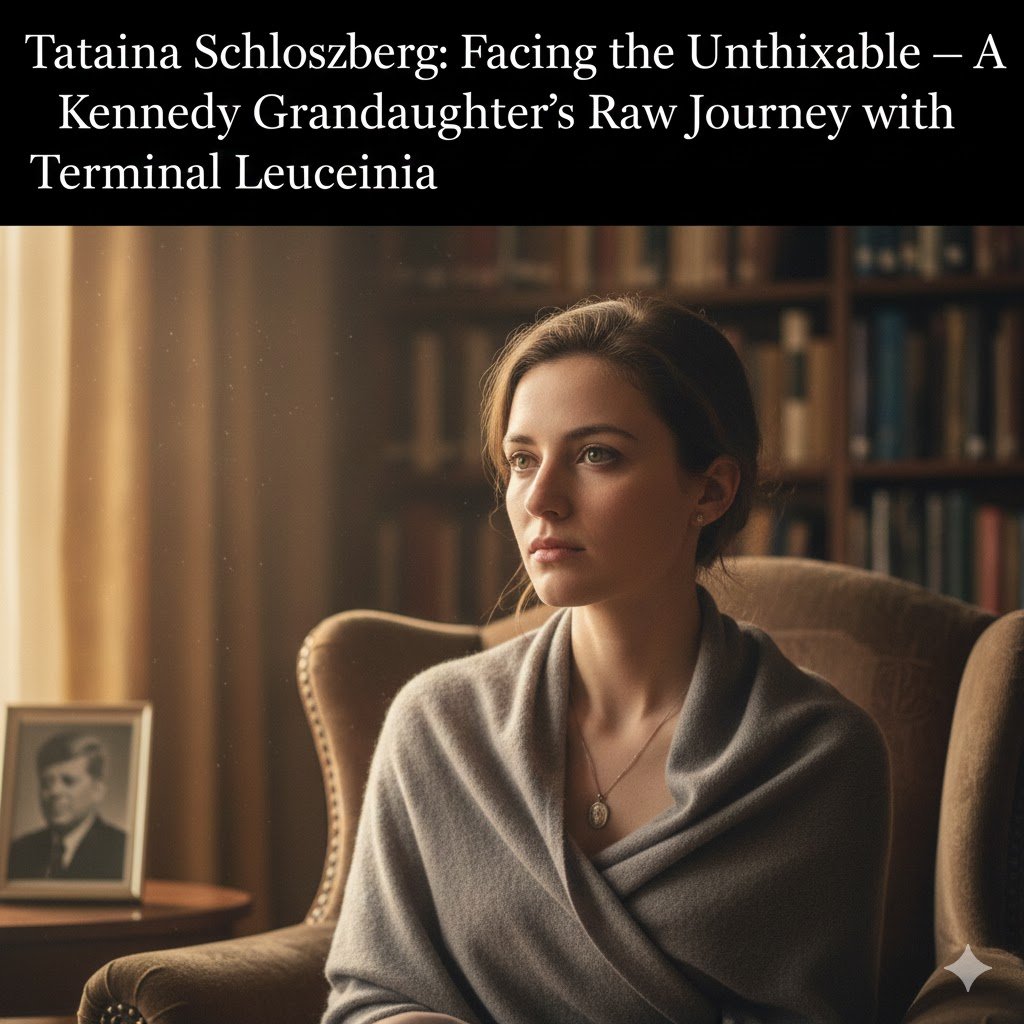
In the shadow of one of America’s most storied political dynasties, Tatiana Schlossberg has always carved her own path, blending sharp intellect with a quiet passion for the planet’s fragile future. But on a crisp November weekend in 2025, the 35-year-old environmental journalist shattered the veneer of invincibility that often cloaks the Kennedy name. In a deeply personal essay for The New Yorker, she laid bare a devastating truth: she is battling acute myeloid leukemia, a blood cancer so aggressive and rare in its mutation that her doctors have given her less than a year to live. Tatiana Schlossberg, granddaughter of President John F. Kennedy and daughter of former U.S. Ambassador to Australia Caroline Kennedy, didn’t just share her diagnosis – she invited readers into the chaos of her unraveling world, where hospital gowns replace running shoes, and fleeting memories become lifelines against oblivion.
It’s a story that hits like a gut punch, not because of the family’s fame, but for its aching universality. Who among us hasn’t stared down illness and wondered, “Why me?” For Tatiana, the question echoes louder amid a legacy marked by triumphs and tragedies – assassinations, plane crashes, addictions – yet also by unyielding public service. Her words, laced with wry humor and unflinching honesty, transform a private agony into a public elegy, urging us to confront not just one woman’s fight, but the fraying threads of healthcare and hope in a divided nation.
Born on May 5, 1990, in the bustling heart of New York City, Tatiana Celia Kennedy Schlossberg entered a world already buzzing with expectation. Her mother, Caroline Bouvier Kennedy, the only surviving child of JFK and Jacqueline Kennedy Onassis, had spent her youth under the relentless glare of Camelot’s spotlight. Caroline’s marriage to artist and designer Edwin Schlossberg in 1986 brought a measure of normalcy to the fairy-tale narrative, and Tatiana, along with siblings Rose and Jack, grew up in a home that balanced privilege with purpose. Their childhood unfolded across Manhattan brownstones and Hyannis Port summers, where the Atlantic’s roar mingled with tales of a grandfather whose voice still stirred the soul of a nation.
From an early age, Tatiana showed a fierce independence. She attended the elite Brearley School and later the Nightingale-Bamford School, institutions that nurtured her curiosity without smothering it under the weight of legacy. Summers at the Kennedy compound weren’t just playgrounds for sailboats and beach volleyball; they were classrooms in resilience. Tatiana recalls in her essay a vivid snapshot from those days: mixing mud pies with neighborhood kids on Martha’s Vineyard, only to watch one ignite in a spontaneous blaze – a metaphor, perhaps, for the unpredictable fires that would one day rage in her veins. Those carefree experiments foreshadowed her adult pursuits, where she’d dive headfirst into stories that demanded both grit and grace.
Academically, Tatiana blazed trails that honored her lineage while forging new ones. She graduated from Yale University in 2012 with a degree in history, immersing herself in the archives of environmental movements and the quiet revolutions of sustainable living. It was there, amid ivy-covered walls, that she honed a voice that could dissect complex ecological crises with the precision of a surgeon. Post-graduation, she didn’t chase the corridors of power like so many Kennedys before her. Instead, she turned to journalism, landing a coveted spot as a reporter for The New York Times. For nearly a decade, Tatiana Schlossberg chronicled the hidden costs of our carbon footprint – from the methane belches of dairy farms to the plastic-choked arteries of urban rivers.
Her 2019 book, Inconspicuous Consumption: The Environmental Impact You Don’t Know You Have, became a sleeper hit among eco-conscious millennials, earning praise for its accessible takedown of everyday indulgences. “We shop, we eat, we stream – but what if those choices are slowly poisoning the air we breathe?” she wrote, challenging readers to see the invisible threads connecting personal habits to planetary peril. The book wasn’t preachy; it was a wake-up call wrapped in wit, much like her Times columns that exposed how coffee pods contribute to e-waste mountains or how fast fashion fuels toxic dyes in distant waterways. By 2024, Tatiana had transitioned to freelance writing and advocacy, her byline a beacon for those grappling with climate anxiety in an era of escalating wildfires and melting ice caps.
What set Tatiana apart in the crowded field of green journalism wasn’t just her pedigree – though the Kennedy name opened doors – but her boots-on-the-ground ethos. She once plunged into a Massachusetts cranberry bog for a story on agricultural runoff, emerging coated in ruby-red muck and armed with firsthand proof of industry’s dirty secrets. Or consider her endurance feats: swimming three miles across the Hudson River to raise funds for the Leukemia and Lymphoma Society – an irony that stings in retrospect – and skiing 50 kilometers in Norway’s grueling Birkebeiner race. These weren’t stunts; they were statements, embodiments of a philosophy that action must precede alarm. Friends and colleagues describe her as “relentlessly optimistic,” a woman who could rally a room with a single, knowing smile, even as she dissected the doom-scrolling headlines of our warming world.
Yet beneath the public persona lay a deeply private life, one Tatiana guarded like a rare manuscript. In September 2017, she married George Moran, a urology resident whose steady presence would soon become her North Star. The wedding, held at the Kennedy family estate on Martha’s Vineyard, was an intimate affair – wildflowers and ocean breezes, no paparazzi in sight. George, with his dry humor and unflappable calm, complemented Tatiana’s intensity perfectly. “He’s the kind of partner who makes chaos feel containable,” a close friend once quipped.
Their family grew in 2022 with the arrival of their son, a bundle of energy who inherited his mother’s adventurous spirit. Tatiana balanced motherhood with deadlines, scribbling notes on climate policy while chasing a toddler through Central Park. Then, in May 2024, joy doubled: their daughter arrived at Columbia-Presbyterian Hospital, a tiny miracle amid the beeps and bustle of delivery rooms. For a fleeting moment, life felt scripted for happily-ever-after. Tatiana, ever the planner, envisioned family hikes in the Adirondacks and bedtime stories laced with ocean facts. But fate, that capricious editor, had other revisions in store.
The unraveling began mere hours after her daughter’s birth. A standard blood draw flagged an anomaly: Tatiana’s white blood cell count soared to 131,000 per microliter – over ten times the norm. Her obstetrician, sensing trouble beyond postpartum fatigue, ordered urgent tests. What followed was a whirlwind of consultations and confessions: acute myeloid leukemia, the aggressive invader of bone marrow, compounded by a rare Inversion 3 mutation more common in the elderly than in a vibrant 34-year-old. “It could just be something related to pregnancy,” the doctor hedged initially, but deep down, Tatiana knew. The blasts – those rogue, immature cells crowding out the healthy ones – had been silently multiplying.
Treatment commenced with the ferocity of a storm. Five weeks in the hospital blurred into a haze of IV drips and isolation gowns. Chemotherapy ravaged her body, shrinking blasts but stripping her strength; she lost her hair, her appetite, her illusion of control. A postpartum hemorrhage nearly claimed her life, staunched only by swift intervention and a drug – misoprostol – whose future availability now hangs in political limbo. Transfer to Memorial Sloan Kettering brought hope via stem cell transplants: first from her sister Rose, a perfect match who endured grueling harvests; then from an anonymous donor, a young man from the Pacific Northwest whose cells offered a second chance.
Experimental therapies followed – CAR-T cell treatment, where engineers reprogrammed her sister’s immune warriors to hunt leukemia, only to unleash cytokine storms that choked her lungs and inflamed her organs. Relapses came like cruel echoes, each one eroding remission’s fragile ground. Graft-versus-host disease turned her skin to sandpaper; an Epstein-Barr infection ravaged her kidneys. By autumn 2024, the verdict landed: terminal. “You start remembering everything when you’re dying,” Tatiana writes, her prose a lifeline amid the flood. Childhood giggles erupt unbidden – a college boyfriend’s slapstick tumble into slush, the acrid thrill of that flaming mud pie. She jokes about her bald pate making her a “busted-up Voldemort,” but the levity masks terror: Will her son, now three, recall her voice crooning lullabies? Will her daughter, robbed of those first months in a sterile nursery, ever know her mother’s touch without the specter of infection?
In the essay’s tender core, Tatiana grapples with memory’s tyranny. “Maybe my brain is replaying my life now because all these memories will be lost,” she muses, invoking Seamus Heaney’s plea for miracles from “The Cure at Troy.” These vignettes aren’t nostalgia; they’re anchors, pulling her from the abyss. She savors her son’s gleeful “drives” of her hospital bed, the seltzer fizz lighting her baby’s gap-toothed grin. Yet guilt gnaws – for burdening her family, for the oceans book she’ll never finish, its pages heavy with unwritten warnings about vanishing coral reefs.
Family, that unbreakable Kennedy alloy, has been her bulwark. George, the “kind, funny, handsome genius,” juggles residency shifts with diaper changes, decoding insurance labyrinths while she slumbers under sedation. Caroline and Edwin, pillars of quiet strength, ferry grandkids to playgrounds and sit vigil through her fevers, their faces etched with the unspoken grief of watching a child fade. Siblings Rose and Jack, half-matches in marrow but full in heart, quip about genetic lotteries to pierce the gloom. “We’ve always been a clan that turns pain into purpose,” Tatiana reflects, echoing the ethos that propelled her uncle Ted through brain cancer and her aunt Eunice through MS. But this fight feels personal, a rogue wave crashing against Camelot’s shores.
Beyond the bedside, Tatiana’s voice sharpens into advocacy. Her essay isn’t just memoir; it’s manifesto. She credits public-funded breakthroughs – mRNA tech from COVID vaccines, now eyed for leukemias; CAR-T’s immune hacks born in NIH labs – for her every borrowed breath. Yet fury simmers at her cousin Robert F. Kennedy Jr., confirmed as Health Secretary in a Trump administration redux. His slashes to research budgets – half a billion from mRNA, billions from NIH – gut the very trials sustaining her. “As I spent more time under doctors striving to improve lives, I watched Bobby dismantle the tools that could save mine,” she writes, her words a scalpel to anti-vax dogma that endangers her vaccine-dependent fragility. Layoffs at Columbia, her birthplace of diagnosis, underscore the cuts’ human toll: 180 researchers gone, experiments halted. Even cytarabine, her chemo lifeline derived from sea sponges, traces to federally backed ocean studies now imperiled. Tatiana’s plea is clear: In a nation polarized by distrust, science isn’t optional – it’s oxygen.
The outpouring has been swift and heartfelt. On X, formerly Twitter, posts flood with solidarity: People magazine shares her story to millions, while oncologists like Harold Burstein hail the essay’s power, reminding us “cancer affects everyone.” Friends rally with meal trains and memory jars, filling them with notes for her children. Climate allies, from Times editors to Sierra Club activists, vow to carry her torch, petitioning for restored funding in her name.
Tatiana Schlossberg’s story, at once intimate and immense, reminds us that even immortals bleed. In her final months, she chooses candor over curtain calls, weaving a tapestry of love, loss, and lingering fight. As winter whispers across the Hudson – that river she once conquered stroke by stroke – her words endure, a call to cherish the mud pies, the slush falls, the unburnt tomorrows. In battling her blood, she honors the Kennedy fire: not with fanfare, but with fierce, flickering truth. May it light the way for cures yet unseen.