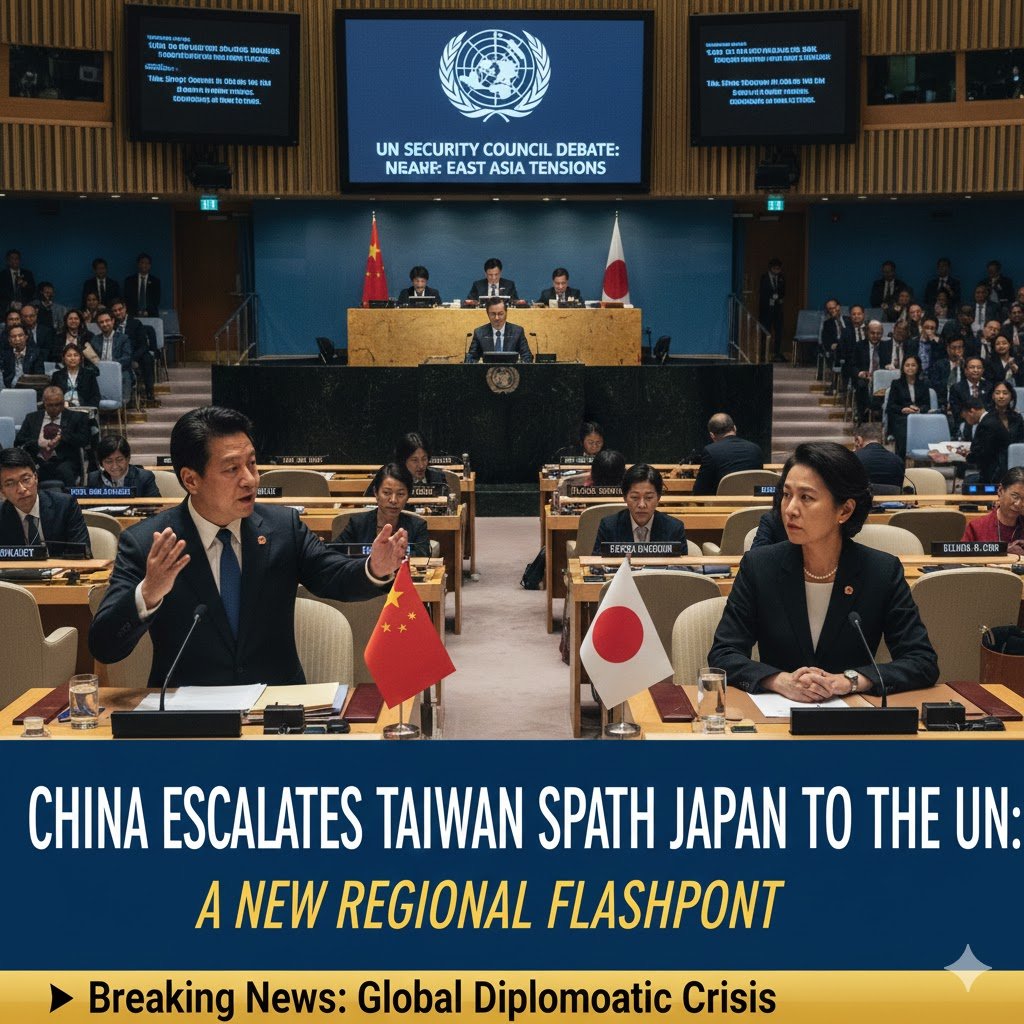
The geopolitical landscape of East Asia has always been complex, layered with history, territorial claims, national pride, and international rivalry. But the recent diplomatic tension between China and Japan over Taiwan has brought a new level of confrontation—one that has now reached the corridors of the United Nations. China, asserting that Japan has crossed diplomatic lines, has escalated its complaint to the UN, reinforcing its longstanding claim over Taiwan and vowing to “defend itself” against what it describes as external interference.
This development is not an isolated incident. It has emerged from a chain of political statements, defense partnerships, regional military movements, and lingering historical mistrust between Beijing and Tokyo. The incident highlights the widening strategic competition in the Asia-Pacific region, especially as Taiwan becomes an increasingly central flashpoint in global politics.
This article provides an in-depth and human-tone analysis of the situation—how the spat began, China’s motivations for involving the UN, Japan’s growing security role, and how Taiwan sits at the heart of one of the world’s most sensitive geopolitical disputes.
How the Spat Between China and Japan Started
What triggered this latest confrontation was a series of statements made by Japanese leaders expressing concern about peace and stability across the Taiwan Strait. Japan’s remarks suggested that Taiwan’s security is directly connected to Japan’s own national security. This sentiment is not entirely new—Japan has repeatedly voiced such concerns in recent years—but the tone has grown stronger as tensions between China and Taiwan increase.
For Beijing, however, Japan’s statements crossed a “red line.” China views Taiwan not as a separate political entity but as an inalienable part of its territory. Any foreign comments that appear to support Taiwan’s autonomy or question China’s sovereignty are considered hostile. When Japan referred to Taiwan’s situation as a “global issue” and emphasized the need for international attention, China responded sharply.
The Chinese Foreign Ministry accused Japan of interfering in its internal affairs, warning Tokyo to “stop poisoning the atmosphere” in the region. It was after additional comments from Japanese officials and joint U.S.–Japan security discussions on Taiwan that China decided to take the matter to the United Nations.
Why China Took the Issue to the United Nations
China’s decision to raise the issue at the UN reflects three primary motivations:
1. To Deliver a Global Warning
By involving the United Nations, Beijing is signaling its intent to make the matter highly visible. China wants to warn not only Japan but also the broader international community that it will not tolerate any external involvement in Taiwan-related discussions.
2. To Reinforce Its Sovereignty Claim
China uses international platforms to restate its “One China Principle”—the foundation of its foreign policy—which asserts that Taiwan is an indivisible part of China. By formally lodging a complaint, Beijing aims to strengthen this stance on the global record.
3. To Counter Growing International Cooperation on Taiwan
Countries such as the United States, Japan, Australia, India, and several European nations have increased dialogue over Taiwan’s security. China considers this a threat and is trying to push back diplomatically before the situation escalates militarily.
The move to the UN highlights China’s fear that a broader coalition could emerge to support Taiwan’s defense in case of a conflict. China wants to ensure that the global community stays aligned—or at least neutral—regarding its Taiwan policies.
Japan’s Position: Why It Is Speaking Up for Taiwan
Japan has shifted its posture significantly in recent years. While it once maintained distance from the Taiwan issue to avoid angering China, Tokyo is now openly expressing concern.
1. Taiwan’s Proximity to Japan
Taiwan lies just over 100 kilometers from Japan’s Yonaguni Island. Any military confrontation in the Taiwan Strait would directly affect Japan’s territory, airspace, and maritime routes.
2. China’s Increasing Military Activities
China’s rapid military expansion—including aircraft and naval patrols near Taiwan—has raised alarms in Tokyo. Japanese defense white papers consistently highlight China as a major security challenge.
3. Strategic Partnership With the United States
Japan’s security alliance with the U.S. has grown stronger. Washington has repeatedly emphasized Taiwan’s importance, and Japan, as a close partner, has echoed concerns.
4. International Norms and Stability
Japan argues that peace in the Taiwan Strait is essential to global supply chains and economic stability—especially because Taiwan is the world leader in semiconductor manufacturing.
Japan’s involvement is not purely internal or emotional—it is strategic, practical, and heavily influenced by security calculations.
China’s Response: A Vow to “Defend Itself”
China’s fierce reaction stems from both political and strategic reasons. In its UN submission and public statements, Beijing said it is prepared to “defend itself against external interference.” While the phrase may appear defensive, it carries deeper implications:
1. A Warning of Military Resolve
China has repeatedly said it will not rule out the use of force to reunify Taiwan. The vow to defend itself is a reminder that Beijing views the Taiwan issue as non-negotiable.
2. Rejecting Japan’s Historical Legacy
China frequently references Japan’s wartime past as a reason why Tokyo should not comment on China’s internal affairs. By invoking history, China seeks to portray Japan’s involvement as dangerous and provocative.
3. A Message to the U.S. and Allies
Although the spat is officially between China and Japan, the underlying message is aimed at the United States and its security partners. China is signaling that international involvement will be met with firm resistance.
4. Domestic Political Strength
Chinese leadership uses strong statements on Taiwan to maintain national unity and demonstrate political strength at home. Any sign of softness could be interpreted domestically as weakness.
Taiwan’s Role in the Entire Dispute
Taiwan sits at the center of this geopolitical storm. As a self-governed democracy, Taiwan rejects Beijing’s sovereignty claim. Its government sees itself as an independent entity with its own identity, economy, and political system.
1. Taiwan Welcomes International Attention
Taiwan’s leadership views Japan’s comments as supportive. The island prefers global involvement to ensure it is not isolated in its conflict with Beijing.
2. Taiwan Is a Critical Global Technology Hub
Its dominance in semiconductor technology makes Taiwan globally indispensable. Any conflict would disrupt industries worldwide—from smartphones to automobiles and defense systems.
3. Taiwan’s Identity Is Strengthening
The younger generation in Taiwan increasingly identifies as Taiwanese, not Chinese. This cultural shift fuels Beijing’s frustration, as political reunification appears less likely.
4. Taiwan Wants Peace—but Preparedness
While expressing commitment to peace, Taiwan continues to strengthen its defense capabilities, partly supported by U.S. military aid.
The more Taiwan asserts its identity, the more China feels pressured. This creates a tension that external players—like Japan—cannot avoid.
Regional and Global Reactions
The world is closely watching the China–Japan spat. Several countries have responded subtly, reflecting the delicate balance they must maintain.
United States
The U.S. has reaffirmed its stance that maintaining peace across the Taiwan Strait is essential. While staying neutral on sovereignty issues, Washington has made it clear that China should not escalate tensions.
European Union
European nations, especially those with strong trade ties to Taiwan, have called for dialogue and stability. Several EU members have recently increased diplomatic engagement with Taipei.
ASEAN Nations
Southeast Asian countries remain cautious. They prefer not to take sides due to economic dependence on China, but they emphasize peaceful resolution.
South Korea
South Korea, while careful not to provoke Beijing, shares Japan’s concerns about China’s growing military presence.
This mixture of caution and alignment shows that Taiwan’s status is becoming a global issue, regardless of China’s insistence that it is an internal matter.
What This Means for the Future of East Asia
The escalation of the China–Japan dispute over Taiwan could have several long-term implications:
1. Increased Militarization of the Region
Japan may further expand its defense capabilities. China, in response, may intensify its military presence around Taiwan.
2. Growing International Support for Taiwan
More countries might express concerns about Taiwan as the situation becomes more volatile.
3. Greater UN Involvement
Although the UN usually avoids taking sides in sovereignty disputes, China’s complaint could initiate deeper discussions.
4. Risk of Miscalculation
With military aircraft, warships, and diplomacy all intensifying, the chance of accidental conflict increases.
5. Strengthening of Alliances
Japan, the U.S., India, Australia, and European partners might deepen their cooperation to counterbalance China.
The region is entering a period of heightened tension, and the Taiwan issue is at the center of every strategic calculation.
Conclusion
China’s decision to take its spat with Japan over Taiwan to the United Nations marks a new chapter in East Asian diplomacy. Beijing’s vow to “defend itself” signals both political resolve and strategic warning. Japan, however, shows no intention of stepping back, emphasizing that Taiwan’s security is deeply connected to its own.
The dispute is more than a bilateral disagreement—it reflects the shifting power balance in Asia, the rising importance of Taiwan in global politics, and the growing willingness of international actors to challenge China’s geopolitical assertiveness.
As tensions rise, the world will continue to watch closely. Taiwan remains the focal point of one of the most sensitive, dangerous, and consequential geopolitical issues of the 21st century. The coming years will test diplomacy, alliances, and the region’s commitment to peace.