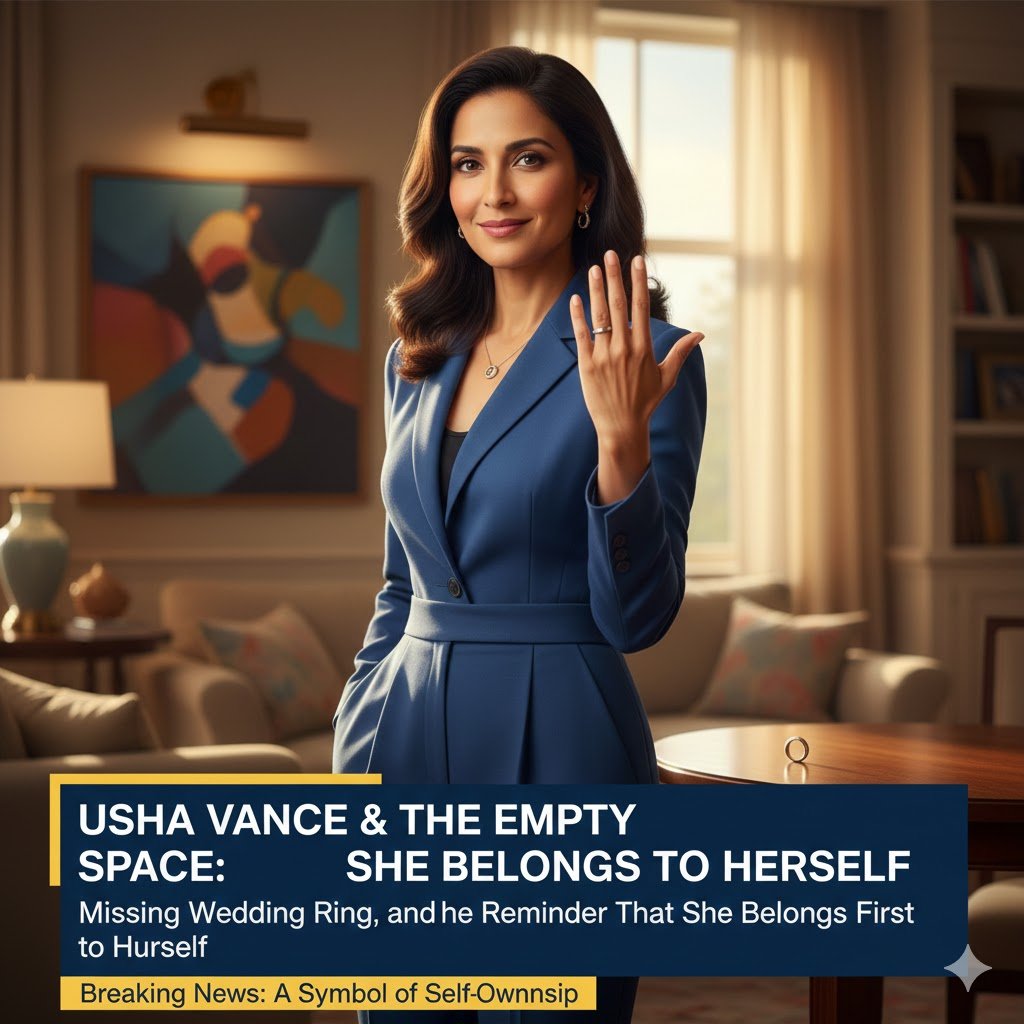
Public life has always come with an unavoidable spotlight. Every gesture, every outfit, every expression, and sometimes even the smallest details are examined through a magnifying glass. For Usha Vance, the Second Lady of the United States and wife of Vice President J.D. Vance, this reality became unmistakably clear when a simple observation—her missing wedding ring—spiraled into widespread speculation. What began as a minor visual detail swiftly became a trending topic, sparking conversations, assumptions, and theories about her marriage, her identity, and her role in public life.
But beneath the noise lies a far more meaningful message: Usha Vance belongs first to herself. This idea, though simple, carries weight in the context of politics, gender expectations, cultural identity, and the evolving understanding of womanhood. Her missing ring became a symbol through which deeper issues emerged—issues about autonomy, judgment, and the complex expectations placed on women in positions of influence.
This article explores the situation, the public reaction, and the larger meaning behind it—to understand not just what happened, but what it reveals about society and the standards it imposes on women like Usha Vance.
A Moment Turned Into a Public Narrative
It started with a set of photographs. Usha Vance appeared at a public event without her wedding ring on her finger. The images spread quickly, prompting observers to ask: Why wasn’t she wearing it? Was something happening in her marriage? Was this a statement? Or was it simply a personal choice without any hidden meaning?
In an age where social media thrives on rapid conclusions and dramatic interpretations, the conversation grew louder. Some saw it as a sign of trouble. Others treated it as gossip. A few even projected political meaning onto it. But many women came forward with a different perspective: sometimes a ring is simply not worn, and it has nothing to do with the state of a relationship.
Whether she forgot it, removed it for practicality, or simply chose not to wear it, the fact remains that her personal decision was turned into public analysis. And that reveals much more about society than it does about Usha Vance.
The Weight Placed on Women in Public Life
Society often treats women—especially women in public or political positions—as symbols rather than individuals. Their choices are rarely seen as simple or personal; instead, they are dissected, interpreted, and judged. Clothing choices are called statements. Body language becomes evidence. A missing piece of jewelry suddenly carries meaning.
Usha Vance’s ring became part of this pattern.
This scrutiny is especially intense when a woman holds a culturally unique position. Usha Vance is not only the Second Lady but also among the most visible Indian-American women in national politics. She represents multiple social identities at once: a professional woman, a mother of three, a person of Hindu faith married into a Christian political family, and a public figure in a polarized country.
With such visibility comes a heightened level of expectation. But expectations often become burdens when they strip away individuality. And that is precisely what this conversation highlighted: the challenge of maintaining autonomy while living under constant observation.
The Symbolism of the Ring — and Why It Shouldn’t Define Her
A wedding ring carries cultural significance. It’s a symbol of commitment and partnership. But it is still just that—a symbol. The real strength of a relationship does not rest on metal but on understanding, respect, communication, and shared purpose.
Usha Vance’s marriage, like any marriage, is built on private foundations that the world does not see. Yet the public discourse attempted to reduce it to whether a ring was visible in a few photographs. This assumption—that the presence or absence of jewelry reflects the health of a relationship—is outdated, restrictive, and unfair.
Many married people don’t wear their rings every day. Some remove them for work, caregiving, travel, or safety. Others prefer not to wear jewelry at all. These decisions are personal, practical, and harmless.
However, the eagerness to assign meaning to her ring suggests something deeper: society still expects women to express their marital status visually, constantly, and perfectly, as if their identity hinges on it. This expectation doesn’t apply to men in the same way.
Usha Vance’s missing ring sparked controversy not because it signaled anything real, but because society is conditioned to scrutinize women in ways it does not scrutinize men.
Cultural Complexity and Personal Identity
Usha Vance’s life is shaped by multiple cultural influences. Born to Indian immigrant parents, raised in an academically driven household, and married into a high-profile American political family, she inhabits a unique space. As a Hindu woman married to a Christian man, her identity became a topic of discussion even before the ring episode.
This intersection of identities—Indian-American, Hindu, professional, mother, political spouse—creates a layered public perception. People often try to fit her into one box or another, ignoring the fact that human beings simply do not fit neatly into predefined categories.
The missing ring was, for some, an excuse to reopen conversations about her faith, her marriage, and her role in her husband’s political life. But this reveals another truth: when a woman embodies multiple identities, she faces multiple expectations.
Yet, throughout these conversations, a powerful message has emerged:
She belongs to her own identity first. Not to public assumptions. Not to political expectations. Not to cultural stereotypes. Not even to the symbolic weight society attaches to a ring.
Autonomy as a Woman, Mother, and Public Figure
Usha Vance is more than the spouse of a political leader. She is a highly accomplished professional, educated at top institutions, and deeply involved in her own career and family life. Her autonomy is not diminished by her public role; if anything, it becomes more important.
The ring debate reinforces why her autonomy matters:
1. It reminds society that women are individuals before they are symbols.
A woman does not exist merely as a wife, mother, or figurehead. Her thoughts, decisions, and preferences belong to her.
2. It challenges outdated beliefs about marriage and femininity.
A ring does not validate commitment. Relationships are emotional, not ornamental.
3. It highlights the need to respect personal boundaries.
Not everything a public figure does is a message. Sometimes, a missing ring is just a missing ring.
4. It emphasizes the importance of self-ownership.
In public life, it is easy for one’s identity to be absorbed by narratives created by others. Claiming personal space becomes an act of strength.
The Broader Conversation: Why This Moment Matters
The conversation around Usha Vance’s missing wedding ring is not really about the ring at all. It is about what the ring represents in the public mind. And more importantly, it is about what her choice—intentional or not—reminds us.
It reminds us that women in politics continue to face disproportionate scrutiny.
It reminds us that cultural and personal identities are not public property to dissect.
And it reminds us that autonomy is not optional—it is essential.
When we say “Usha Vance belongs first to herself,” we acknowledge that:
- Her value is not defined by marital symbolism.
- Her identity is not limited to her role as the Second Lady.
- Her choices need not satisfy public curiosity.
- Her womanhood is not measured by whether she wears a ring.
This recognition is powerful. It moves the conversation away from gossip and toward dignity, respect, and individuality.
Conclusion: Beyond the Ring, Toward a Fuller Understanding
The debate about Usha Vance’s missing wedding ring is ultimately a reflection of society—not of her. It reveals how quickly people jump to conclusions, how deeply gender biases run, and how much pressure women face to conform to symbolic expectations.
But it also presents an opportunity to shift the narrative.
Instead of seeing her through the lens of a missing piece of jewelry, we can recognize her as a complete individual—intelligent, accomplished, multifaceted, and human. A woman who balances family, career, cultural identity, and public responsibility. A woman who reserves the right to have private decisions that require no explanation.
And above all, a woman who belongs first to herself.
In a world eager to define her, judge her, or decode her, this truth is perhaps the most important of all.