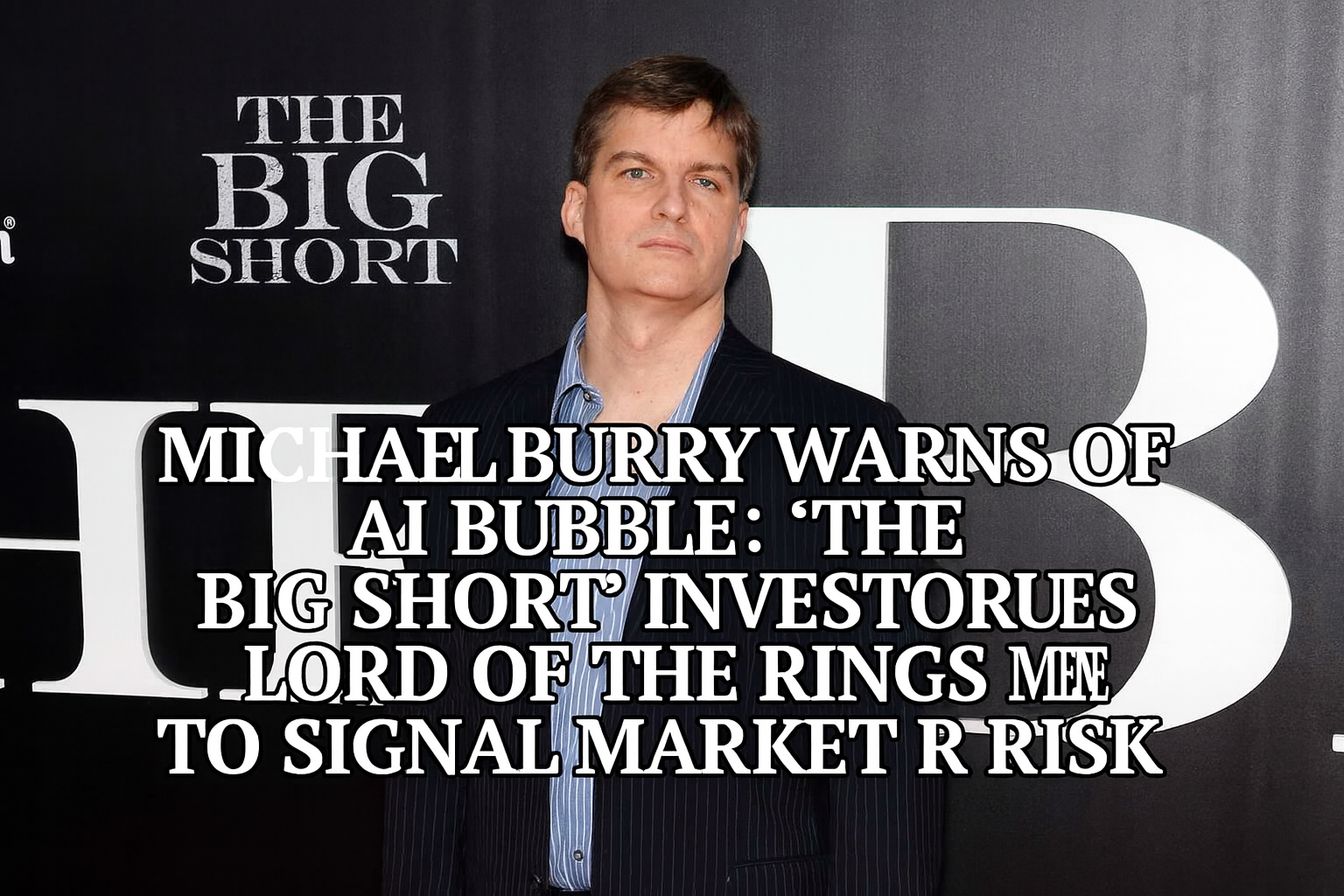
Michael Burry, the contrarian investor famously portrayed in The Big Short, has once again captured the attention of the financial world. Known for his uncanny ability to spot asset bubbles before they burst, Burry is now issuing a stark warning about the artificial intelligence (AI) boom. According to him, the current frenzy around AI investments could be dangerously overhyped, resembling the speculative manias of the past. This time, he has even used a pop-culture reference — a Lord of the Rings meme — to illustrate his concerns about investor complacency.
The Meme That Carries a Message
In a recent post on social media, Burry shared a two-part visual. The first was a data chart; the second was a meme from The Lord of the Rings. The meme shows Gandalf questioning Frodo about what he is observing. while Frodo stares at the One Ring. But rather than the usual ominous Elvish inscription, the ring displayed the phrase “Live Laugh Love.”
The underlying message is clear: investors are so enamored with AI hype that they are overlooking the potential risks. Just as the One Ring in Tolkien’s story possesses immense power and danger, AI holds enormous transformative potential — but with that comes the risk of massive overvaluation and possible financial fallout. Burry’s use of this meme cleverly conveys that many investors are ignoring the dark side of this technological boom.
The Data Behind the Warning
Beyond pop culture, Burry has backed his warning with substantive financial analysis. He highlighted a chart that tracks U.S. capital expenditures (capex) over the past 35 years, adjusted for depreciation and mapped against GDP. His point: historically, periods of rapid capital spending often precede market peaks, not begin after them. In past speculative booms like the dot-com bubble or the housing market surge, stock prices peaked in the middle of an investment spending frenzy, leaving many late investors overexposed and vulnerable.
Today, Burry sees a similar pattern. AI-related spending is skyrocketing, driven by massive investments in data centers, advanced chips, and related infrastructure. While these investments are fueling rapid technological advances, they also resemble the overextension that marked previous bubbles. If history repeats itself, this surge in capital expenditures could signal that a market correction is looming.
Burry’s Financial Moves Signal Conviction
Burry’s warnings are not merely theoretical. His hedge fund, Scion Asset Management, has reportedly taken substantial positions that profit if certain AI-heavy companies decline in value. In particular, his firm has made large bets against companies like Nvidia and Palantir. Such moves reflect deep skepticism about the current valuations of leading AI companies and suggest that Burry anticipates a sharp revaluation in the near future.
Moreover, Burry has deregistered part of his fund, signaling a shift from active investment in the hype-driven AI sector to positioning himself for potential market turmoil. His actions align with his historical approach: act when the market is irrational, rather than follow the crowd.
Accounting Practices: A Hidden Risk
A critical aspect of Burry’s warning is not just the level of spending but how it is accounted for. Many companies engaged in AI development are stretching the depreciation of hardware assets over longer periods than their economic usefulness warrants. Servers, chips, and data centers may wear out faster or become technologically obsolete sooner than companies are recognizing in their financial statements.
This practice can create the illusion of stronger profitability while masking the true costs of AI infrastructure. Burry argues that this misrepresentation inflates earnings and lulls investors into a false sense of security. When the reality of overinvestment and asset obsolescence emerges, it could trigger abrupt downward pressure on stock prices.
Investor Complacency: The Core of the Warning
Burry’s use of a meme and his commentary highlight a central concern: complacency. Investors are enthralled by AI’s potential and have largely ignored the lessons of past financial crises. They see the excitement, growth, and promise, but they are failing to consider the downside risk. By likening the AI boom to the One Ring, Burry underscores that what appears harmless or positive can harbor significant danger.
This complacency is exacerbated by a market environment that has rewarded risk-taking and speculative behavior in tech stocks. Many investors are betting that AI innovation alone is sufficient to justify ever-higher valuations, a mindset that historically precedes bubbles.
Lessons from Historical Bubbles
Burry’s warning echoes patterns from two of the most infamous market bubbles:
- The Dot-Com Bubble (Late 1990s): Technology companies with little or no profits saw their valuations skyrocket. When the bubble burst, many firms collapsed, wiping out billions in investor capital.
- The Housing Bubble (Mid-2000s): Easy credit and unchecked optimism about real estate prices led to overbuilding and excessive leverage. The eventual collapse caused a global financial crisis.
In both cases, asset prices soared far beyond intrinsic value, and many investors ignored warning signs. Burry sees parallels in today’s AI-driven market surge: rapid investment in infrastructure, inflated valuations, and widespread investor enthusiasm without a careful assessment of underlying fundamentals.
Why Timing Matters
One of Burry’s central points is the timing of the bubble. Historically, bubbles tend to last longer than observers expect, but when they burst, the collapse can be swift and severe. While AI investment may continue to grow over the next year or two, Burry suggests that this growth could be unsustainable. Once capital expenditures outpace real demand or profitability, market correction may follow, potentially leading to a broader economic impact.
This perspective reflects Burry’s broader investment philosophy: it is not just about identifying risk but understanding when that risk is likely to materialize. The timing of a market correction is often as important as the prediction itself.
Potential Consequences if the AI Bubble Bursts
If Burry’s warning proves accurate, several outcomes could unfold:
- Stock Market Volatility: Companies heavily invested in AI may experience sharp declines in valuation, leading to increased market volatility.
- Economic Repercussions: Overinvestment without corresponding returns could dampen corporate earnings, potentially impacting employment and economic growth.
- Stranded Assets: Expensive AI infrastructure could become underutilized or obsolete, leaving companies with sunk costs that cannot be recovered.
- Investor Disillusionment: A sudden collapse in AI stock prices could undermine investor confidence in the technology sector for years.
- Accounting Scrutiny: Overstated profits due to extended depreciation schedules may invite regulatory and auditor scrutiny.
Counterpoints and Alternative Views
It is important to note that not all investors agree with Burry’s pessimism. Proponents of AI argue that:
- The Growth Story is Real: AI is fundamentally transforming industries, and its economic impact could justify current valuations.
- Infrastructure Has Longevity: Data centers and hardware may serve multiple generations of AI applications, potentially lengthening their useful life.
- Innovation Drives Value: Traditional accounting may underrepresent the value created by AI innovations, suggesting that valuations could be sustainable.
- Timing Risk: Even if a bubble exists, predicting its collapse is challenging, and investors may benefit from AI adoption before any correction occurs.
While these perspectives offer some reassurance, Burry’s cautionary stance serves as a counterbalance, reminding investors to assess risks carefully and not be blinded by optimism.
Broader Implications for Markets and Investors
Burry’s warning carries significance beyond individual stock picks:
- For Investors: His message underscores the importance of due diligence, diversification, and risk management. Blindly following AI hype could be financially perilous.
- For Companies: Firms leading in AI may need to justify not just growth potential but the sustainability of their investment and accounting practices.
- For the Economy: Excessive capital allocation to AI without corresponding economic returns could have broader macroeconomic effects, influencing market stability.
- For Analysts and Regulators: Scrutiny on depreciation practices, asset utilization, and risk disclosure may increase if Burry’s predictions gain traction.
Burry’s Use of Storytelling in Finance
One notable aspect of Burry’s recent communications is his storytelling approach. By using pop culture references such as The Lord of the Rings, he communicates complex financial risks in a memorable and relatable way. This strategy serves multiple purposes:
- Simplification: Makes intricate financial concepts easier to understand.
- Engagement: Captures attention in a crowded news environment dominated by bullish headlines.
- Moral Lesson: Parables and metaphors convey cautionary messages that purely numerical analysis might fail to impress.
Conclusion: Proceed With Caution
Michael Burry’s warning about a potential AI bubble is both timely and provocative. By combining financial data, accounting scrutiny, and cultural references, he delivers a cautionary tale: rapid technological advancement and investment fervor can mask underlying risks.
While AI undoubtedly offers transformative potential, Burry urges investors to remain vigilant. The lessons of past bubbles — the dot-com crash and the housing crisis — remind us that excessive optimism can precede sharp corrections. Whether the AI market continues to thrive or faces a downturn, his perspective underscores the importance of critical thinking, prudent investment, and awareness of historical patterns.
Investors and market observers alike would do well to heed his warning. The AI boom may be exciting, but even the most alluring opportunities can carry hidden dangers, and the wisdom of the past should not be ignored.