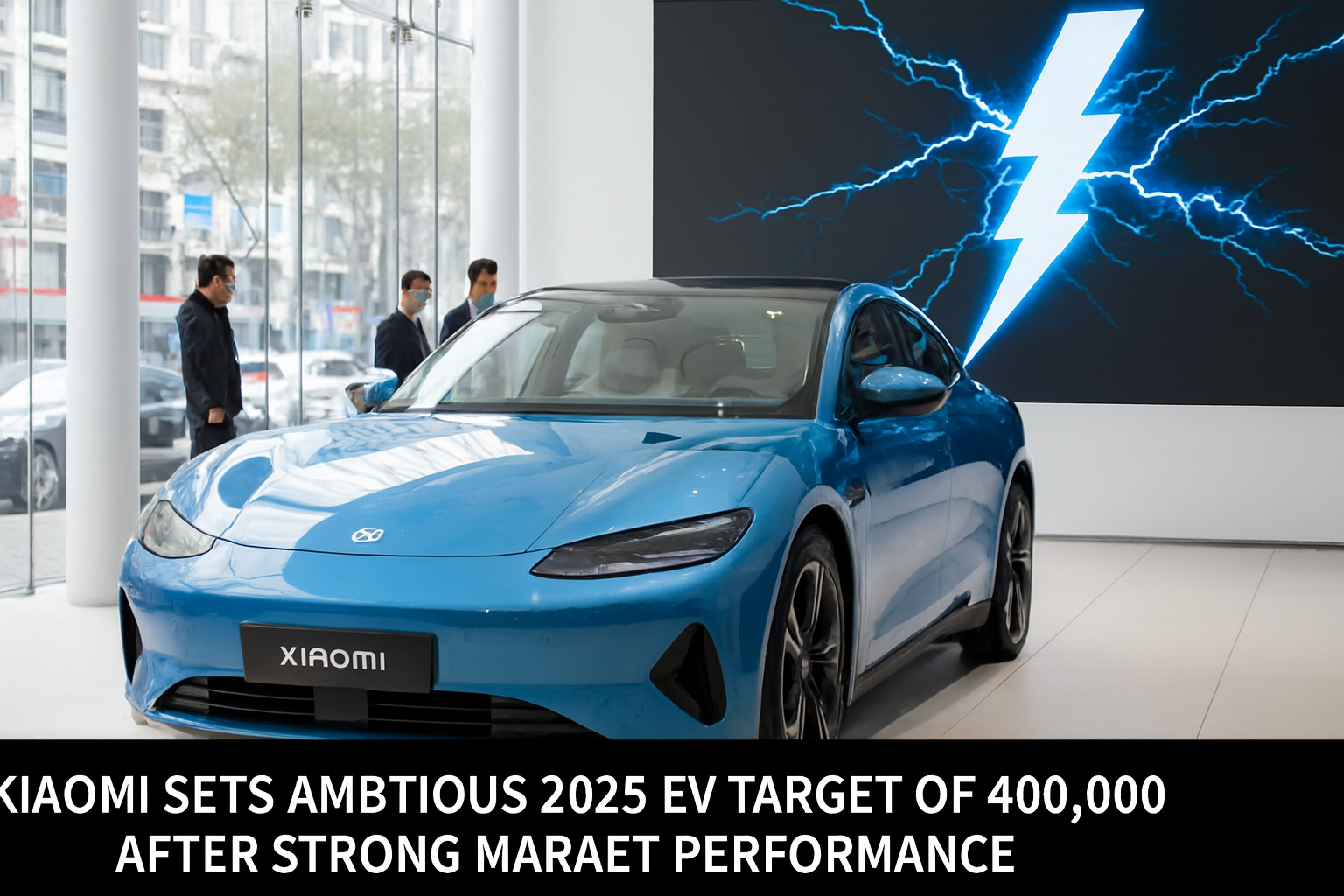
The global electric vehicle (EV) market is witnessing massive disruption, and one of the most unexpected yet powerful entrants is Xiaomi. Known worldwide as a smartphone and consumer electronics giant, Xiaomi has now accelerated its presence in the EV sector with bold confidence and strategic clarity. After successfully breaking even with its automotive business earlier than predicted, Xiaomi has officially raised its 2025 EV delivery target to an impressive 400,000 units.
This announcement not only demonstrates Xiaomi’s strong market momentum but also signals its long-term ambition to become one of the world’s leading smart EV manufacturers. Below is a detailed, 1500-word analysis of Xiaomi’s decision, the factors that led to it, and what it means for the global EV landscape.
Xiaomi’s Break-Even Milestone: A Turning Point for the Company
When Xiaomi first announced its entry into the electric vehicle segment in 2021, the industry was skeptical. Established automakers had spent decades perfecting their technologies, while Xiaomi was essentially starting from scratch. However, in less than four years, Xiaomi managed to build, launch, and commercialize its first EV — the Xiaomi SU7 — which quickly received overwhelming demand in China.
Breaking even is a huge milestone for an EV company, especially considering the massive upfront investments required for manufacturing, supply chain setup, research and development, and charging ecosystem integration. Xiaomi confirmed that strong early sales of its SU7 lineup, efficient cost optimization, and smart production strategies helped them achieve profitability sooner than expected.
This early success has emboldened the company to set even more ambitious goals for the upcoming years.
The New 2025 Target: 400,000 EVs
After analyzing production capacity, consumer demand, and the future mobility market, Xiaomi increased its 2025 EV delivery target from its previous estimate to 400,000 units. This major upward revision signals multiple developments:
1. Strong Consumer Demand
Xiaomi’s brand loyalty in China is extremely high. The trust built through smartphones, smart home appliances, and IoT products naturally expanded into the auto industry. Consumers perceive Xiaomi’s EV as a technologically advanced, feature-rich, and value-driven product — similar to its other devices.
The SU7 garnered tens of thousands of pre-orders immediately after launch, indicating a strong appetite for Xiaomi EVs.
2. Rapid Manufacturing Expansion
Xiaomi has massively accelerated production at its Beijing factory. Reports indicate plans to expand shifts, optimize assembly lines, and introduce more automation to match rising demand.
Its modular EV platform, self-developed operating system, and in-house software capabilities also reduce dependency on third-party suppliers, enabling faster scalability.
3. Competitive Pricing Strategy
Xiaomi has positioned itself aggressively in the EV market by offering high-performance features at a price significantly lower than many competitors. This strategy mirrors its success in the smartphone sector.
4. Integrated Smart Ecosystem
One of Xiaomi’s unique advantages is its ecosystem — smartphones, wearables, smart appliances, AI assistants, and now vehicles — all connected through the company’s HyperOS.
Consumers can control home appliances from their car, sync phone apps seamlessly, and experience a unified digital ecosystem across multiple devices.
Why Xiaomi’s EV Strategy Is Working
Unlike traditional automakers, Xiaomi entered the EV space with tech-driven DNA. The company emphasized software integration, artificial intelligence, and device connectivity. This gives it an advantage in a world where cars are rapidly becoming “computers on wheels”.
Here are key factors driving Xiaomi’s success so far:
1. Vertical Integration and Localized Supply Chain
Xiaomi ensures tight control over components, batteries, chips, and operating systems. This reduces manufacturing costs and protects it from global supply chain disruptions. Moreover, China’s well-developed EV ecosystem further strengthens Xiaomi’s sourcing capabilities.
2. Advanced AI and Smart Driving Technology
The company invested heavily in autonomous driving systems, using AI-powered perception models, high-precision sensors, and neural network computation. Xiaomi’s self-developed autonomous driving stack allows features like:
- Lane assist
- Adaptive cruise control
- Automated parking
- Real-time traffic prediction
- OTA (over-the-air) software upgrades
This makes Xiaomi EVs attractive for tech-savvy consumers.
3. Seamless HyperOS Integration
Xiaomi’s custom HyperOS connects:
- Smartphones
- Tablets
- Smart homes
- Wearables
- Smart TVs
- Vehicles
This connected ecosystem is unique in the EV industry, giving users a superior and cohesive experience.
4. Brand Trust and Fan Culture
With millions of loyal “Mi Fans”, Xiaomi benefits from an existing customer base that trusts its quality and pricing philosophy. This kind of loyalty is rare in the automotive industry.
5. Aggressive R&D Investments
Xiaomi has reportedly invested billions of dollars into EV research, hiring top engineers, AI experts, and automotive specialists. The company aims to position itself as a global EV leader within a decade.
Market Impact: How Xiaomi Is Challenging Tesla and BYD
The EV industry is dominated by major players like Tesla, BYD, NIO, and emerging Chinese brands. However, Xiaomi’s entry has intensified the competition.
1. Competing With Tesla
Xiaomi positions its SU7 as a premium, tech-loaded alternative to Tesla’s Model 3 — but at a lower cost. Many customers see Xiaomi as a more ecosystem-friendly choice, especially in China where Tesla lacks integrated device connectivity.
2. Competing With BYD
BYD dominates China’s EV sector. But Xiaomi’s strong brand identity and tech-first approach appeal to younger urban consumers who seek futuristic features.
3. New Market Dynamics
Xiaomi’s rapid rise forces other automakers to:
- Improve smart software
- Reduce EV pricing
- Enhance infotainment systems
- Boost AI-driving capabilities
This creates a more competitive and consumer-friendly EV market globally.
Future Lineup: What Xiaomi Plans After SU7
Xiaomi has hinted at expanding its EV portfolio with new models, potentially including:
- SU7 Pro / Max upgrades
- A mid-range electric SUV
- A compact hatchback EV
- A premium variant with extended range
Its long-term strategy includes entering international markets, though the specifics are yet to be confirmed.
Why the 400,000 Target Is Achievable
Industry analysts believe Xiaomi’s revised goal is realistic due to:
- Strong brand presence
- Advanced manufacturing readiness
- Increasing EV adoption globally
- Competitive pricing
- High technological integration
- Early profitability
- Strong pre-orders
Xiaomi’s EV division is no longer an experiment — it’s becoming a core business segment.
Challenges Xiaomi Might Face
Despite positive progress, Xiaomi must navigate several challenges:
1. Global Competition
Tesla, BYD, Volkswagen, and other established brands have deeper automotive experience.
2. Scaling Internationally
Entering foreign markets requires compliance with safety regulations, building sales networks, and setting up service infrastructure.
3. Battery Supply Risks
Despite strong partnerships, battery shortages can impact production.
4. Dependence on Chinese Market
Xiaomi must diversify to avoid market saturation.
Conclusion: Xiaomi’s Bold Step Toward EV Dominance
Xiaomi’s decision to increase its 2025 EV delivery goal to 400,000 units marks a defining moment in the company’s history. It shows confidence, capability, and a clear vision for the future of mobility. By breaking even earlier than expected, Xiaomi has proven that its tech-driven approach, integrated ecosystem, and aggressive pricing strategy resonate strongly with consumers.
As the EV industry continues to evolve, Xiaomi is uniquely positioned to shape the next era of smart, connected, and affordable electric vehicles. The company’s momentum suggests that the global EV space will witness massive competition and innovation in the years ahead — with Xiaomi playing a central role.