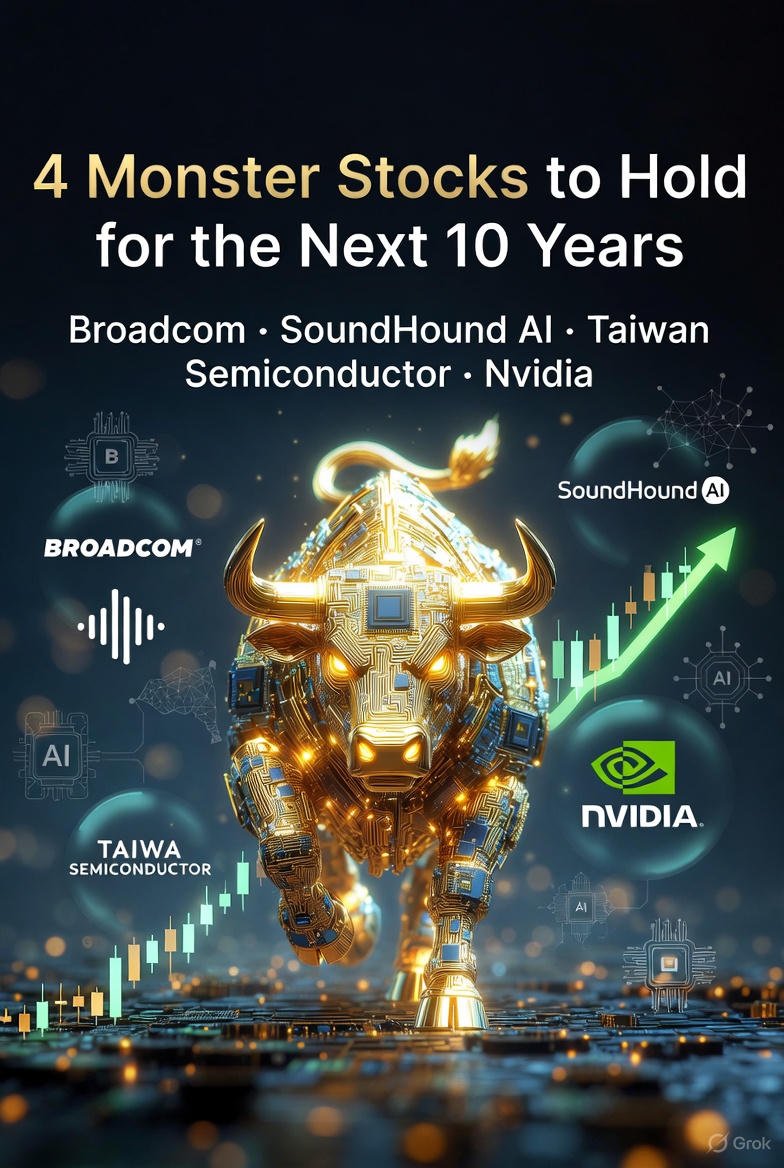
In the fast-evolving world of technology, where artificial intelligence (AI) is reshaping everything from everyday gadgets to global industries, picking the right stocks for the long haul can feel like betting on the future itself. As we hit late 2025, the AI boom shows no signs of slowing down. Data centers are sprouting up like digital forests, voice assistants are getting eerily smarter, and semiconductors—the unsung heroes powering it all—are in hotter demand than ever. But with market volatility and geopolitical jitters, not every tech play is built to last.
That’s where long-term “monster stocks” come in: companies with ironclad moats, explosive growth trajectories, and the kind of innovation that could dominate for a decade or more. In this piece, we’re zeroing in on four such beasts: Broadcom (AVGO), SoundHound AI (SOUN), Taiwan Semiconductor Manufacturing (TSM), and Nvidia (NVDA). These aren’t just trendy picks; they’re foundational players in the AI ecosystem. Broadcom cranks out the chips and software glueing it together, SoundHound is revolutionizing how machines hear and respond to us, TSM fabs the world’s most advanced silicon, and Nvidia? Well, they’re the undisputed king of AI acceleration.
Why these four? Over the past two years, they’ve delivered jaw-dropping returns—AVGO up 283%, SOUN a whopping 421%, TSM 190%, and NVDA 271%—fueled by AI tailwinds. Looking ahead to 2035, analysts see continued double-digit revenue growth, thanks to exploding demand for efficient computing. Of course, no stock is risk-free; competition, supply chain snarls, and regulatory hurdles loom large. But for patient investors, these could be the cornerstones of a portfolio that compounds wealth quietly and powerfully. Let’s dive into why each deserves a spot in your 10-year watchlist.
Broadcom: The AI Infrastructure Powerhouse
When it comes to the AVGO stock, one thing stands out: it’s not just riding the AI wave—it’s building the surfboard. Broadcom, a semiconductor and infrastructure software giant, has quietly become the backbone of modern data centers and networking. Founded in the late ’90s, the company has grown through savvy acquisitions and relentless R&D, now boasting a market cap north of $800 billion. In 2025 alone, AVGO stock has surged 122% year-to-date, closing at around $364 as of late November, outpacing the S&P 500 by a mile.
What makes Broadcom a monster for the next decade? Start with its dual-engine business: custom AI chips (think ASICs for hyperscalers like Google and Meta) and high-margin software for VMware and Symantec ecosystems. AI accelerator revenue is projected to hit $15 billion this fiscal year, up from peanuts a few years back, with analysts eyeing 30%+ annual growth through 2030. The company’s 48% compound annual EPS growth over five years speaks volumes—insiders are snapping up shares, signaling confidence. Plus, that juicy 1.2% dividend yield adds a nice income kicker for holders.
Peering further, Broadcom’s edge in optical connectivity and 5G infrastructure positions it for the edge computing explosion. As AI moves from cloud behemoths to devices in our pockets, Broadcom’s tech will be everywhere. Wall Street agrees: 28 analysts rate it a “Strong Buy” with an average target of $354, implying modest upside but ignoring the long runway. Risks? Sure—overreliance on a few big clients (Apple alone is 20% of revenue) and chip cycle downturns could sting short-term. But with a fortress balance sheet (net cash position) and buyback machine, AVGO stock weathers storms better than most.
In a world where AI infrastructure spend could top $1 trillion annually by 2030, Broadcom isn’t just participating—it’s engineering the wins. If you’re hunting for a stock that blends growth, stability, and dividends, AVGO deserves prime real estate in your portfolio. Hold tight; this one’s wired for the long game.
SoundHound AI: The Voice of Tomorrow’s Machines
SoundHound AI might not have the household name of Siri or Alexa, but don’t sleep on it—SOUN stock is the underdog with the sharpest teeth in conversational AI. This California-based innovator specializes in voice recognition tech that lets machines understand context, accents, and even emotions in real-time. Launched publicly in 2022, SoundHound has pivoted from music search to enterprise solutions, powering drive-thrus at White Castle, hotel bookings via Oracle, and automotive assistants in Hyundai vehicles. At $11.61 per share, it’s up 66% this year and 421% over two, with a $6 billion market cap that screams “early innings.”
The bull case for holding SOUN over 10 years? Explosive scalability in a voice AI market forecasted to balloon from $20 billion today to $150 billion by 2032. SoundHound’s proprietary Houndify platform processes queries 10x faster than competitors, with 90% accuracy across 25 languages. Revenue guidance for 2025 sits at $172.5 million, a 100%+ jump from last year, driven by deals with Nvidia and Tencent. If growth sustains at 50% annually (conservative, given 100%+ this year), top-line could hit $582 million by 2028—trading at 20x forward sales, that’s an $11.6 billion valuation, more than doubling today’s price.
Long-term, SoundHound’s moat lies in its agentic AI—systems that don’t just listen but act, like ordering food or diagnosing car issues hands-free. As robots and smart homes proliferate, partnerships with 1,000+ brands (including Krispy Kreme for voice menus) will compound. Analysts peg a $16.94 target, a 46% pop, but the real magic is in untapped verticals like healthcare and finance.
That said, it’s not all smooth sailing. SoundHound burns cash ($90 million loss last year) and faces giants like Google. Execution risks abound in a nascent market. Yet, with a lean team and no debt, it’s nimble. For risk-tolerant investors eyeing the next big AI disruptor, SOUN stock is a voice worth amplifying. Over a decade, as voice becomes the default interface, SoundHound could echo far louder than its current whisper.
Taiwan Semiconductor: The Foundry Kingpin
Taiwan Semiconductor Manufacturing (TSM) is the quiet architect behind the AI revolution—without it, your smartphone, EV, or ChatGPT query wouldn’t exist. As the world’s top pure-play foundry, TSM doesn’t design chips; it builds them for everyone else, from Apple to AMD. Holding 60% market share in advanced nodes (under 7nm), TSM’s $282 stock price reflects 47% YTD gains and 190% over two years, with a staggering $900 billion+ market cap.
Why bet on TSM for 10 years? It’s the indispensable pick-and-shovel play in semiconductors. With AI chip demand surging—Nvidia alone funnels billions—TSM’s 3nm and upcoming 2nm processes (25-30% more power-efficient) will capture the lion’s share. Q3 2025 revenue jumped 30% YoY to $25 billion, with net income at $15 billion; full-year guidance points to 25% growth. By 2030, analysts see revenue doubling to $150 billion, propelled by $65 billion in capex for U.S., Japan, and European fabs to diversify from Taiwan.
Geopolitics is the elephant: U.S.-China tensions could disrupt 90% of production on the island. But TSM’s hedging—$12 billion Arizona plant ramping in 2026—mitigates this. Plus, its tech lead (A16 node by 2026) crushes rivals like Samsung. Consensus targets $265 average for 2025, but long-term bulls eye $400+ as AI data centers guzzle advanced silicon.
Risks include cyclical slumps and capex bloat, but TSM’s 50% gross margins and $50 billion cash hoard provide buffers. In a chip-starved world, TSM isn’t optional—it’s essential. Holding this stock means owning the factory floor of the future economy.
Nvidia: The AI GPU Titan
Nvidia (NVDA) needs no introduction—it’s the $4.9 trillion behemoth that’s turned AI hype into cold, hard cash. From gaming roots to data center dominance, Nvidia’s GPUs are the gold standard for training massive models. At $179 per share, it’s “only” up 22% YTD after 2024’s frenzy, but 271% over two years cements its legend.
The 10-year hold thesis? Nvidia’s CUDA software ecosystem locks in developers, while Blackwell chips (launching 2026) promise 4x inference speed. Fiscal 2026 revenue could top $200 billion (60% growth), with data centers at 80% of mix. By 2035, as AI permeates autonomous vehicles, drug discovery, and robotics, Nvidia’s total addressable market swells to $1 trillion. Analysts forecast $210-$220 by year-end 2025, but visionaries see $900 by 2030.
Competition from AMD and custom chips bites, and valuation (50x forward earnings) invites pullbacks. Yet, Nvidia’s 40% AI market share and R&D spend ($10 billion annually) build an unassailable lead. It’s not just a stock; it’s a bet on intelligence exploding across industries.
Wrapping It Up: Building Your Monster Portfolio
These four—AVGO, SOUN, TSM, NVDA—form a synergistic quartet: design (Nvidia), fab (TSM), specialize (Broadcom), and interface (SoundHound). Allocate 20-30% each for balance, diversify beyond tech, and rebalance yearly. In 10 years, as AI adds $15 trillion to global GDP, these monsters could turn modest stakes into fortunes. Remember, investing is marathon, not sprint—patience pays. Consult a advisor, but don’t miss the roar.